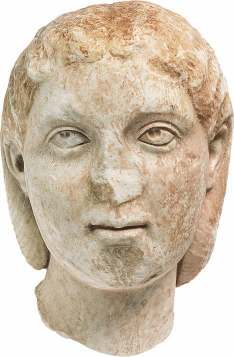
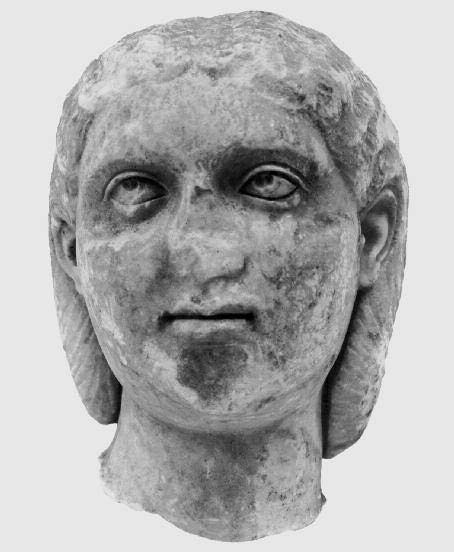
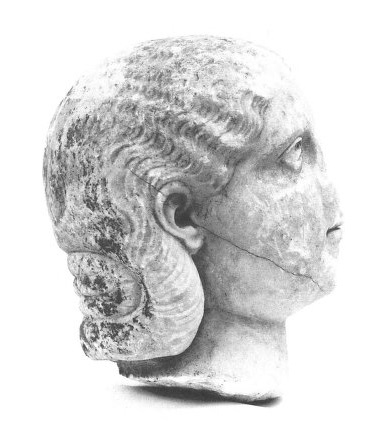
The head is preserved almost intact. Only the nose, the chin and a small part on the surface of the hair on the left are broken off. Smaller breaks and chipping are evident sporadically on the surface of the marble. The marble has fissured on the right side of the face, diagonally, from the ear to the chin. The slit of the mouth, the ears, but also the delineation of the eyes and of the upper eyelids in particular, are worked with the drill, giving a strong light-shadow effect. The head depicts a young woman turned slightly to the right, with an oval, plump face, almond-shaped eyes, a unibrow (the texture of the individual hairs is rendered by incising on the surface of the marble with the point) and a short mouth with thin lips. The pupil and iris are marked. The hairstyle draws closely upon the iconography of the mother of Alexander Severus, Julia Mamaea. In particular, the hair is divided at the top of the forehead into two equal parts, which are combed in broad wavy locks (leaving the ears uncovered) towards the back of the head, where they end in braids that form a rectangular flat recessed bun (cf. the portrait-head of probably Julia Mamaea in the Athens National Archaeological Museum inv. no. 571: P. Konstantinidis, Γυναικείοι δυναστικοί εικονιστικοί ανδριάντες αυτοκρατορικής περιόδου από την Ελλάδα (τέλη 1ου αι. π.Χ. – 5ος αι. μ.Χ.), Athens 2024, 487-488, cat. no. Γ39, figs. 786-790; for additional parallels see Bonanno-Aravantinos 2000, 780-781 notes 80-82). A small lunate lock of hair is left free on the surface of the face in front of each ear. Good quality of workmanship.
M. Bonanno-Aravantinos, “I ritratti di età romana della Beozia. Considerazioni preliminary”, in V. Aravantinos ed., Επετηρίς της Εταιρείας Βοιωτικών Μελετών, Γ΄ διεθνές συνέδριο Βοιωτικών μελετών, Θήβα 4-8 Σεπτεμβρίου 1996, Athens 2000, 780-781, figs. 29-30; V. Aravantinos, Το Αρχαιολογικό Μουσείο Θηβών, Athens 2010, 351 (principate of Alexander Severus); Μ. Bonanno-Aravantinos, “La scultura di età romana nella Beozia: importazioni e produzioni locali”, in Th. Stephanidou-Tiveriou, P. Karanastasi, D. Damaskos eds., Κλασική παράδοση και νεωτερικά στοιχεία στην πλαστική της ρωμαϊκής Ελλάδας. Πρακτικά διεθνούς συνεδρίου, Θεσσαλονίκη, 7-9 Μαϊου 2009, Athens 2012, 240, fig. 4.