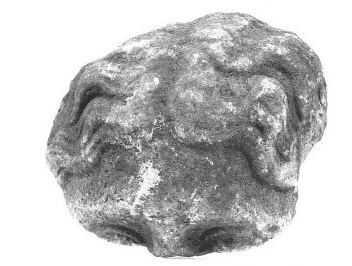
Only the upper part of the head is preserved from eye level to the top of the skull. Chipping and traces of waethering are observed on the surface of the marble. The head depicts a woman with a broad forehead, eyes with thin upper lids and the iris and pupil marked. The hair is divided at the top of the forehead into two equal parts, and combed in wide open waves towards the sides and back, in a manner similar to portraits of Faustina the Younger (cf. the fourth and fifth portrait types of the empress, as well as the second portrait type of her daughter, Lucilla, dated to the third quarter of the 2nd c. CE – for parallels and analysis, see Chioti 2012, 156-157).
M. Bonanno-Aravantinos, “I ritratti di età romana della Beozia: considerazioni preliminary”, in V. Aravantinos ed., Επετηρίς της Εταιρείας Βοιωτικών Μελετών Γ΄. Διεθνές συνέδριο βοιωτικών μελετών, Θήβα 4-8 Σεπτεμβρίου 1996, Athens 2000, 778-779, fig. 27; E. Chioti, Αυτοκρατορικά και ιδιωτικά πορτρέτα της εποχής των Αντωνίνων στην Ελλάδα (PhD. thesis Aristotle University of Thessaloniki), Thessaloniki 2012, 150-151, 156-157, 351, cat. no. 200, pl. 160δ.