
 Museum/Current place of storage:
 |
Chalkida, Diachronic Archaeological Museum “Arethousa”. |
 Inv. no:
 |
4162 |
 Dimensions:
 |
|
 Material:
 |
H. 0,284m., 0,192m. (head), w. 0,165m. |
 Findspot:
 |
In 1976, in Chalkida, in the A. Zervas plot, where a Roman building complex was excavated. Some of the rooms in the NE section of the complex (rooms I and III) were probably used as the storage space of a pottery and a marble-carving workshop, which must have been located nearby (the absence of tools and marble chippings in the two rooms rules out the possibility that the marble-carving workshop operated in situ; see Sampson 1976, 149-152; Karapaschalidou 1990, 9, 11; P. Karvonis, M. Mikedaki, Tabula imperii romani: Smyrna. I. Aegean Islands, Athens 2012, 215; E. Kalavria, «Εικονιστικές κεφαλές της εποχής Ιουλίων και Κλαυδίων από την Εύβοια και οι μαρτυρίες για τη δυναστεία στο νησί», in D. Damaskos, P. Karanastasi, Th. Stephanidou-Tiveriou eds., Πλαστική στη ρωμαϊκή Ελλάδα: νέα ευρήματα και νέες έρευνες. Διεθνές αρχαιολογικό συνέδριο, Αθήνα, 12-14 Δεκεμβρίου 2019, Thessaloniki 2022, 149, note 11). The head, which belongs to a statuette, was found together with other marble sculptures – some of which unfinished – and architectural members, as well as lamps, vases, figurines and figurine molds of the pottery workshop (for the rest of the sculptures found see Sampson 1976, 149, 151, pls. 107-108; Karapaschalidou 1990; Kalavria 2022, 149-152, figs. 1-5). |
 Original Display Location:
 |
In situ in the storage space of the two workshops. |
 Date:
Date: |
2nd c. CE. |
 Statuary Type (body) :
 |
- |
 Mode of Self-Representation (head):
 |
Generic classicistic hairstyle (“melon” coiffure) and strongly idealized face («non-portrait»). |
 Civic Presence (Social Role Represented):
 |
Priestess (or initiate)? (due to the wreath). |
 Inscribed Base:
 |
No. |
 Author:
 |
Panagiotis Konstantinidis |
 Added:
 |
2024-09-07 |
 Edited:
 |
Description - Comments:
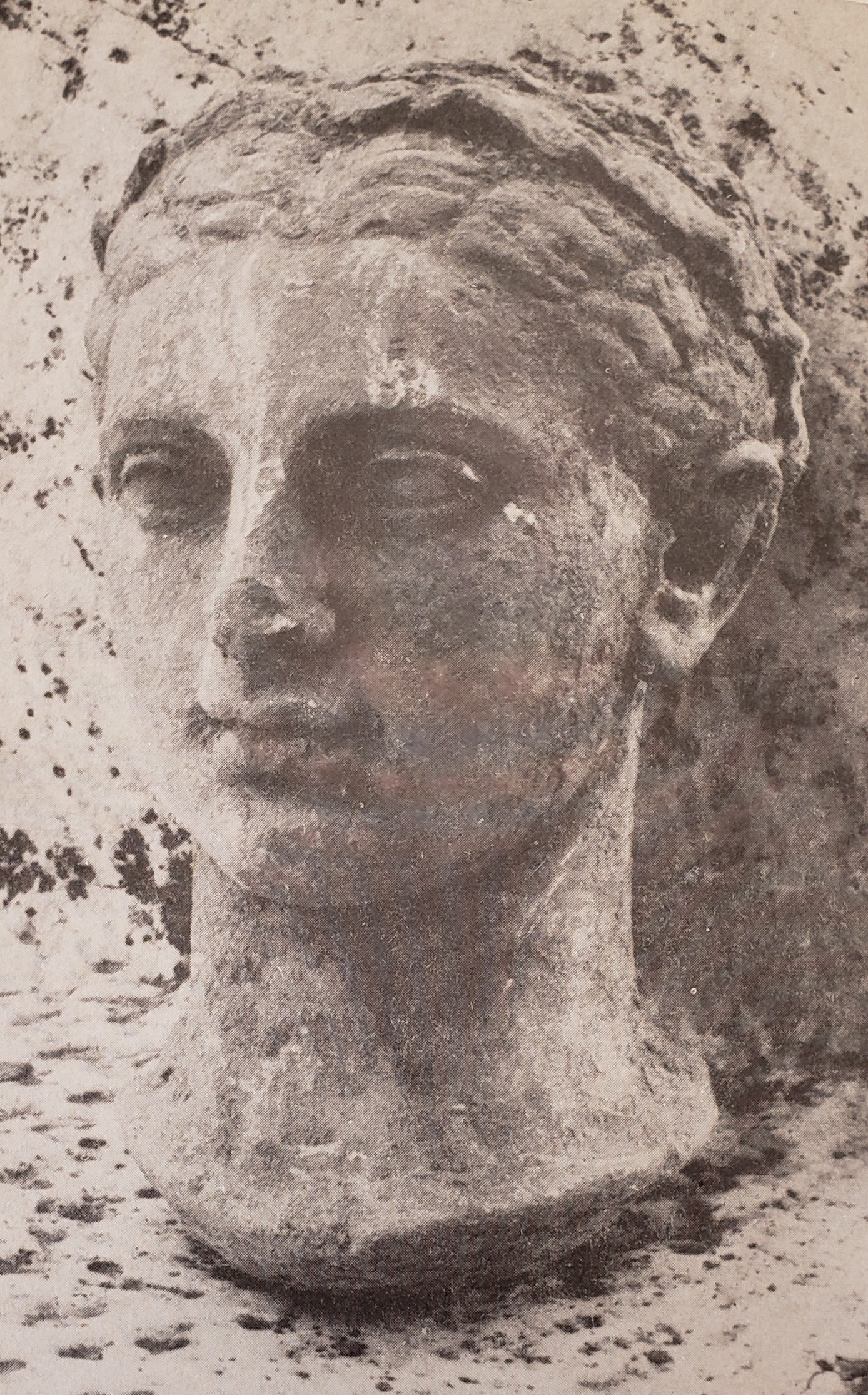
The head, under-life-sized, is preserved essentially intact, together with the neck. Small breaks and chipping are evident on the mouth, tip of the nose, right earlobe and lower on the right side of the neck and the round tenon for the insertion to the body. It depicts a young female, wearing a wreath of stylized leaves. The face is oval, the eyes almond-shaped with wide lids, the mouth narrow with puffy lips. The lacrimal duct at the corners of the eyes, the mouth and nostrils are worked with the drill. The hairstyle consists of parallel elongated strands of hair divided vertically into zones, following the pattern of the so-called “melon” coiffure of the Classical period (typically indicating young age). The face is fleshy and strongly idealized. The iris and pupil are not marked. Perhaps the wreath indicates a priestly function or an initiate status (cf. e.g. {Γ6}). Local workshop.
Bibliography:
A. Sampson, “Οικόπεδο Άγγ. Ζέρβα (Εργατικές Κατοικίες)”, ArchDelt 1976 Β1, 149, no. 4; A. Sampson, Αρχαία Χαλκίδα Ι, Athens 1986, 34, fig. 14; A. Karapaschalidou, Ρωμαϊκά γλυπτά από τη Χαλκίδα Ι, Chalkida 1990, 21, no. 14, pl. 15; A. Simosi, Αρέθουσα. Το Αρχαιολογικό Μουσείο Χαλκίδας, Athens 2022, 91 (fig.; 2nd c. CE).