
 Museum/Current place of storage:
 |
Athens, Museum of the Ancient Agora (Stoa of Attalos). |
 Inv. no:
 |
S 525 |
 Dimensions:
 |
|
 Material:
 |
H. 0,355m., w. 0,204m., th. 0,232m. |
 Findspot:
 |
On the 26th of February 1935, during excavations conducted by the American School of Classical Studies, in an Ottoman period deposit in the central part of the Agora. |
 Original Display Location:
 |
In the Agora (the exact display location is unknown). |
 Date:
Date: |
Julio-Claudian period (principate of Tiberius - early principate of Claudius). |
 Statuary Type (body) :
 |
- |
 Mode of Self-Representation (head):
 |
The coiffure follows contemporary imperial fashion protypes (“Modefrisur”), while the face is idealized. |
 Civic Presence (Social Role Represented):
 |
Unknown. |
 Inscribed Base:
 |
No. |
 Author:
 |
Panagiotis Konstantinidis |
 Added:
 |
2024-09-08 |
 Edited:
 |
Description - Comments:
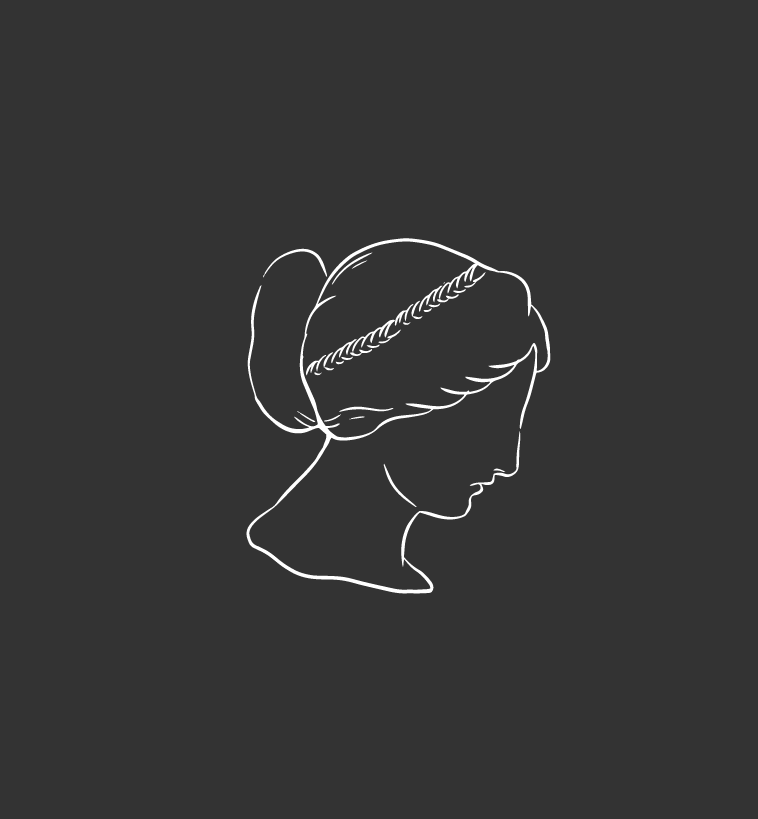
The head of the statue is preserved along with the neck and the tenon for the attachment to the body. The nose, lips and a large part of the jaw are broken. Smaller breaks and chipping are evident on the eyebrows, cheeks, ears and the left side of the neck. The surface of the marble is heavily weathered. Rasp marks are visible on the surface of the neck. The head, frontal, depicts a young woman. Cheeks are smooth, eyelids and eyebrows thin. The iris and pupil of the eyes were rendered in paint. The drill has been used to delineate the corners of the mouth. Two “rings of Venus” are plastically rendered on the surface of the neck. The headdress is divided at the top of the forehead into two equal parts combed in strong waves, covering the upper part of the ears, towards the nape of the neck, where it was tied in an elongated bun (the lower part of the bun was carved into the torso of the figure, where the head was attached). The “waves” surround the skull forming a kind of crown. The texture of the individual strands of hair is indicated by means of engraved wavy lines onto the surface of the marble. The coiffure finds its best parallels in the period between the principate of Tiberius up to the early principate of Claudius; it draws upon such portrait types as the (Q)Salus Augustae(Q) type of Livia and the “Wilton House” type of Antonia the Younger (see K. Polaschek, Studien zur Ikonographie der Antonia minor, Roma 1973; D. Boschung, “Die Bildnistypen der iulisch-claudischen Kaiserfamilie: ein kritische Forschungsbericht”, JRA 6 [1993], 51-52; Π. Κωνσταντινίδης, Γυναικείοι δυναστικοί εικονιστικοί ανδριάντες από την Ελλάδα [τέλη 1ου αι. π.Χ. – 5ος αι. μ.Χ.], Athens 2024, 36-37, 46-47; for analysis see also Kalavria 2015, 245-246).
Bibliography:
E.B. Harrison, The Athenian Agora I. Portrait Sculpture, Princeton N.J. 1953, 22, cat. no. 10, pl. 8; E. Kalavria, Αττικά πορτρέτα κατά την εποχή της ρωμαιοκρατίας (1ος αι. π.Χ. - αρχές 2ου αι. μ.Χ.), ζητήματα τυπολογίας, λειτουργίας και παραγωγής (Ph.D. thesis, National and Kapodistrian University of Athens), Athens 2015, 483-484, cat. no. 86, pl. 86; https://agora.ascsa.net/id/agora/object/s%20525?q=S525&t=&v=list&sort=&s=2