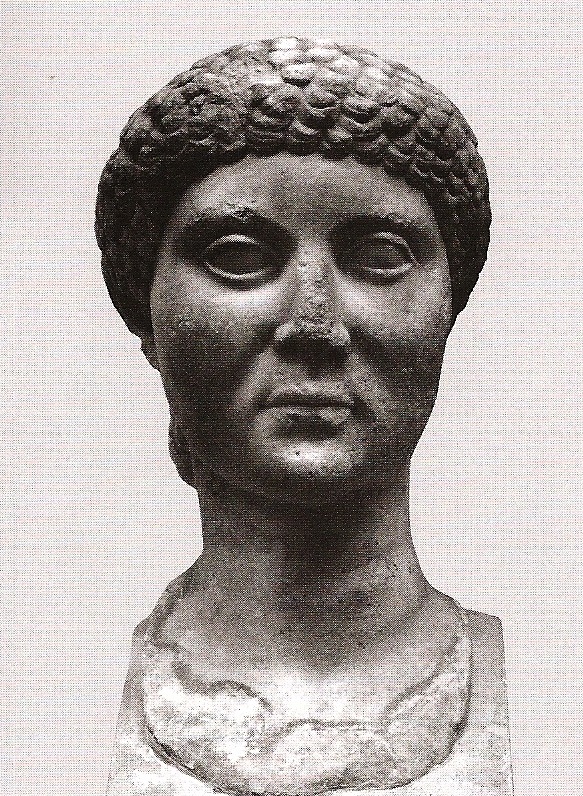
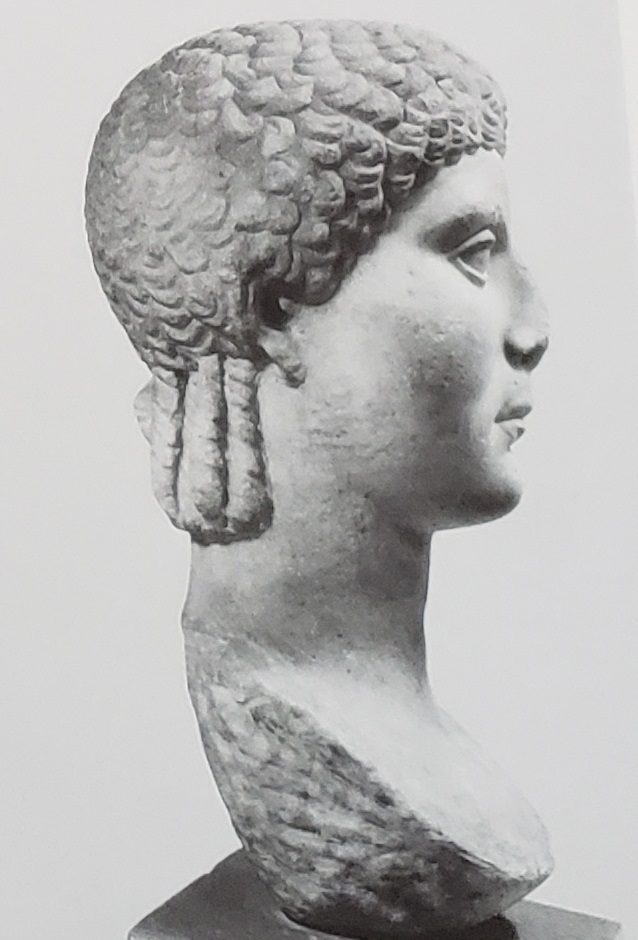
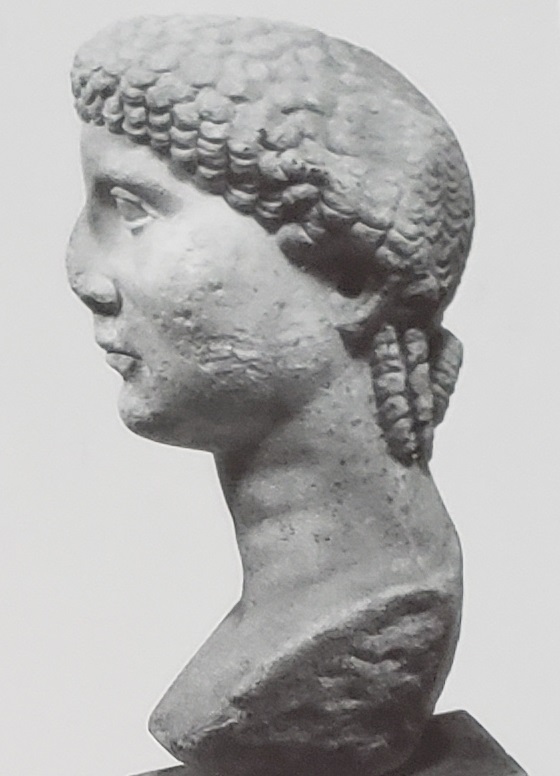
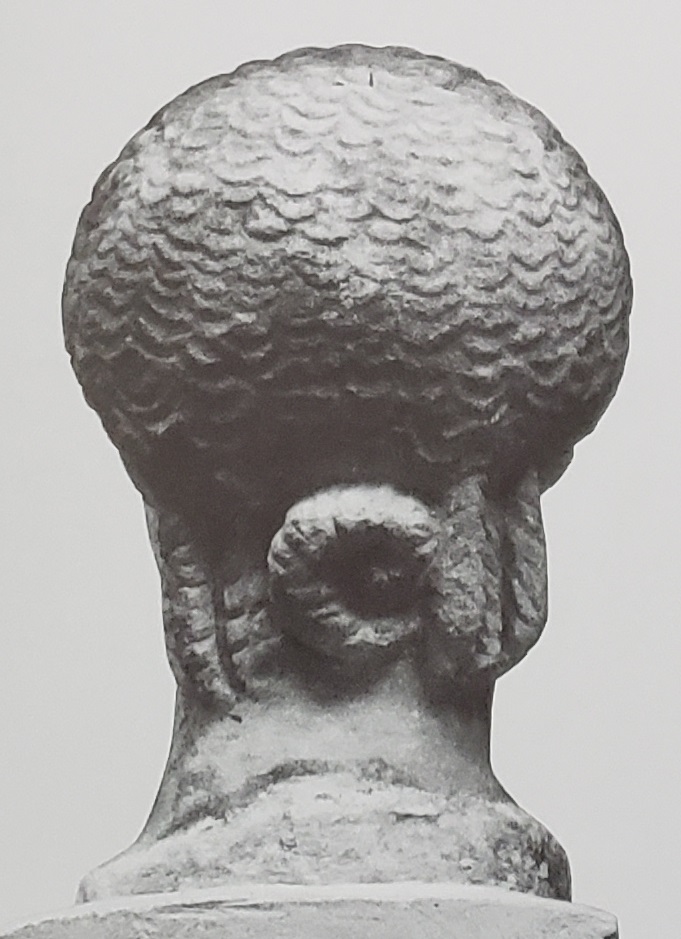
The head is preserved essentially intact, together with the neck, part of the chest in front and the tenon for the insertion into the body. Good state of preservation. Only the ridge and tip of the nose are broken, while smaller breaks and chipping are evident on the eyebrows and sporadically the headdress. It depicts a young woman with an oval plump face (rasp marks are evident on the surface of the marble), large eyes with thin lids (the iris and pupil were marked in paint) and a narrow mouth with thin lips, slightly turned to the left. The eyebrows are defined by sharp ridges on the surface of the marble, while the nasolabial lines are accentuated. On the neck there are two plastically rendered “Venus rings”. The coiffure consists of small lunate overlapping locks resembling “scales” that cover the entire surface of the skull, leaving the ears uncovered. The lunate overlapping locks are rendered larger, with more volume, at the front and top of the head, while at the back they are smaller and flatter. Low at the nape, the mass of hair ends in cork-screw parallel strands, four on the right and three on the left part of the neck, behind each ear (the grooves between them have been worked with the drill), and a central one which spirals into a small bun. Although a dating to the period of Trajan, ca. 100 CE, has been proposed for the head (Dontas 2004, 49-50, cat. no. 18), the structure of the headdress (a band of locks around the face and corkscrew strands behind the ears on either side of a bun), as has already been observed (Kalavria 2015, 247-248), is closer to protypes of the Julio-Claudian period, in particular the principates of Claudius-Nero. This element, combined with the unique rendering of the texture of the individual locks of hair, extending over the entire surface of the skull, which, as far as I know, does not find exact parallels, and which is probably a simplification made by the sculptor (re the part framing the face) of the elaborate spiral locks opened with the drill characteristic of the Flavian period, leads us, as E. Kalavria also argues, to place the head in the early Flavian period.
G. Dontas, Corpus Signorum Imperii Romani. Greece I.1 Les portraits attiques au Musée de l'Acropole, Athènes 2004, 49-50, cat. no. 18, pl. 15 (Trajanic period, ca. 100 CE); E. Kalavria, Αττικά πορτρέτα κατά την εποχή της ρωμαιοκρατίας (1ος αι. π.Χ. - αρχ. 2ου αι. μ.Χ.), ζητήματα τυπολογίας, λειτουργίας και παραγωγής (PhD thesis, National and Kapodistrian University of Athens), Athens 2015, 247-248, 485-486, cat. no. 89, pl. 89 (early Flavian period).