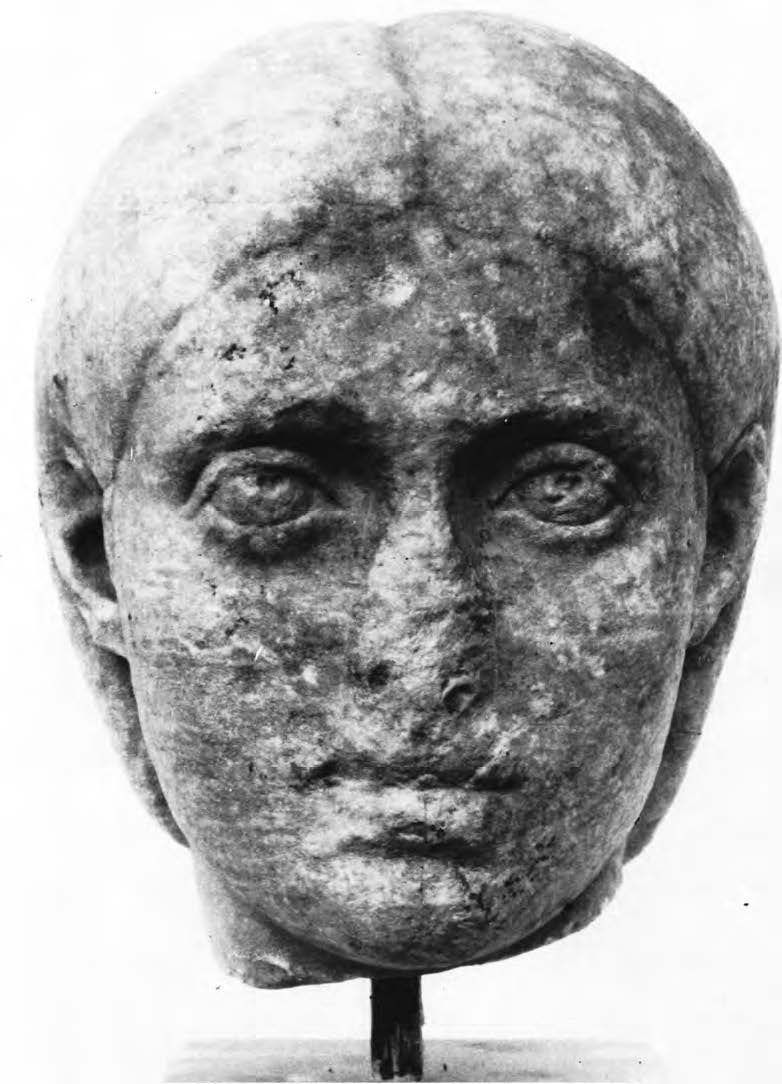
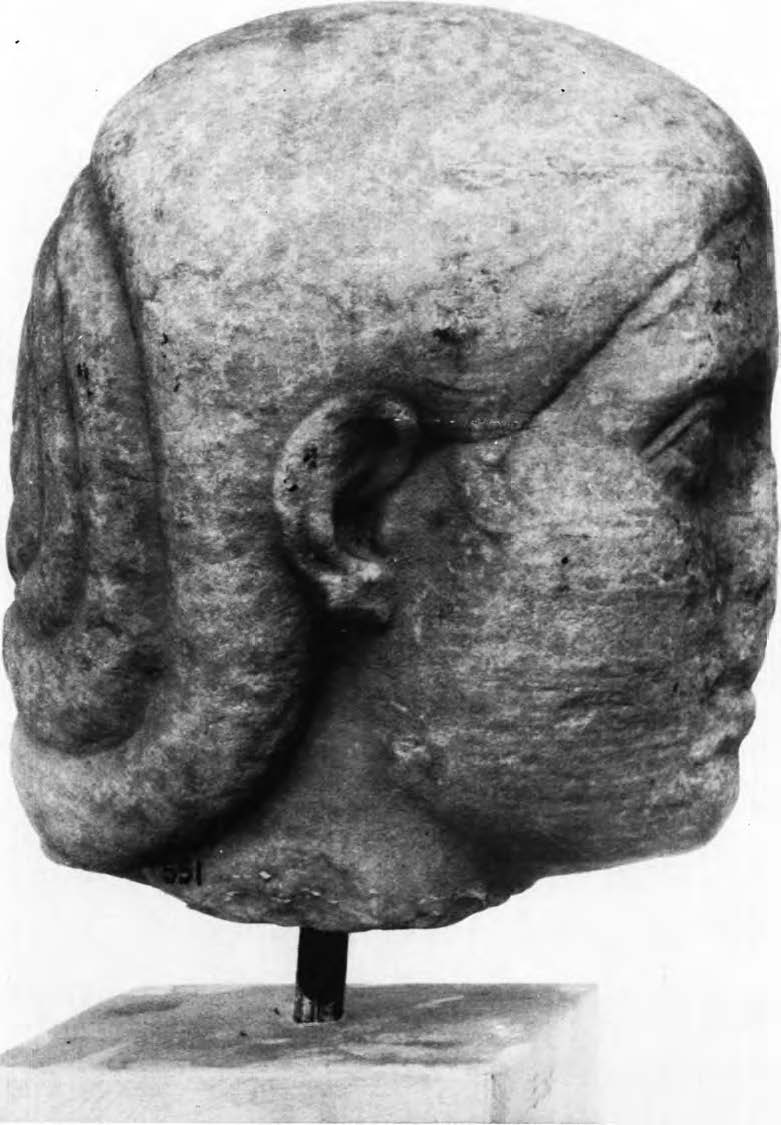
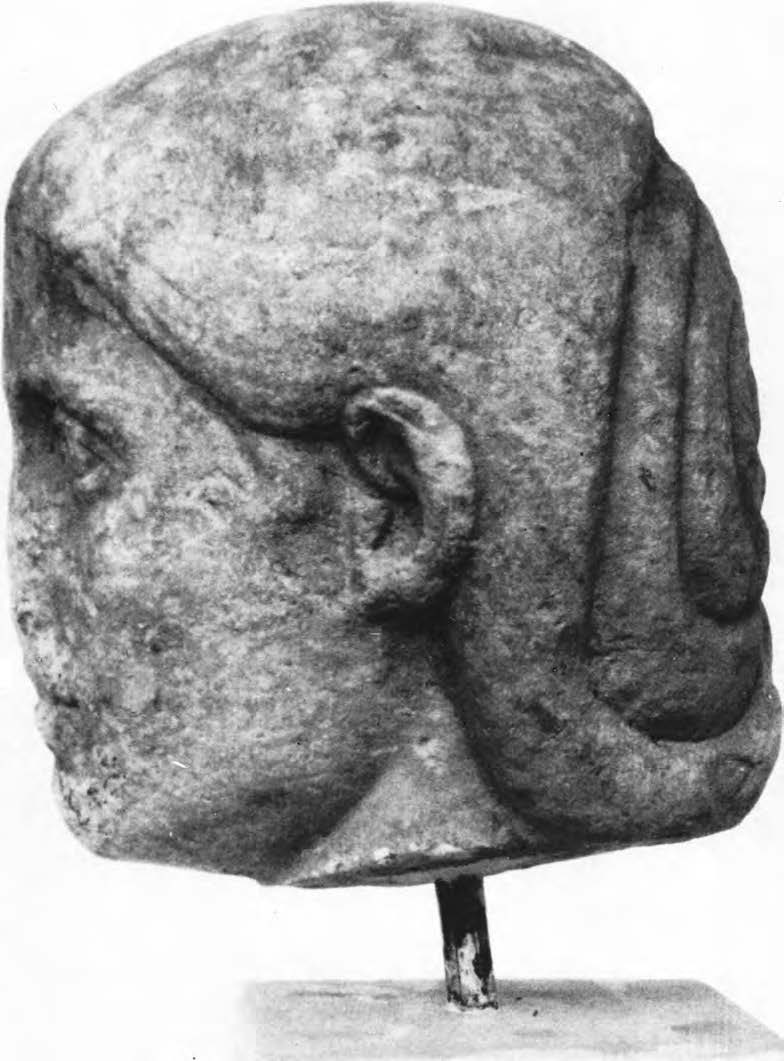
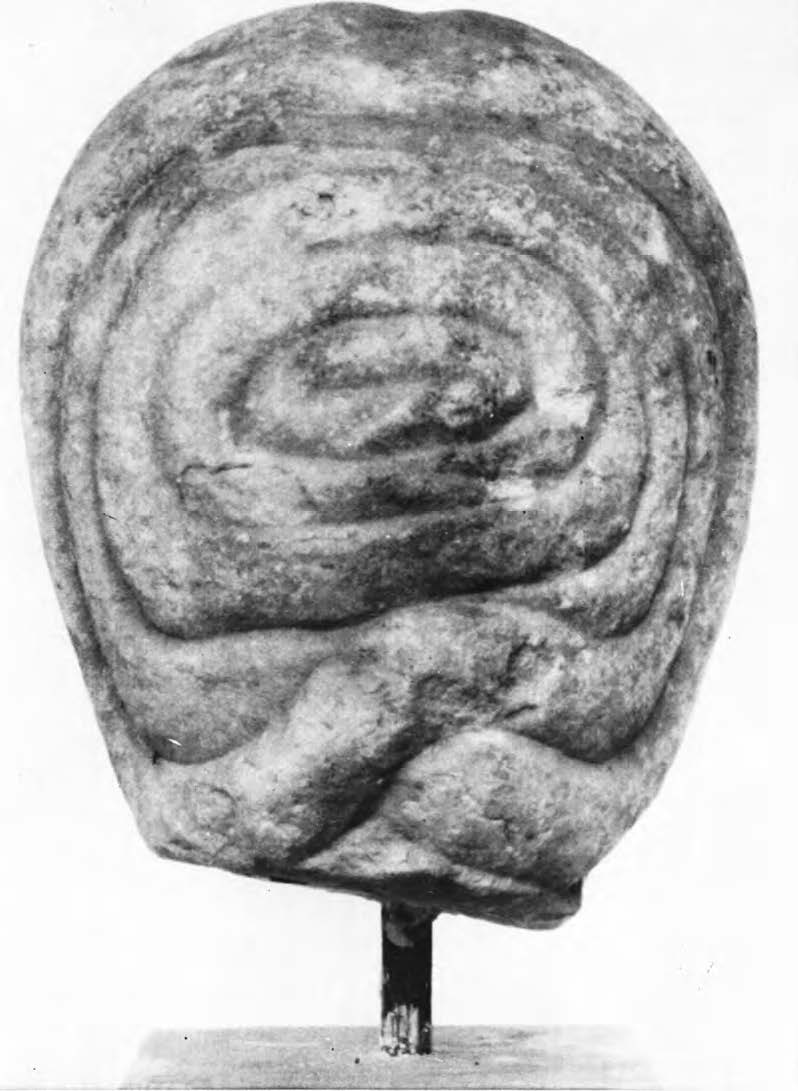
The head is mediocrely preserved, with the beginning of the neck. The surface of the marble is strongly weathered, especially in the area of the face. The nose is broken off (the two drill-holes for the nostrils are barely discernible). Smaller breaks and chipping are evident sporadically on the surface of the marble, especially on the cheeks, ears and mouth. The head depicts a young woman with an oval plump face, smooth cheeks and a narrow mouth with plump lower lip. The eyes are narrow, with wide upper and lower lids that overlap at the outer edges. The iris, pupil (shield-shaped; see P. Konstantinidis, Γυναικείοι δυναστικοί εικονιστικοί ανδριάντες αυτοκρατορικής περιόδου από την Ελλάδα [τέλη 1ου αι. π.Χ. – 5ος αι. μ.Χ.], Athens 2024, 397-398, notes 524 and 531) and tear-duct are indicated. The coiffure is divided at the top of the forehead into two equal parts which are combed without waves, and leaving the ears completely uncovered, towards the back of the head, where they are gathered into a long plait. The latter spirals in such a way as to form a broad almost flat bun that covers the back of the skull. The texture of the individual locks of hair is indicated by curved lines incised onto the surface of the marble. The headdress belongs to the Severan period, and follows broadly the official iconography of Julia Maesa (“Nestfrisur”, 220-225 CE; cf. K. Wessel, “Römische Frauenfrisuren von der seversichen bis zur konstantischen Zeit”, JdI 61/62 [1946/1947], pl. I; M. Wegner, Das Römische Herrscherbild III.1. Caracalla, Geta, Plautilla, Macrinus bis Balbinus, 1971, 154-155, pl. 37), diverging in such features as the absence of the plastically rendered waves of the coiffure, the presence of a spiraling tentacle forming the bun at the back of the head, instead of a braid, and the latter’s larger size. Cf. also the portrait K. Fittschen, P. Zanker, Katalog der römischen Porträts in der Capitolinischen Museen und den anderen kommunalen Sammlungen der Stadt Rom III, Mainz am Rhein 1983, 104-106, cat. no. 155, pl. 183 (ca. 220 CE).
L. von Sybel, Katalog der Skulpturen zu Athen, Marburg 1881, no. 3279; P. Kavvadias, Γλυπτά του Εθνικού Μουσείου: κατάλογος περιγραφικός, Athens 1890, 291, no. 551; P. Kastriotis, Γλυπτά του Εθνικού Μουσείου: κατάλογος περιγραφικός, Εν Αθήναις 1908, 87, no. 551; A. Datsouli-Stavridi, “Εικονιστικά Β´”, ArchEph 30 (1975), Α´, 188-189, pls. 78-81; A. Datsouli-Stavridi, Ρωμαϊκά πορτραίτα στο Εθνικό Αρχαιολογικό Μουσείο της Αθήνας, Athens 1985, 78-79, pls. 105-106.