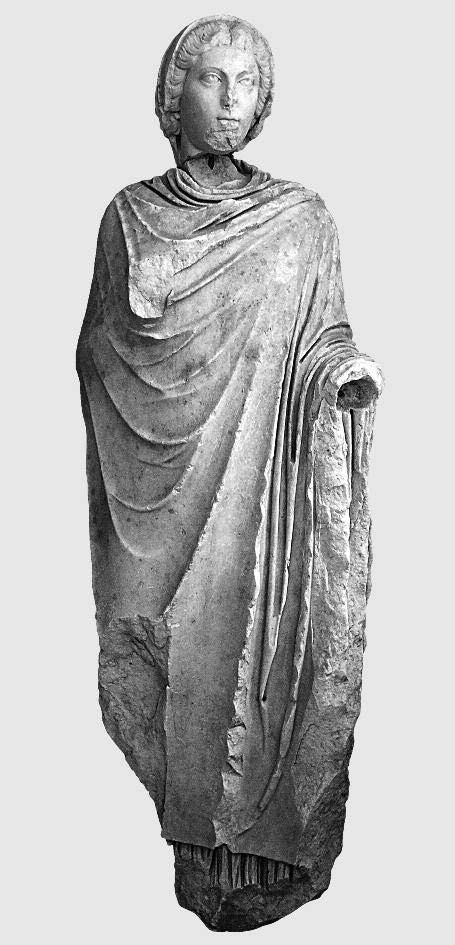
The figure is in a good state of preservation. The lower part of the statue with the feet, the right hand, the left inset arm from the middle of the forearm, part of the edge of the himation around the forehead, the tip of the nose, the chin and the front part of the neck are missing. Smaller breaks are evident sporadically on the surface of the marble, especially along the ridges of the folds of the garments. The figure is depicted standing, frontal, wearing a long chiton and a long, wide himation. The himation covers the entire body, including the hands and head. The right arm, bent at the elbow, is carried diagonally to the right side of the body, while the inset left, also bent at the elbow, is extended at waist level (based on other copies of the statuary type the wrist would project from the edge of the garment). The face sports a small fleshy mouth and almond-shaped eyes with thick lids (both the iris and pupil are indicated) in the same way as we see in official portraits of the empress Lucilla, especially of her first portrait type in the classification of K. Fittschen (dated to ca. 165 CE). The same is true for the hairdo, which is divided at the top of the forehead into two equal parts and then combed forming a sequence of wide S-shaped locks of hair, placed perpendicular to the face (the texture of the individual hairs on each lock is indicated by engraved parallel lines on the surface of the marble; cf. e.g. the head in Munich K. Fittschen, Die Bildnistypen der Faustina minor und die Fecunditas Augustae, Göttingen 1982, pl. 46.3-4; idem pp. 75-77 for the first portrait type of Lucilla).
K. Krystalli, “Οικόπεδον Ελένης Γιάννου (Μποζονέλόυ)”, ArchDelt 22 (1967), 171, pl. 126δ; Ch. Ktirzas, “Πάροδος Δαναού (οικόπεδον Χρήστου Κωντσαντή ή Κωτσιαντή”, ArchDelt 29 (1973-1974) Β2, 225-226, pl. 156α-β; L. Guerrini, “Copie romane del tipo Aspasia-Sosandra da Creta”, Antichità cretesi. Studi in onore di Doro Levi 2 (Cronache di archeologia 13), Catania 1974, 230, no. 27; K. Fittshen, P. Zanker, Katalog der römischen Porträts in den Capitolinischen Museen und den anderen kommunalen Sammlungen der Stadt Rom III, Mainz am Rhein 1983, 92 note 4d (in cat. no. 133; period of Crispina, 180-190 CE); P. Karanastasi, “Γυναικεία εικονιστικά αγάλματα στη ρωμαϊκή Κρήτη. Εικονογραφία και κοινωνικές προβολές”, in P. Karanastasi, Th. Stephanidou-Tiveriou, D. Damaskos eds., Γλυπτική και κοινωνία στη ρωμαϊκή Ελλάδα: καλλιτεχνικά προϊόντα, κοινωνικές προβολές, διεθνές συνέδριο, Ρέθυμνο, 26-28 Σεπτεμβρίου 2014, Thessaloniki 2018, 249, with note 65, figs. 12-13 (draws upon the first portrait type of Lucilla).