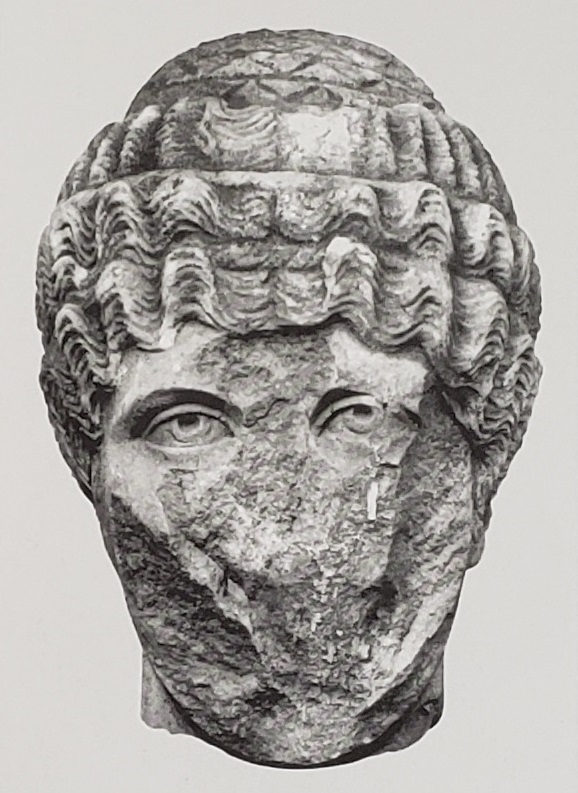
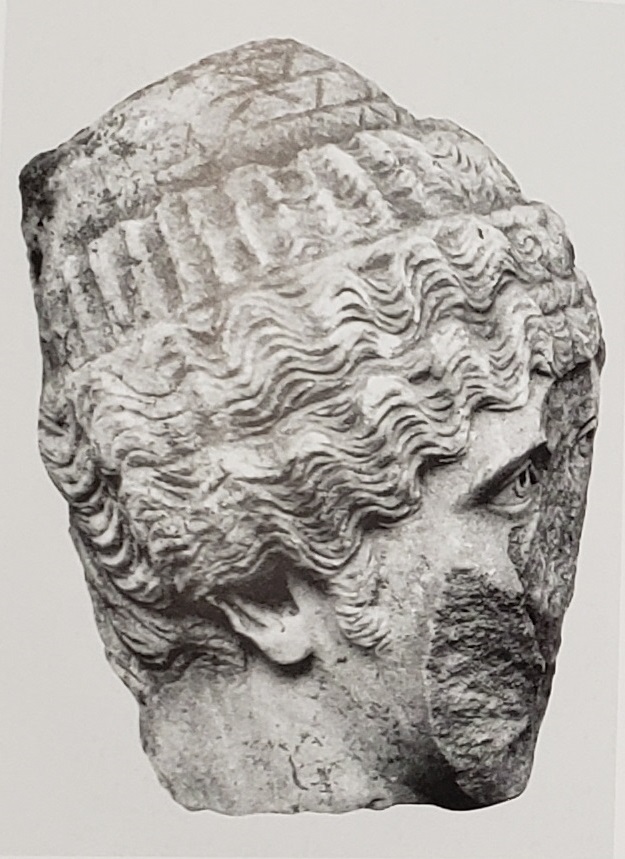
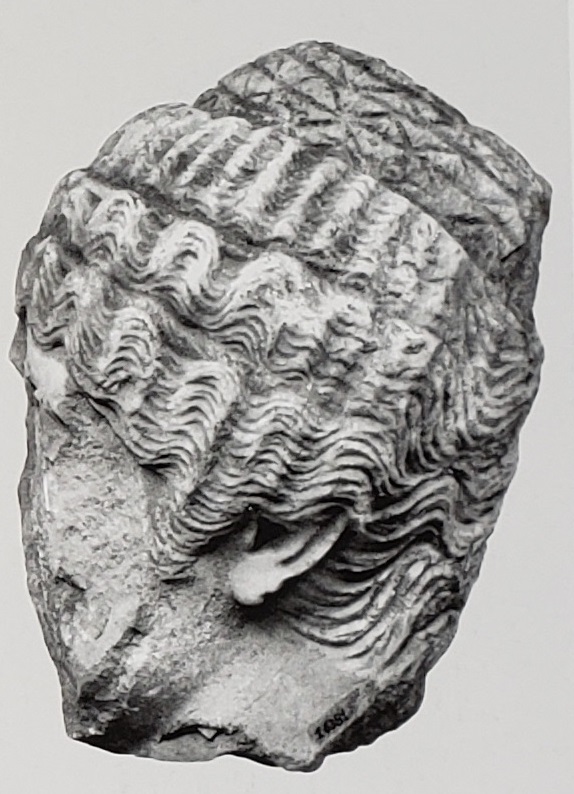
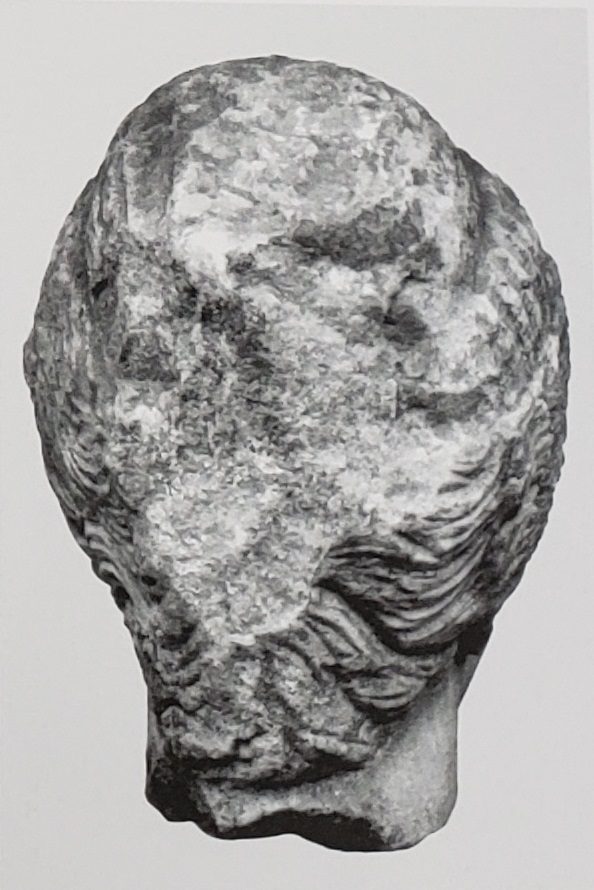
The head and a small part of the neck are preserved. The face is broken, except for the eyes, and partly the eyebrows. Smaller breaks and chipping are attested sporadically on the surface of the marble, especially on the forehead and coiffure. The woman is depicted turning slightly to the left. The eyes are almond-shaped with thin eyelids, the right eyebrow is thin, ending in a sharp ridge. The iris and pupil are marked (the pupil has a shield-like shape). The tear gland is also indicated. The coiffure consists of three superimposed bands of curved tong-shaped locks forming a continuous pattern (narrower in the third band); The bands are separated from each other by thin twisted plaits, surrounding the head. Only the upper part of the ears is covered by the coiffure, while a round elongated lock of hair is left free on the surface of the temples. The texture of the individual hairs on the surface of both the free locks of hair on the temples and on the tongue-like locks of the three bands is meticulously rendered with the point. The three bands of tongue-like locks of hair join at the back of the head in braids that rise sharply to the top of the skull, where they form a broad bun, consisting of five superimposed braids (broken at the top). The texture of the hair on their surface is indicated by incised triangles. Based on the above, it becomes clear that the coiffure (bun placed high at the top of the head, row of tongue-like locks, thin braids, round elongated free locks of hair at the temples) follows broadly patterns of the official iconography of Faustina the Elder (cf. the so-called “Dresden 384” portrait type, usually considered as a posthumous creation, and dated to the principate of Antoninus Pius, 160-161 CE; for the type see K. Fittschen, P. Zanker, Katalog der römischen Porträts in den Capitolinischen Museen und den anderen kommunalen Sammlungen der Stadt Rom III, Mainz am Rhein 1983, 17 cat. no. 17, pls. 21-22 [K. Fittschen]; Chioti 2012, 55, 57 with bibliography), although creating a new structure. The existence of another almost identical replica of the coiffure in a portrait statue in Italy, in the baths of Suio (Aquae Vescinae) northeast of the city of Minturnae and northwest of Sessa Aurunca (Fittschen 2021, 183- 184, no. 109a, pls. 118.4, 119.1-3, 7), indicates that this new coiffure is a distinct iconographic type, created in the early Antonine period (dated to 140-150 CE by K. Fittschen), for an important personality, who had a presence both in Italy and in Messene. Based on the findspots of the two copies of the type and the persuasive argumentation of K. Fittschen (2021, 183-185, no. 109, pls. 118-119 [“Terme di Suio/Messene” type]), we should probably recognize in the type a female member of the prominent Messenian family of the Saethides, members of which are known to have been senators in Rome and to have had in general relations with Italy, where they owned property, on the one hand, and to have financed the construction of the scaenae frons of the theater of Messene on the other, where inscribed bases and portrait statues of members of the family have been found (see {Γ122}). More specifically, perhaps the head represents the mother of the sponsor of the stage of the theater of Messene, Tiberius Claudius Saithedas Caelianus (II) (A.D. Rizakis, S. Zoumbaki, Cl. Lepenioti, Roman Peloponnese II. Roman Personal Names in Their Social Context, Athens 2004, no. MES 157), and wife of Tiberius Claudius Frontinus I, the first Messenian senator and father of the sponsor (Rizakis et al. 2004, no. MES 142), whose name we do not know. If this is correct, then the head should be dated in the 160s CE, when the sponsor is known to have been active in the theater of Messene (P. Themelis, “Ανασκαφή Μεσσήνης”, Prakt 2010, 56, 58; see {804}), and when the “Dresden 384” type is also usually dated.
B. Petrakos, “Μεσσήνη”, Ergon 55 (2008), 51-52, fig. 54; P. Themelis, “Ανασκαφή Μεσσήνης”, Prakt 163 (2008), 37, pl. 32α-δ (Faustina the Younger – the head was recarved from a male portrait-head of the Julio-Claudian period, probably of Nero); I. Chioti, Αυτοκρατορικά και ιδιωτικά πορτρέτα της εποχής των Αντωνίνων στην Ελλάδα (PhD thesis Aristotle University of Thessaloniki), Thessaloniki 2012, 141, 142-143, 334, cat. no. 170, pl. 136γ-δ (138-150 CE); Μ. Geivanidou, Εικονιστικοί ανδριάντες στα θέατρα των ρωμαϊκών ανατολικών επαρχιών, Thessaloniki 2021, 54, 170, cat. no. 64, pl. 8.3; K. Fittschen, Privatporträts mit Repliken. Zur Sozialgeschichte römischer Bildnisse der mittleren Kaiserzeit, Wiesbaden 2021, 184, no. 109b, pl. 119.4-6, 8 (160 CE).