
 Museum/Current place of storage:
 |
Messene, Archaeological Museum. |
 Inv. no:
 |
1354 |
 Dimensions:
 |
|
 Material:
 |
H. 0,275m. |
 Findspot:
 |
In front of the west corner of the stylobate of the Arsinoe fountain of ancient Messene (for the fountain see in brief Themelis 2010, 115-120; Themelis 2014, 74-77). |
 Original Display Location:
 |
In the Arsinoe fountain. |
 Date:
Date: |
2nd c. CE (?). |
 Statuary Type (body) :
 |
- |
 Mode of Self-Representation (head):
 |
Generic classicistic coiffure (?), and idealized face (“non-portrait”?). |
 Civic Presence (Social Role Represented):
 |
Unknown. |
 Inscribed Base:
 |
No |
 Author:
 |
Panagiotis Konstantinidis |
 Added:
 |
2024-09-15 |
 Edited:
 |
Description - Comments:
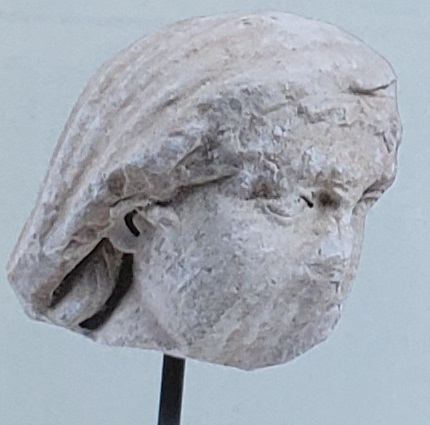
The head is preserved with the beginning of the neck at the back. The nose and mouth are broken. The left side of the head is also quite broken, while smaller breaks and chipping are evident sporadically on the surface of the marble, especially on the hair around the forehead. The surface of the marble is also heavily weathered. It depicts a woman with full cheeks and small, almond-shaped eyes with wide lids. The outline of the eyes and the irises are rendered with deep incisions, while the drill is used for the rendition of the lacrimal gland and the pupils. The head is covered by the himation. The hair is divided at the top of the forehead into two equal parts, which are combed with flat wavy locks towards the back. An elongated twisted strand of hair can be seen on the neck behind the right ear. The head is – to my knowledge - only known from a small photograph, which makes dating difficult (non vidi). A terminus post quem for its carving is the principate of Hadrian, due to the presence of the marked iris and pupil. The motif of the covering of the head with the himation is not a certain indication that the woman depicted was a priestess. In Greek art the motif is attested in several statuary types (such as the “Large Herculaneum Woman”), and it is not exclusive to priestesses (several certain depictions of priestesses do not have their heads covered – cf. A. Mantis, Προβλήματα της εικονογραφίας των ιερειών και των ιερέων στην αρχαία Ελληνική τέχνη, Athens 1990; J.B. Connely, Portrait of a Priestess. Women and Ritual in Ancient Greece, Princeton/Oxford 2007; I. Leventi, “Godlike Images. Priestesse in Greek Sculpture” in R. Morais, D. Leao, D. Rodriguez-Perez eds., Greek Art in Motion. Studies in Honour of Sir John Boardman on the Occasion of his 90th Birthday, Oxford 2019, 69-77). In addition to piety, it is also a broader symbol of social dignity, modesty and restrain (see also Th. Stephanidou-Tiveriou, «Les héros de Palatiano. Une nouvelle proposition de restitution et d’interprétation du groupe statuaire», BCH 133.1 [2009], 361).
Bibliography:
P. Themelis, Αρχαία Μεσσήνη, Ιστορία - Άνθρωποι – Μνημεία, Athens 2010, 342 (priestess; It belongs to the last construction phase of the fountain, dated to the second half of the 3rd c. CE); P. Themelis, Αρχαία Μεσσήνη, Athens 2014, 154, fig. 186 (priestess; It belongs to the last construction phase of the fountain, dated to the second half of the 3rd c. CE); P. Themelis, "The Sculpture of Messene", in O. Palagia (ed.), Handbook of Greek Sculpture, Berlin 2019, 567, fig. 18.22 (second half of the 3rd c. CE); P. Konstantinidis, Γυναικείοι δυναστικοί εικονιστικοί ανδριάντες αυτοκρατορικής περιόδου από την Ελλάδα (τέλη 1ου αι. π.Χ. – 5ος αι. μ.Χ.), Athens 2024, 166 note 235.