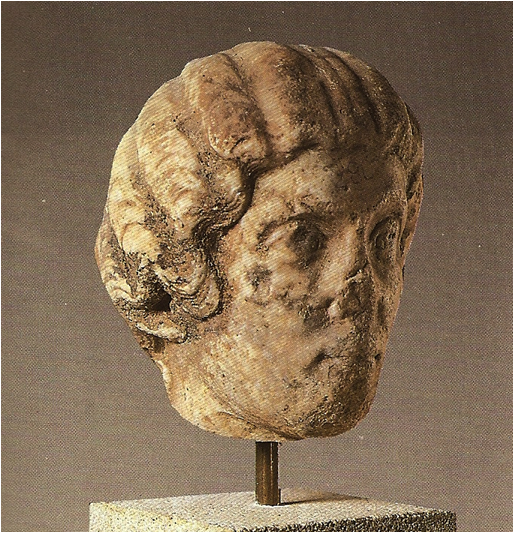
The head is preserved with a small part of the neck at the back. The nose, mouth (its center) and chin are broken. The eyes, as well as the face, but also the entire front and left part of the head together with the headdress are weathered away. It depicts a young woman with an oval plump face, a narrow forehead, narrow almond-shaped eyes with wide lids and thin arched eyebrows. Traces on the surface of the eyes indicate that the pupil (with a small hole) and iris (incised) were marked, as is the tear-duct. The hair is divided at the top of the forehead into two equal parts (on either side of the parting there are two narrow flat sections), which are combed with strong waves towards the back. At the back they gather in a bun low at the nape. The mass of hair covers the ears, except for the lobes. In front of each ear there is a circular lock of hair, while a curly lock is left free on the surface of the neck, behind each ear. The texture of the individual hairs is diligently rendered with the point (preserved only on the right part of the head). The headdress draws upon the second portrait type of the daughter of Faustina the Younger, Lucilla, hence the head should be dated to ca. 166 CE (for the portrait type see Fittschen 1982, 70, 78-80).
M. Wegner, R. Unger, “Verzeichnis der Kaiserbildnisse von Antoninus Pius bis Commodus II”, Boreas 3 (1980), 22; K. Fittschen, Die Bildnistypen der Faustina minor und die Fecunditas Augustae, Göttingen 1982, 59 note 41; N. Kaltsas, Αρχαία Μεσσήνη, Athens 1989, 35 no. 7, fig. 20 (Faustina the Younger, 161-180 CE); E. Chioti, Αυτοκρατορικά και ιδιωτικά πορτρέτα της εποχής των Αντωνίνων στην Ελλάδα (PhD. thesis, Aristotle University of Thessaloniki), Thessaloniki, 2012, 162-163, 358, cat. no. 210, pl. 169α (third quarter of the 2nd c. CE; draws upon the seventh portrait type of Faustina the Younger, in essence a simplified version of the type); Th. Stephanidou-Tiveriou, N. Kaltsas eds., Εθνικό Αρχαιολογικό Μουσείο. Κατάλογος γλυπτών IV.1. Γλυπτά των ρωμαϊκών χρόνων: αυτοκρατορικά πορτρέτα, Athens 2020, 168, 169 note 10 (K. Fittschen; It draws upon the second portrait type of Faustina the Younger or the second portrait type of Lucilla).