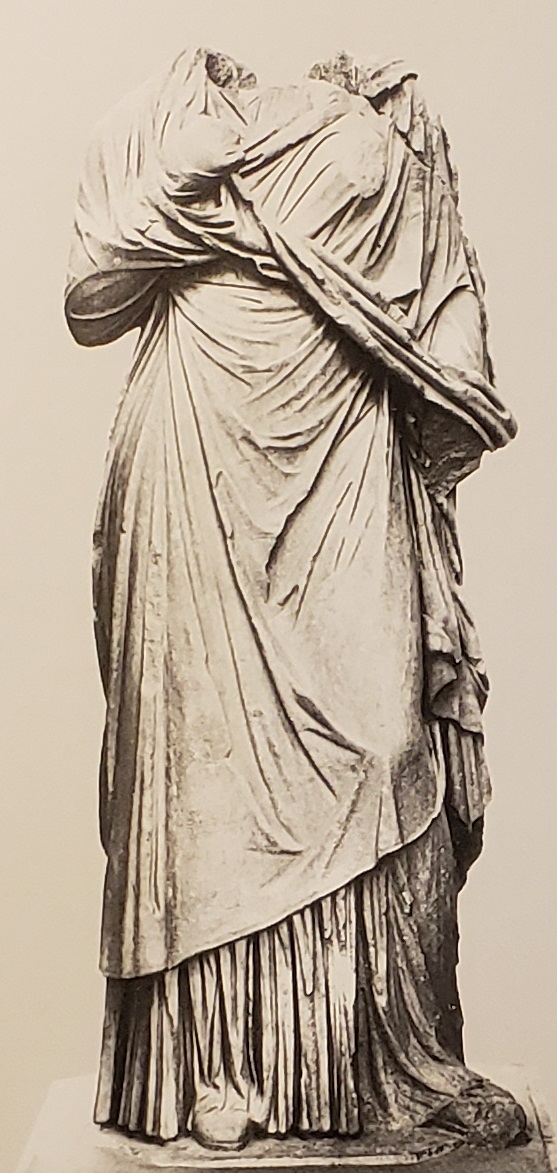
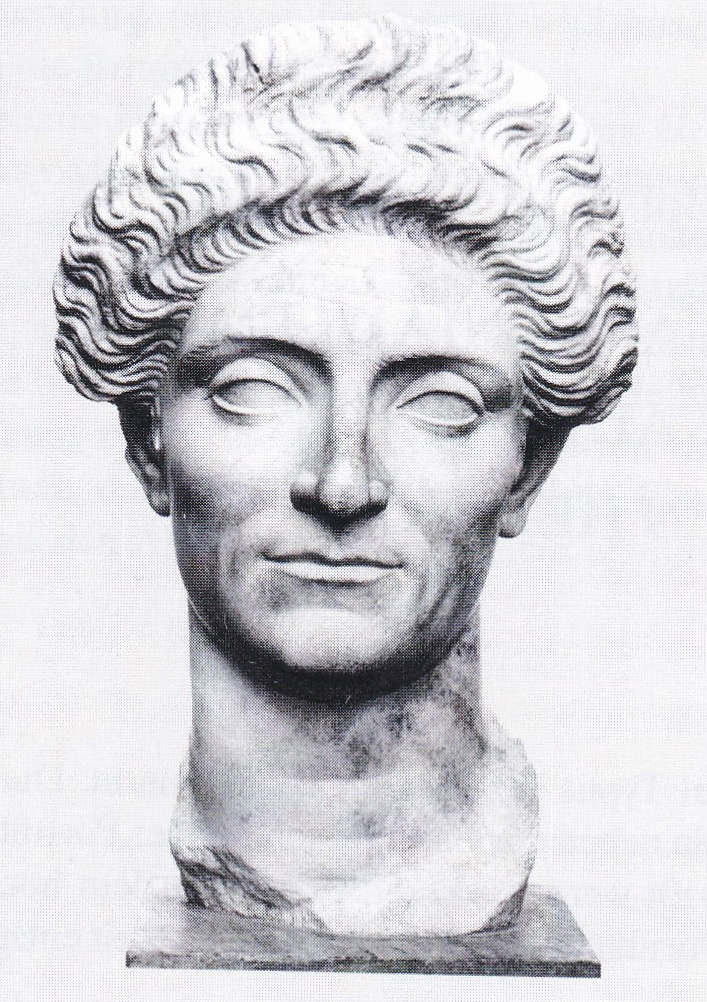
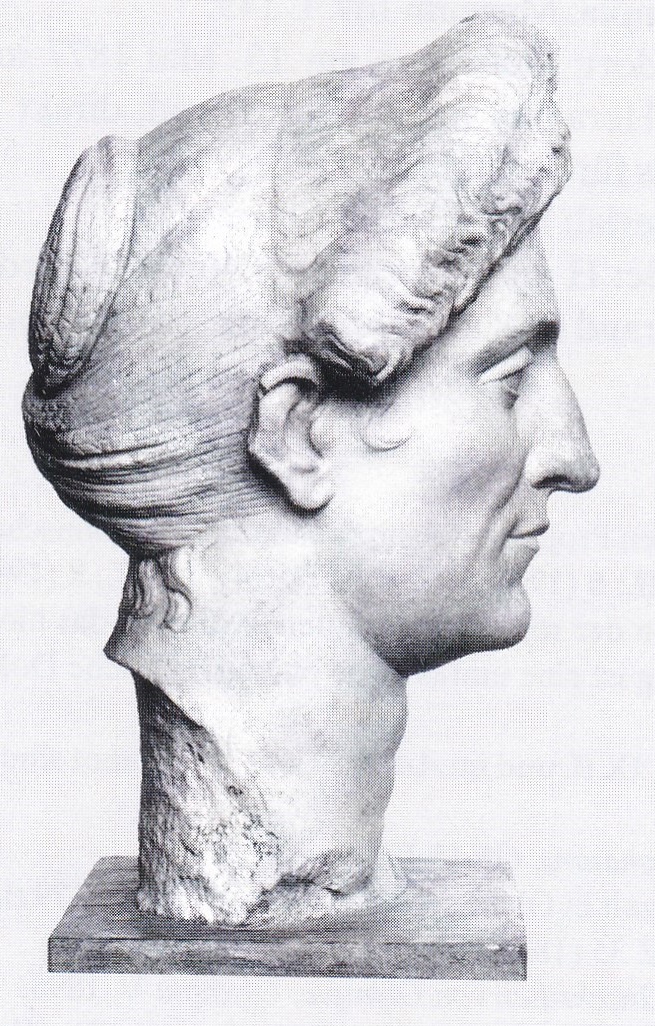
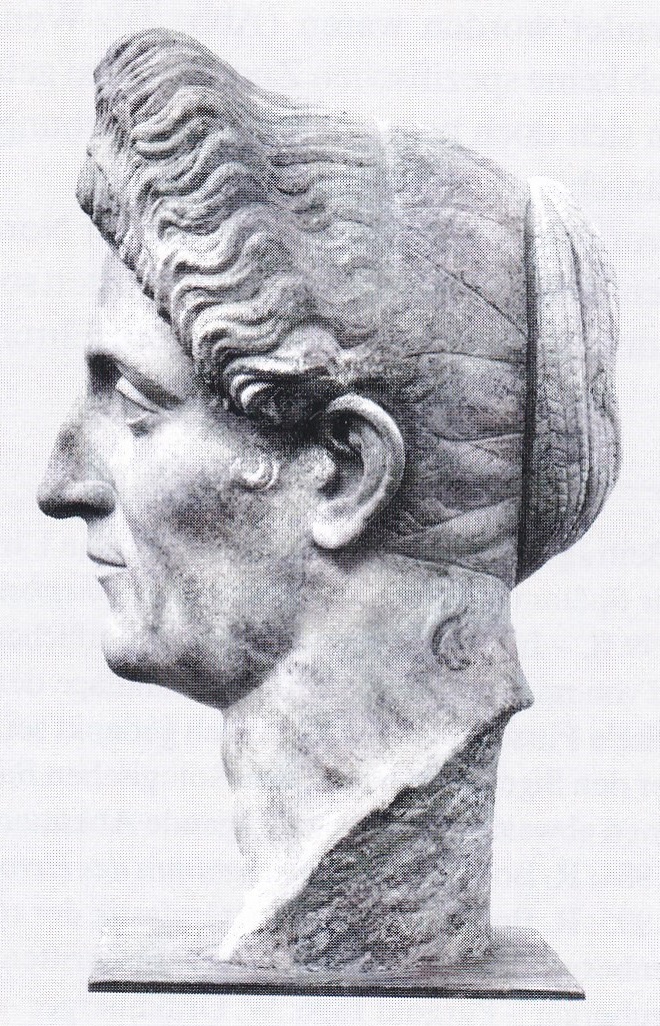
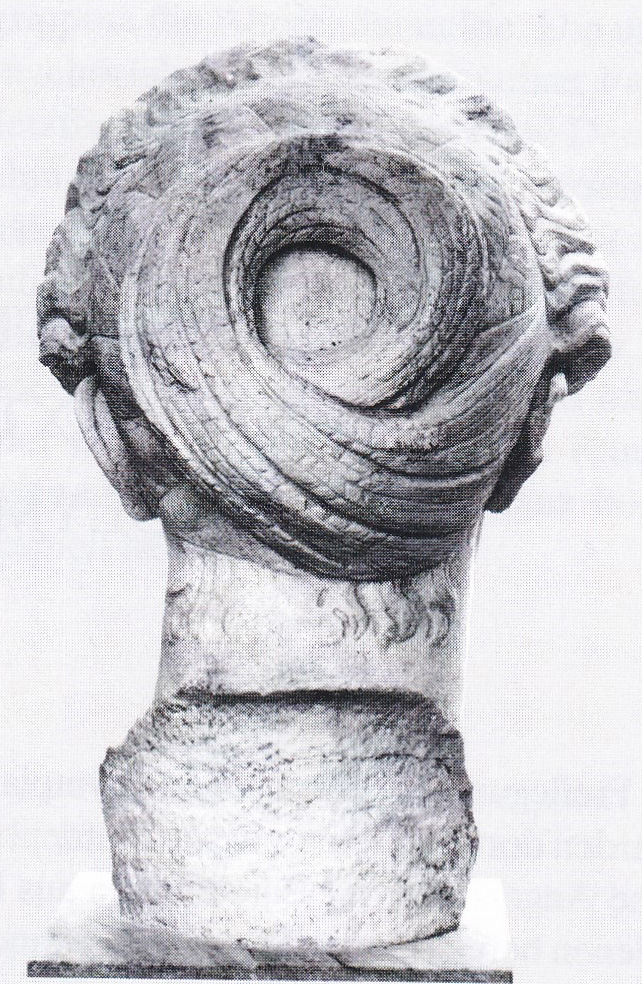
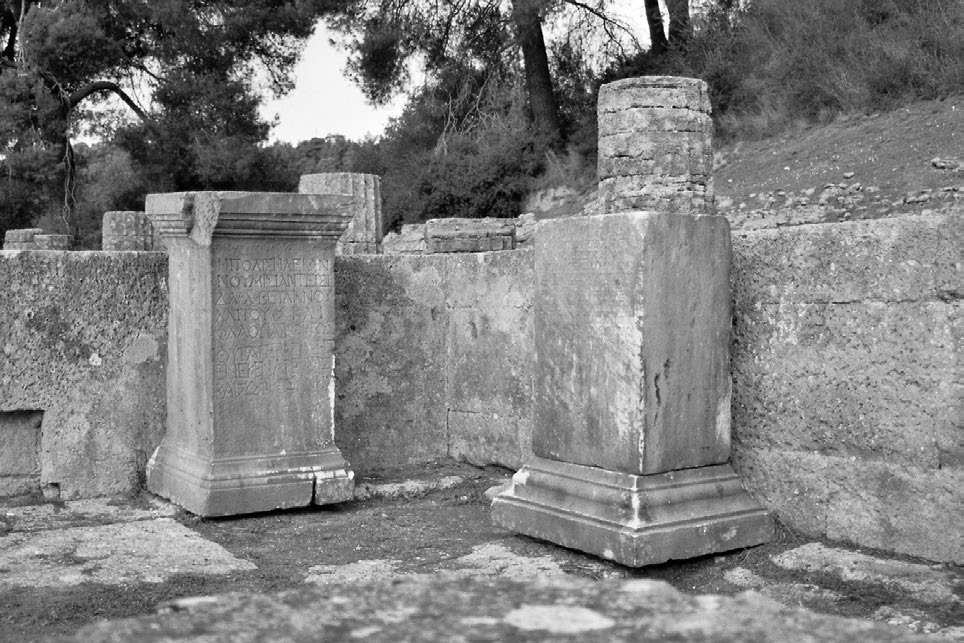
The statue is preserved almost intact. The left hand and a small part of the left shoulder are missing. The right hand is also broken at the fingers, while minor breaks and chipping are evident sporadically on the surface of the marble, especially on the drapery, and the left foot. The head is preserved intact, with the exception of a small break at the front right part of the tenon. It depicts a standing, frontal figure wearing a long chiton, a long himation that tightly envelops the body, as well as soft leather shoes (calcei muliebres). On the surface of the himation at the right knee, there is an inscription mentioning the artist, the Athenian sculptor Aulos Sext(i)os Eraton (cf. S. Kansteiner et al., Der neue Overbeck: die antiken Schriftquellen zu den bildenden Künsten der Griechen, Berlin 2014, no. 4148 [K.Hallof, S.Kansteiner]). The edges of the himation are held by the hands of the figure forming a triangle, characteristic of the statuary type of the “Large Herculaneum Woman”. The hairdo belongs to a well-known type of the Trajanic period; at the front, long stiff curved locks of hair frame the face, while the rest of the hair forms a wide, open “nest-like” bun, consisting of thin individual braids (for parallels and stylistic analysis see Bol 2008, 154). The face of the figure is oval, the eyebrows thin (the texture of the individual hairs is rendered by parallel incisions), the nose and mouth long and thin. The iris and pupil are not marked. There is a tendency for a “veristic” representation of the face, sporting individual traits of advanced age, such as the wrinkles on the forehead, outer corners of the eyes and mouth, the sunken cheeks, the strong nasolabial lines, the tendency for a double chin and the “rings of Venus” on the neck. According to the inscribed base, preserved in situ in the north part of the pronaos of the temple of Hera, the statue depicts Antonia Cleodice, daughter of Marcus Antonius Alexion and Claudia Cleodice and mother of Tiberius Claudius Pelops, Claudia Damoxena and Tiberius Claudius Aristomenes (S. Zoumbaki, Elis und Olympia in der Kaiserzeit: das Leben einer Gesellschaft zwischen Stadt und Heiligtum auf prosopographischer Grundlage, Athen 2001, 211-212, no. A78). The statue is dedicated by the city of Elis and the Olympic Boule to Olympian Zeus. High-quality product of an Attic workshop.
G. Treu, Olympia III. Die Bildwerke von Olympia in Stein und Thon, Berlin 1894, 252-255, figs. 288-290, pl. 62,6; W. Dittenberg, K. Purgold, Olympia V. Die inschriften von Olympia, Berlin 1896, no. 429; S. Reinach, RSGR II.2, Paris 1898, 671 no. 9; G.A.S. Snijder, Romeinsche Kunstgeschiedenis, Groningen 1925, pl. 4, fig. 14; P. Graindor, Athènes de Tibere à Trajan, Le Caire 1931, 18, fig. 2ο; G.M.A. Richter, “Who Made the Roman Portrait Statues - Greeks or Romans?”, PAPS 95 (1951), 188, fig. 26; M. Bieber, “The Copies of the Herculaneum Women”, PAPS 106 (1962), 118, 125; H. Kruse, Römische weibliche Gewandstatuen des zweiten jahrhunderts n.Chr., Göttingen 1975, 269, cat. no. Β1 (ca. 100 CE); R. Bol, "Ideal-und Portratplastik der romischen Kaiserzeit in Olympia", Nikephoros 8 (1995), 180-182, pl. 16.1-2; A. Alexandridis, Die Frauen des römischen Kaiserhauses: eine Untersuchung ihrer bildlichen Darstellung von Livia bis Iulia Domna, Mainz am Rhein 2004, 241, no. 86 (Hadrianic – Antonine); R. Bol, “Die Bildnisstatue der Antonia Cleodice im Kontext ihrer Aufstellung im Olympischen Heraion”, in Amicitiae Gratiae. Τόμος στη μνήμη Αλκμήνης Σταυρίδη, Athens 2008, 149-156; R. Krumeich, “Vom Haus der Gottheit zum Museum? Zu Ausstattung und Funktion des Heraion von Olympia und des Athenatempels von Lindos”, AntK 51 (2008), 85, πίν. 15.3, 6; O. Palagia, “Sculptures from the Peloponnese in the Roman Imperial Period”, in A.D. Rizakis, C.E. Lepenioti eds., Roman Peloponnese III. Society, Economy and Culture under the Roman Empire: Continuity and Innovation, Athens 2010, 437; J. Trimble, Women and Visual Replication in Roman Imperial Art and Culture, Cambridge 2011, 125-126, 363-364, figs. 3-4; K. Fittschen, «Über die Haartrachten von Kaiserinnen und Bürgerinnen in der mittleren Kaiserzeit», ÉtTrav 25 (2012), 108 note 45; M. Tasopoulou, Το πορτρέτο της εποχής του Τραϊανού στην Ελλάδα (MA thesis Aristotle University of Thessaloniki), Thessaloniki 2018, 54, 55, 111-112, cat. no. 43; Th. Stephanidou-Tiveriou, “Γλυπτά με χαμένες (;) ταυτότητες”, ArchEph 2021, 74· P. Konstantinidis, Γυναικείοι δυναστικοί εικονιστικοί ανδριάντες αυτοκρατορικής περιόδου από την Ελλάδα (τέλη 1ου αι. π.Χ. – 5ος αι. μ.Χ.), Athens 2024, 222 note 181; https://arachne.dainst.org/entity/1193569?fl=20&q=%22Olympia,%20Griechenland%22&resultIndex=494