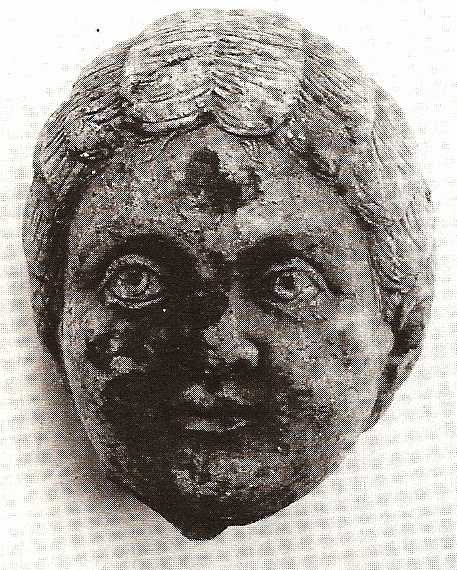
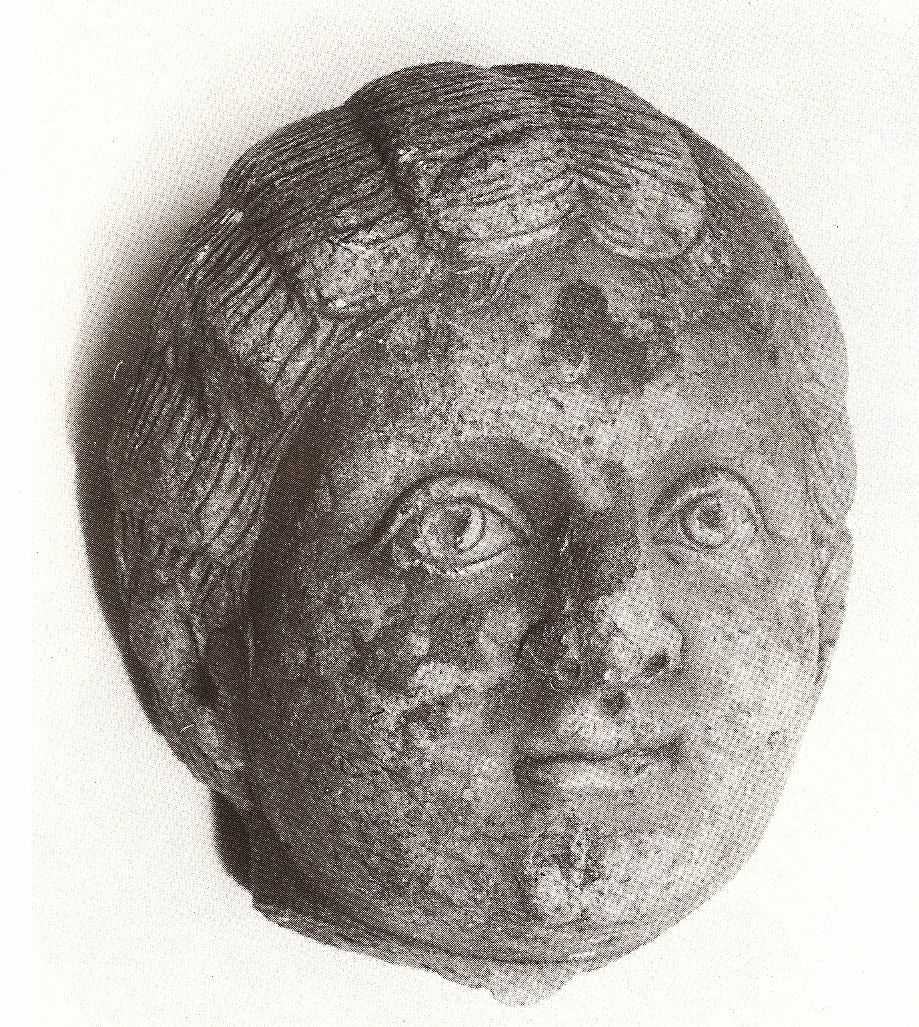
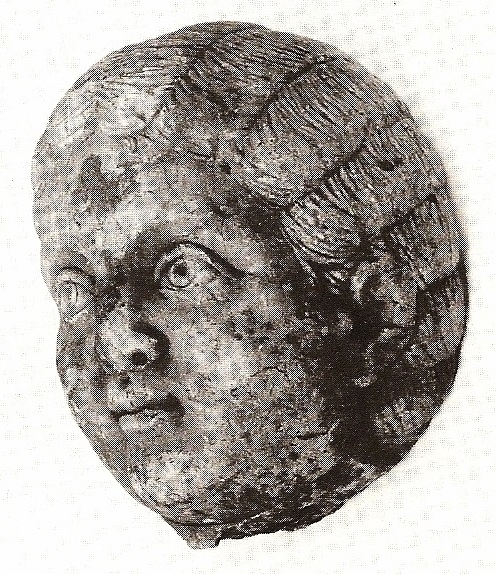
The head is preserved up to the beginning of the neck almost intact, with the exception of the back of the head. Small breaks and chipping are evident sporadically on the surface of the marble, especially in the area of the nose, eyebrows, chin and hair. The drill is used for rendering the mouth and nostrils. It depicts a small girl with a round plump face, a small narrow mouth with fleshy lips, a round chin, thin eyebrows and small almond-shaped eyes with wide lids. The iris and pupil are indicated. The girl wears the so-called “melon” coiffure, usually an element of young age (the coiffure is used during the imperial period for portraits of girls, young women, but also – less frequently - married women), while thin S-shaped locks of hair are left free on the surface of the forehead and the temples. The rendering of the coiffure with the “slices” slightly overlapping is close to that on the portrait head of a girl in the Archaeological Museum of Thessaloniki, inv 61, dated to the beginning of the 3rd c. CE (it draws upon the early portrait types of the empress Plautilla; G. Despinis, T. Stephanidou-Tiveriou, E. Voutiras eds., Κατάλογος Γλυπτών του Αρχαιολογικού Μουσείου Θεσσαλονίκης ΙΙ, Thessaloniki 2003, cat. no. 307, figs. 975 -978 [D. Kaplanidou]; ibid. for the “melon” coiffure, its history and duration, with bibliography). The portrait head of the small girl of the Sparta Museum should also be placed at the beginning of the 3rd c. CE, judging also by its style, although the break at the back of the head does not allow us to know the exact form of the circular bun, i.e. to know if the head followed the official iconography of Plautilla more closely (cf. also the portrait head of a priestess from Athens {Γ43} which, also drawing upon the iconography of Plautilla, sports a “melon” coiffure with a circular bun, although different from that in the official iconography of the empress, and free S-shaped locks of hair on the temples).
A. Datsouli-Stavridi, “Ρωμαϊκά πορτραίτα στο Μουσείο Σπάρτης”, in Πρακτικά του Α’ Τοπικού Συνεδρίου Λακωνικών Μελετών, Μολάοι 5-7 Ιουνίου 1982 (Peloponnesiaka Suppl. 9), Athens 1982-1983, 307, fig. 5; A. Datsouli-Stavridi, Ρωμαϊκά πορτραίτα στο Μουσείο της Σπάρτης, Athens 1987, 22, no. 1009/3724, figs. 43-44 (period of Plautilla); K. Fittschen, Privatporträts mit Repliken. Zur Sozialgeschichte römischer Bildnisse der mittleren Kaiserzeit, Wiesbaden 2021, 198, note 1f.