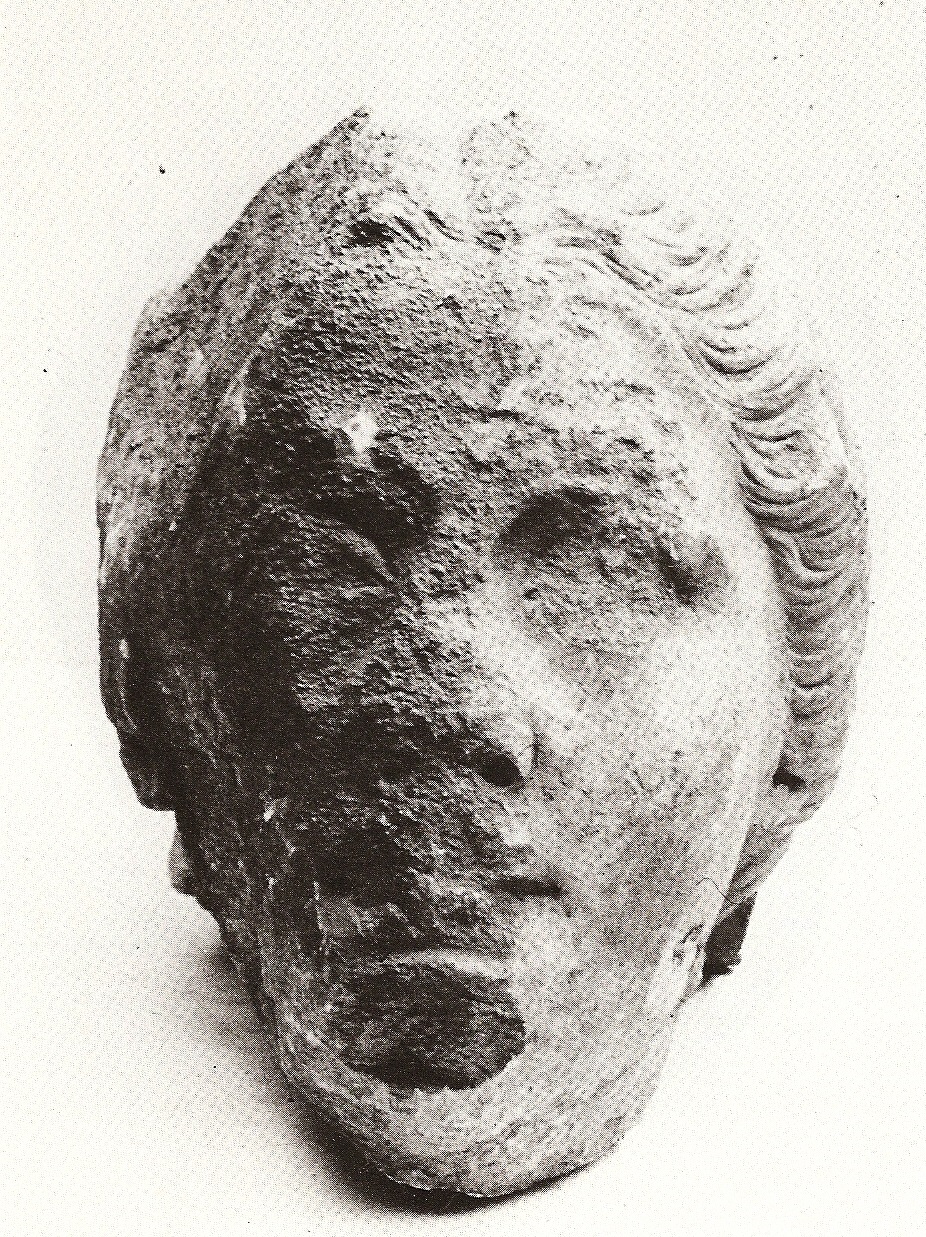
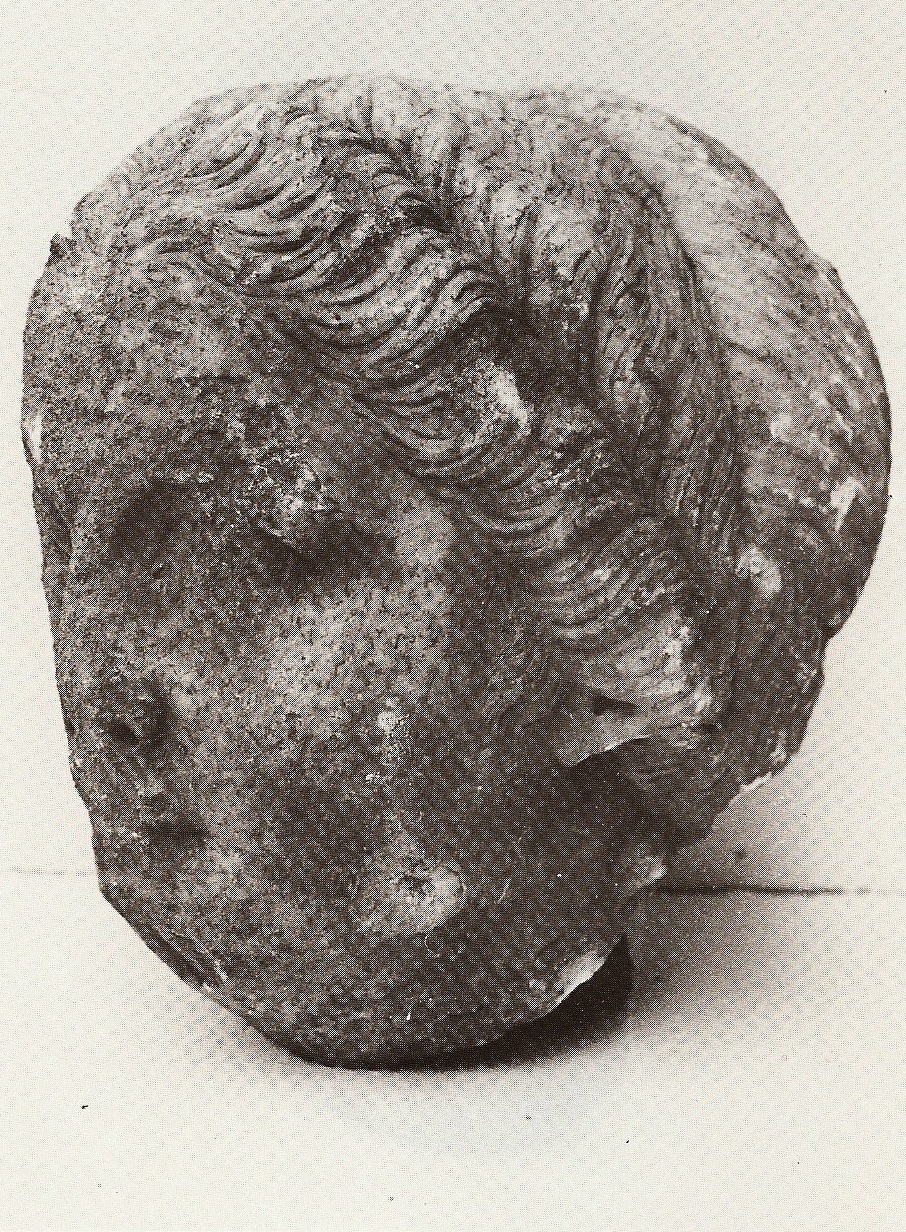
The head is preserved up to the beginning of the neck. The forehead, nose, mouth, chin, eyes, eyebrows, and the right part of the coiffure are partially broken. More specifically, only the inner corners of the eyes and the mouth, as well as the nostrils are preserved. The nostrils and mouth are worked with the drill. The surviving left cheek is smooth. The head depicts a mature woman with an oval face and a tendency towards a double chin. The eyes are almond-shaped with thin lids, while the mouth is elongated. The coiffure is divided at the top of the forehead into two equal parts, which form a wide upward wave (the texture of the individual hairs is rendered meticulously with parallel incisions with the point), framing the face (it covers the ears, except for the lobes). The rest of the mass of the coiffure, which also consists of locks of hair of the same shape and direction, although rendered flat on the surface of the marble, is separated by a deep ridge from the zone around the forehead. The entire back of the skull is covered by a broad bun (roughly worked with the flat chisel; its lower left part seems to have been chiseled away), while a broad wavy lock of hair is left free on the surface of the left temple. Although, to my knowledge, there are no exact parallels for the coiffure, the zone around the face, combined with the broad bun at the back of the head are reminiscent of the official iconography of Plautilla (202-205 CE– cf. H.B. Wiggers, M. Wegner, Das Römische Herrscherbild III.1. Caracalla, Geta, Plautilla. Macrinus bis Balbinus, Berlin 1971, pl. 28d). Here we see again the same arrangement of hair around the face which is separated from the next by a deep ridge, as well as the wide bun, which occupies a large part of the back of the head.
A. Datsouli-Stavridi, “Ρωμαϊκά πορτραίτα στο Μουσείο Σπάρτης”, in Πρακτικά του Α’ Τοπικού Συνεδρίου Λακωνικών Μελετών, Μολάοι 5-7 Ιουνίου 1982 (Peloponnesiaka Suppl. 9), Athens 1982-1983, 307, fig. 4; A. Datsouli-Stavridi, Ρωμαϊκά πορτραίτα στο Μουσείο της Σπάρτης, Athens 1987, 21-22, no. 6273, figs. 41-42 (early Severan period, 193-211 CE);
https://arachne.dainst.org/entity/1409460?fl=20&q=Sparta&resultIndex=175
https://arachne.dainst.org/entity/1409456?fl=20&q=%22Sparta,%20Griechenland%22&resultIndex=347