
 Museum/Current place of storage:
 |
Thebes, Archaeοlogical Museum |
 Inv. no:
 |
165 |
 Dimensions:
 |
|
 Material:
 |
Η. 1,14m., 0,09m. (plinth). |
 Findspot:
 |
In 1891 at the site of “Kastro” (i.e. possibly the early byzantine wall that surrounded the ancient city of Thespies; demolished during the excavations conducted by the French Archaeological School of Athens during the 1888-1891 period; for the “Kastro” and the excavation of a building interpreted as a temple of the Muses at the same site see C. Müller, “Les recherches françaises à Thespies et au Val des Muses”, in A. Hurst, A. Schachter eds., La montagne des Muses, Genève 1996, esp. 179, 181, 182 note 41; Β.Α. Robinson, “Mount Helikon and the Valley of the Muses: the production of a sacred space”, JRA 25 [2012], 233, with note 41· Χ. Zoe, Τεμένη Μουσών, υλικά κατάλοιπα και γραπτές μαρτυρίες, Athens 2014 (Ph.D. thesis National and Kapodistrian University of Athens), 13-16). |
 Original Display Location:
 |
Unknown (it could be equally set up in the city of Thespies, as well as the sanctuary of the Muses located nearby, as the byzantine castle of Thespies was built mostly from antiquities transported from the latter; see also I. Leventi, “Ένα άγαλμα Μούσας από τις Θεσπιές στο αρχαιολογικό μουσείο της Θήβας”, in A. Mazarakis-Ainian ed., Αρχαιολογικό έργο Θεσσαλίας και Στερεάς Ελλάδας. Πρακτικά επιστημονικής συνάντησης Βόλος 27.2 – 2.3.2003, Ι, Volos 2003, 773-774). |
 Date:
Date: |
First half of the 2nd c. CE (principate of Hadrian?). |
 Statuary Type (body) :
 |
The statue cannot be ascribed to a specific statuary type, although it draws upon the so-called (Q)Muse(Q) of the “Athens/Thebes” type. |
 Mode of Self-Representation (head):
 |
- |
 Civic Presence (Social Role Represented):
 |
Unknown. |
 Inscribed Base:
 |
No. |
 Author:
 |
Panagiotis Konstantinidis |
 Added:
 |
2024-04-26 |
 Edited:
 |
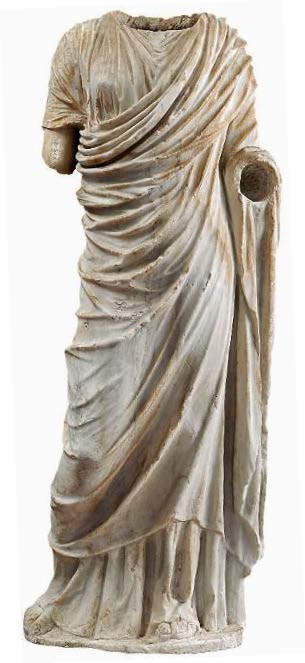
Description - Comments:
The statue is preserved intact, with the exception of the inset head and arms (the right is broken at about the middle of the biscep, while the outstreched left was inset from the middle of the forearm). Small breaks and chipping are evident sporadically on the surface of the marble. It depicts a just under life-sized female figure standing on a circular plinth wearing a chiton, a peplos, a himation and sandals (their straps were probably rendered in paint). Although the statue cannot be ascribed to a particular statuary type, its overall posture and drapery draws upon the so-called “Athens/Thebes” Muse statuary type, with the exception of wide overfold of the himation, placed diagonally on the chest. The latter doesn’t form a cylindrical, partially unrolled mass, but covers diagonally most of the chest area, beginning from the right armpit, and includes the whole of the left shoulder and part of the left biscep. The statue is erroneously published in R.R.R. Smith ed., Aphrodisias II. Roman Portrait Statuary from Aphrodisias, Mainz am Rhein 2006, 225, cat. no. 107, pl. 83, 1st – 3rd c. CE [J. Lenaghan/R.R.R. Smith], as a - now lost – female portrait statue found during the French excavations in Aphrodisias by P. Gaudin. In fact it is stated that only two lines of the inscription are visible in the photograph on the front surface of the base ([.]ΔΗ[..]Σ […?...] | ΜΝΑΣΙΠΟΥ […?...]). The above inscription was already published by P. Jamot in 1902 (Jamot 1902, 292, no. 4 = I.Thespies, 370, 2nd – 1st c. BCE; Thebes, Archaeological Museum inv. 290: Ὁ δῆμος Θεσπιέω[ν] | Μνάσιππον Ἀρχελά[ου] | Διονύσωι). Furthermore, in the photograph illustrating the statue on the Mnasippos base (Smith 2006, pl. 83), probably placed there by P. Jamot, who believed that they belonged together (Jamot 1902, 308-309) it is obvious that the insertion cavity for the statue is placed off-center because (as already mentioned by P. Jamot [1902, 309], but also again noted by J. Lenaghan and R.R.R. Smith in the Aphrodisias volume) the base continued to the left with another block and probably another statue. The statue with certainty does not belong to the base of the portrait statue of Mnasippos, son of Archelaos, dedicated by the demos of the Thespians to Dionysos, as already indicated by A. De Ridder (1922, 241) and A. Plassart (1926, 393 note 1). The identification of the figure as a portrait is not certain (“dubium”).
Bibliography:
P. Jamot, “Fouilles de Thespies: deux familles thespiennes pendant deux siècles”, BCH 26 (1902), 308-309, pl. 1 (mid-1st c. CE; it belongs to the statue base of Mnasippos, son of Archelaos); S. Reinach, RSGR II.1, Paris 1908, 676, no. 9; A. De Ridder, “Fouilles de Thespies et de l’hiéron des muses de l’Hélicon. Monuments figurés”, BCH 46 (1922), 240-241 no. 47, fig. 20 (erroneously associated with and placed on the base of the portrait-statue of Mnasippos, son of Archelaos); A. Plassart, “Fouilles de Thespies et de l'hiéron des muses de l'Hélicon. Inscriptions: Dédicaces de caractère religieux ou honorifique, bornes de domaines sacrés”, BCH 50 (1926), 393 note 1 (it doesn’t belong to the Mnasippos statue base); Chr. Karouzos, Το Μουσείον της Θήβας, Athens 1934, 49, no. 165 (principate of Hadrian); I. Threpsiadis, “Επανέκθεσις Μουσείου Θηβών”, ArchEph 1963 Chronicles, 22 (period of Hadrian); K. Demakopoulou, D. Konsola, Archaeological Museum of Thebes, Athens 1981, 88, no. 165; M. Bonanno-Αravantinos, “Due ritratti di eta antonina nel Museo archeologico di Τebe”, in J. Bouzek, I. Ondrejova eds., Roman Portraits, Artistic and Literary, Acts of the Third International Conference on the Roman Portraits held in Prague and in the Bechině Castle from 25 to 29 September 1989, Mainz 1997, 57, note 9; M. Bonanno-Aravantinos, “I ritratti di età romana della Beozia: considerazioni preliminary”, in V. Aravantinos ed., Επετηρίς της Εταιρείας Βοιωτικών Μελετών Γ΄. Διεθνές συνέδριο βοιωτικών μελετών, Θήβα 4-8 Σεπτεμβρίου 1996, Athens 2000, 783; R.R.R. Smith ed., Aphrodisias II. Roman Portrait Statuary from Aphrodisias, Mainz am Rhein 2006, 225, cat. no. 107, pl. 83 ( J. Lenaghan/R.R.R. Smith; 1st - 3rd c. CE; Aphrodisias find); Μ. Bonanno-Aravantinos, “La scultura di eta romana nella Beozia: importazioni e produzioni locali”, in Th. Stephanidou-Tiveriou, P. Karanastasi, D. Damaskos eds., Κλασική παράδοση και νεωτερικά στοιχεία στην πλαστική της ρωμαϊκής Ελλάδας. Πρακτικά διεθνούς συνεδρίου, Θεσσαλονίκη, 7-9 Μαϊου 2009, Athens 2012, 236 (Hadrianic; chiton and himation); V. Aravantinos, Το Αρχαιολογικό Μουσείο Θηβών, Athens 2010, 347 (left); M. Mikedaki, Tabula Imperii Romani: J 34 Athens. Boeotia, Athens 2019, 112 (first half of the 2nd c. CE).