
 Museum/Current place of storage:
 |
Thebes, Archaeological Museum. |
 Inv. no:
 |
ΒΕ 66 |
 Dimensions:
 |
|
 Material:
 |
H. 1,22m. Base: 0,65m. x 065m. x 0,28m. (insertion cavity: 0,30m. x 0,38m. x 0,03m.). |
 Findspot:
 |
In November 1941 incorporated into a wall of the late-Roman bath complex, built over part of the cella of the temple of Artemis Aulideia (for the bath complex see Threpsiadis 1956, 97). The base in 1956 in the fill of the cella of the temple of Artemis Aulideia, in the same layer – although a bit to the north - as the portrait-statue Thebes Archaeological Museum inv. BE 63 (Threpsiadis 1956, 99, 102, pl. 33β). |
 Original Display Location:
 |
In the cella of the temple of Artemis Aulideia. |
 Date:
Date: |
Late 2nd – early 3rd c. CE. |
 Statuary Type (body) :
 |
“Small Herculaneum Woman”. |
 Mode of Self-Representation (head):
 |
- |
 Civic Presence (Social Role Represented):
 |
Priestess. |
 Inscribed Base:
 |
Yes (SEG XXV 542). |
 Author:
 |
Panagiotis Konstantinidis |
 Added:
 |
2024-04-26 |
 Edited:
 |
Description - Comments:
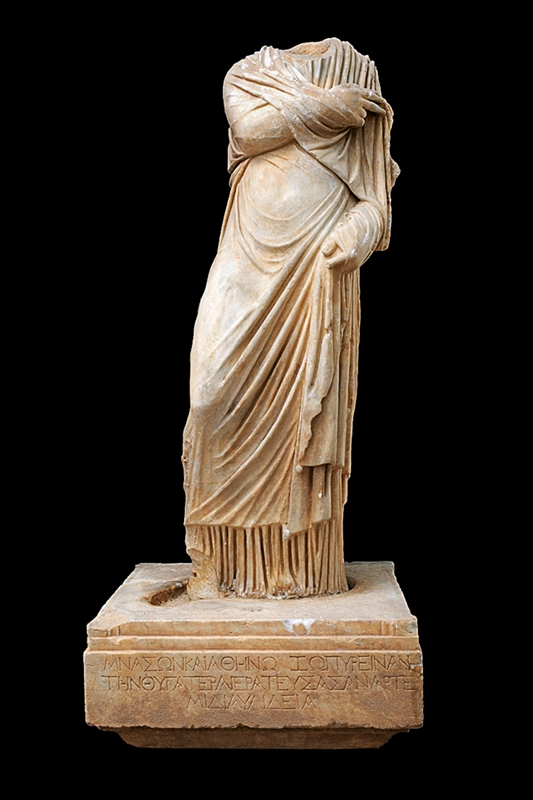
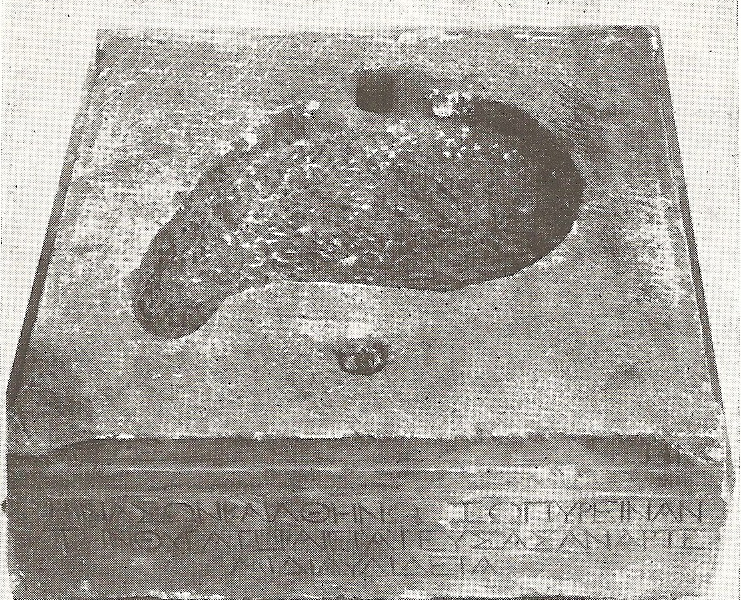
Good state of preservation. The inset head and right foot (a small socket for the insertion of a metal tenon is preserved off-center on the surface of the marble) are missing, while a small part of the chiton at the back of the figure is broken off. Smaller breaks and chipping are evident sporadically on the surface of the marble, especially at the edges of the folds of the garments and at the fingers. It depicts a standing, frontal female figure wearing a foot-long chiton and a himation that tightly envelops the body (a small round tassel is present at the angular end of the himation low at the front of the figure), closely following the statuary type of the so-called “Small Herculaneum Woman”. More specifically, the weight of the body falls on the left leg, with the right leg slightly bent and placed sideways and slightly back. The left arm is bent and placed diagonally across the chest with the wrist resting on the left shoulder, while the left is brought down. Good quality of workmanship. Based on the inscribed base, the statue represents the young priestess of Artemis Aulideia, Zopyreina, dedicated to the goddess by her parents, Mnason and Atheno (SEG XXV 542, late 2nd - early 3rd c. CE; the letter Ζ retains its classical form – see Μ. Guarducci, Epigrafia Greca I, Roma 1967, 381). The statuary type befits the young age of Zopyreina (indicated by the mention of her parents and not her husband as dedicants in the inscription), while the dating of the inscription is also in accordance with the dating of the statue, based on stylistic analysis (cf. the rendering of the chiton on the female portrait-statue in the “Large Herculaneum Woman” type, Thessaloniki Archaeological Museum inv. no. 1964, late 2nd – early 3rd c. CE [G. Despinis, Th. Stephanidou-Tiveriou, E. Voutiras eds., Κατάλογος Γλυπτών του Αρχαιολογικού Μουσείου Θεσσαλονίκης ΙΙ, Thessaloniki 2003, 87-88, cat. no. 225, figs. 637-640 (B. Schmidt-Douna]). The statue was found (in 1941) incorporated into a wall of the late Roman bath complex that occupied part of the cella of the temple of the goddess, and the base (in 1956) in the fill of the cella of the temple of Artemis, in the same layer - although a little further to the north – as the portrait-statue of Livia or Agrippina the Younger, Thebes, Archaeological Museum inv. no. BE 63 (P. Konstantinidis, Γυναικείοι δυναστικοί εικονιστικοί ανδριάντες αυτοκρατορικής περιόδου από την Ελλάδα [τέλη 1ου αι. π.Χ. – 5ος αι. μ.Χ.], Athens 2024, 459-462, cat. no. Γ30, figs. 672-682; see Threpsiadis 1956, 99, 102, pl. 33β [base of the statue of a priestess of Artemis Aulideia “in second use”]). The inscription on the base was the one that revealed the identity of the sanctuary to the excavator, I. Threpsiadis, while the statue was attributed to and placed on the base by him after 1958 (cf. Threpsiadis 1958, pl. 41, where the statue and base are displayed side by side in the Thebes Museum). Given that the insertion cavity at the top of the base closely follows the contour of the plinth of the statue, and despite the somewhat unnatural tilt of the latter to the right (of the viewer), which is probably due to lack of dexterity on behalf of the sculptor (the insertion cavity is quite shallow), the correlation between the two should not be doubted (such doubts have been expressed from time to time). Nevertheless, the existence of a rectangular dowel socket in the front part of the base (a small part of metal is still preserved inside it), and of a second one at the rear edge of the insertion cavity of the statue, both destined, as observed by I. Threpsiadis (1963, 21; see also Kruse 1975, 321, cat. no. C 41), for the attachment of another stone part, indicate, like its architectural type, that the block already existed and that it was re-used for the statue of Zopyreina inverted, when it was probably also inscribed.
Bibliography:
I. Threpsiadis, “Ανασκαφαί εν Αυλίδι”, Prakt 1956, 99, 102, pl. 33β; I. Threpsiadis, “Ανασκαφαί εν Αυλίδι”, Prakt 1958, pl. 41; I. Threpsiadis, “Ανασκαφαί Αυλίδος”, ArchDelt 17 (1961/1962), Chronicles, 141-142; I. Threpsiadis, “Επανέκθεσις Μουσείου Θηβών”, ArchEph 1963 Chronicles, 21, pl. ε’, ΧΙΙΙ, and Κα; H. Kruse, Römische weibliche Gewandstatuen des zweiten jahrhunderts n.Chr., Göttingen 1975, 321, cat. no. C 41; K. Demakopoulou, D. Konsola, Archaeological Museum of Thebes, Athens 1981, 80, no. BE 66, fig. 27; A. Filges, Standbilder jugendlicher Göttinnen, Köln-Weimar-Wien 1997, 170 note 682, 190 note 878; G. Schörner, Votive im römischen Griechenland: Untersuchungen zur späthellenistischen und kaiserzeitlichen Kunst- und Religionsgeschichte, Wiesbaden 2003, 462, cat. no. 905, pl. 86 (late 2nd – early 3rd c. CE); A. Alexandridis, Die Frauen des römischen Kaiserhauses: eine Untersuchung ihrer bildlichen Darstellung von Livia bis Iulia Domna, Mainz am Rhein 2004, 247, no. 121 (priestess; Severan period); J.B. Connelly, Portrait of a Priestess: Women and Ritual in Ancient Greece, Princeton 2007, 158-159, 160, fig. 5.26; V. Aravantinos, Το Αρχαιολογικό Μουσείο Θηβών, Athens 2010, 346 (right; late 2nd – early 3rd c. CE); Μ. Bonanno-Aravantinos, “La scultura di età romana nella Beozia: importazioni e produzioni locali”, in Th. Stephanidou-Tiveriou, P. Karanastasi, D. Damaskos eds., Κλασική παράδοση και νεωτερικά στοιχεία στην πλαστική της ρωμαϊκής Ελλάδας. Πρακτικά διεθνούς συνεδρίου, Θεσσαλονίκη, 7-9 Μαϊου 2009, Athens 2012, 235 (late 2nd – early 3rd c. CE; the base does not belong to the statue); M. Mikedaki, Tabula Imperii Romani: J 34 Athens. Boeotia, Athens 2019, 32.