
 Museum/Current place of storage:
 |
Epidauros, Archaeological Museum. |
 Inv. no:
 |
1 |
 Dimensions:
 |
|
 Material:
 |
Η. 1.63m. (without the plinth), w. 0,745m., 0,485m. (at the shoulders), 0,505m. (at the hips and calves). Plinth: h. 0,10m. (max. restored), w. 0,565m., th. 0,43m. |
 Findspot:
 |
In 1882 near the exedra northeast of the Tholos. |
 Original Display Location:
 |
Probably in the area of the Tholos. |
 Date:
Date: |
Late in the principate of Claudius or in the principate of Nero. |
 Statuary Type (body) :
 |
Kore of the “Munich-Puteoli-Syon House” type. |
 Mode of Self-Representation (head):
 |
- |
 Civic Presence (Social Role Represented):
 |
Unknown. |
 Inscribed Base:
 |
No |
 Author:
 |
Panagiotis Konstantinidis |
 Added:
 |
2024-04-26 |
 Edited:
 |
2024-09-18 |
Description - Comments:
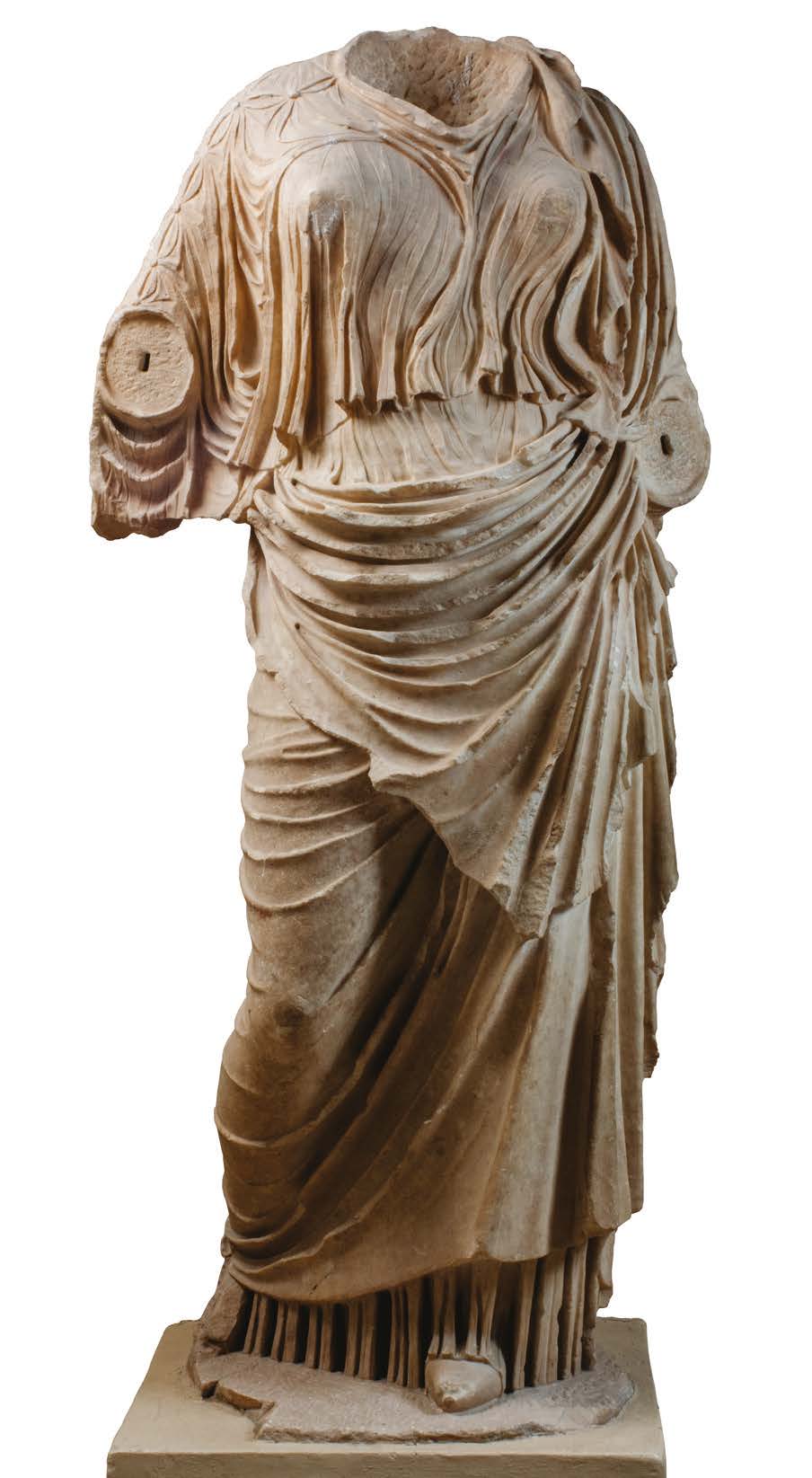
The statue is preserved almost complete, from the plinth to the shoulders. The inset parts, the head with the neck and part of the arms (the right arm from the elbow and the left from the beginning of the forearm) are missing. Chipping is observed on the surface of the folds of the garments. The right side of the plinth with the right foot is broken. The figure is depicted standing, wearing a chiton, a himation and closed leather shoes (calcei muliebres). The weight of the figure is supported on the left leg, while the right is relaxed and placed back and sideways. The torso turns slightly to the left. The upper part of the arms lay close to the body, while the forearms extended forward (the left placed lower than the right). The sleeved chiton forms an overfold that reaches approximately the waist. The himation covers the lower part of the body, forming a triangular overfold at the level of the abdomen, while, coming from the back, it covers the left shoulder and arm. At the back, the himation is summarily rendered, evident in the shallower folds of the garment, an indication that the rear of the statue was probably not meant to be seen. High quality of workmanship.
Bibliography:
S. Reinach, RSGR II.2, Paris 1909, 112, 672 no. 8; Α. Delivorrias, “Problemes de consequence methodologique et d'ambiguite iconographique”, MÉFRA 103 (1991), 145 note 30; L.E. Baumer, Vorbildern und Vorlagen. Studien zur klassischen Frauenstatuen und ihrer Verwendung fur Reliefs und Statuetten des 5. Und 4. Jhs. v. Chr., Bern 1997, 93, no. G2/3, pl. 4,4; St. Katakis, Τα γλυπτά των ρωμαϊκών χρόνων από το ιερό του Απόλλωνος Μαλεάτα και του Ασκληπιού, Athens 2002, 104-105, 144-145, 151, 275-277, 296, 324 note 125, 139, 1168, 1425, cat. no. 111, pls. 114-116 (late Claudian period or in the principate of Nero); A. Alexadridis, Die Frauen des römischen Kaiserhauses: eine Untersuchung ihrer bildlichen Darstellung von Livia bis Iulia Domna, Mainz am Rhein 2004, 257, no. 3 (Julio-Claudian period); M.C. Portale, “Augustae, Matrons, Goddesses: Imperial Women in the Sacred Space”, in M. Galli ed., Roman Power and Greek Sanctuaries: Forms of Interaction and Communication, Athens 2013, 235, 236, fig. 12; J. Lenaghan, “Assessing a Roman Copy: The Story of the Syon Aphrodite”, AJA 123 (2019), 94, fig. 15; S. Katakis, “Les statues honorifiques dans un sanctuaire hors de la ville: le cas du sanctuaire d’Apollon et d’Asclépios à Épidaure à l’époque romaine”, in G. Biard, V. Gaggdis-Robin, N. de Larquier eds., Les mille visages de l’honneur. Actes des IIIes rencontres autour de la sculpture romaine, 8-9 novembre 2019, Arles, Bordeaux 2023, 56-57, fig. 12.