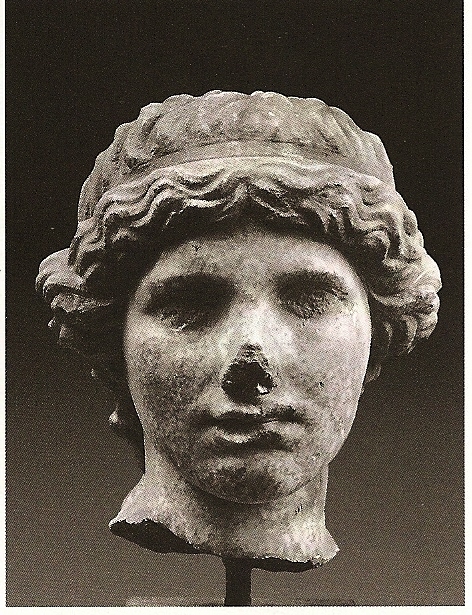
Museum/Current place of storage:
 |
Athens, National Archaeological Museum. |
 Inv. no:
 |
1991 |
 Dimensions:
 |
|
 Material:
 |
H. 0,19m. |
 Findspot:
 |
In 1902, in Chalkida, at the site “Vromousa”, where a 1st – 2nd c. CE necropolis has been excavated (P. Karvonis, M. Mikedaki, Tabula imperii romani: Smyrna. I. Aegean islands, Athens 2012, 219· P. Karvonis, “Τοπογραφία της ρωμαϊκής Εύβοιας”, in V. Vlachou, A. Gadolou eds., Τέρψις. Studies in Mediterranean Archaeology in Honour of Nota Kourou, Brussels 2017, 333). |
 Original Display Location:
 |
Probably part of a funerary monument of unknown type. |
 Date:
Date: |
2nd c. CE (?) |
 Statuary Type (body) :
 |
- |
 Mode of Self-Representation (head):
 |
Generic classicistic coiffure and idealized face (“non-portrait”). |
 Civic Presence (Social Role Represented):
 |
Unknown. |
 Inscribed Base:
 |
No. |
 Author:
 |
Panagiotis Konstantinidis |
 Added:
 |
2024-09-06 |
 Edited:
 |
|