
 Museum/Current place of storage:
 |
Athens, Museum of the Ancient Agora (Stoa of Attalos). |
 Inv. no:
 |
S 1345 |
 Dimensions:
 |
|
 Material:
 |
H. 0.40 m., w. 0.50 m. |
 Findspot:
 |
In 1937, during excavations of the American School of Classical Studies, in the northeastern part of the so-called “Gymnasium” (the Late Antique building complex - ca. 400-530 CE - that occupied the central part of the Agora square, and has occasionally been identified as the seat of a philosophical school of Athens or as the residence of imperial administration in the city, as well as been linked with the Athenian elite family of the empress Eudocia; see Frantz 1988, 110-116 [H. Thompson]; E. Greco ed., Topografia di Atene III , Atene-Paestum 2014, 1091, no. 9.39 [P. Bonini]; P. Karvonis, Tabula Imperii Romani. J 34 Athens. Attica , Athens 2016, 112); used as building material (as indicated by the traces of late Roman mortar on the marble surface). |
 Original Display Location:
 |
In the Agora (the exact location is unknown). |
 Date:
Date: |
Antonine period. |
 Statuary Type (body) :
 |
“Kore/Persephone” of the “Ephesos” type. |
 Mode of Self-Representation (head):
 |
- |
 Civic Presence (Social Role Represented):
 |
Unknown. |
 Inscribed Base:
 |
No. |
 Author:
 |
Panagiotis Konstantinidis |
 Added:
 |
2024-09-08 |
 Edited:
 |
Description - Comments:
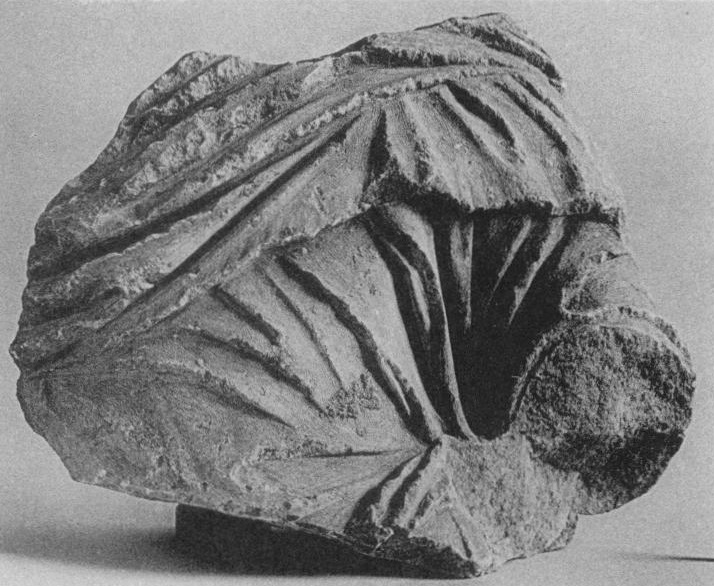
Fragment of the upper left part of a probably standing female figure, preserving the shoulder and a large part of the biscep. The entire back and left side of the fragment are broken off. Smaller breaks and chipping are also evident sporadically on the surface of the marble. The characteristic diagonal mass of the himation (partially unfolded) on the left shoulder, as well as the gathering of folds of the garment lower, between the elbow and the torso (here fragmentarily preserved), indicate that the figure replicated the well-known statuary type of the so-called “Kore/Persephone“ of the “Ephesos” type, quite popular in the province of Achaea. As indicated by their homogenous style, dating and findspot, the statue formed part of a wider sculptural assemblage to which also belonged the portrait statues inv. S 849, 850, 936, 1346 and 1347 (Harrison 1953, cat. nos. 57-61 = Leone 2020, cat. nos. 83-87; five male statues in the so-called himation-clad “arm-sling” type or “Normaltypus”; on the type see R.R.R. Smith, “Cultural Choice and Political Identity in Honorific Portrait Statues in the Greek East in the Second Century A.D.”, JRS 88 [1998], 65-67, 78-79; also P. Konstantinidis, “Archaeology of Anaphe (1100 B.C. – A.D. 600): Part 2”, Ostraka XXX [2021], 91 note 18). E.B. Harrison (1953, 75-76, 78), following H. Thompson, ascribes the above statues (along with the seated male figures inv. S 826, 930 and 1304, probably depicting seated philosophers; see H. Thomspon, “The Odeion in the Athenian Agora”, Hesperia 19 [1950], 126-127, 135; Leone 2020, cat. nos. 89-91 [he also adds the male portrait statue inv. S 1354 to the sculptural decoration of the Odeion of Agrippa]) to the sculptural decoration of the Odeion of Agrippa that occupied the central space of the Agora, and in particular to its second building phase, dated to the middle of the 2nd c. CE, and tentatively attributed by H. Thompson (1950, 133, 141) to Herodes Atticus (for the Odeion and its sculptural program see also Frantz 1988, 65; Ε. Greco ed., Topografia di Atene III, Atene-Paestum 2014, 1087-1089, αρ. 9.38 [S. Leone]· Leone 2020, 79-80). Given the statues’ type and same findspot, their attribution to the sculptural decoration of the Odeion of Agrippa is quite probable. Alternatively, the present female statue along with the standing male ones, all belonging to the same stylistically homogenous group, could belong to an honorary monument erected in the central part of the Agora square, perhaps near the facade of the Odeion. The finding of all statues in the same area probably confirms the fact, as already argued, that they later formed part of the sculptural decoration - of the so-called Late Antique “Gymnasium” (in reuse; see also Harrison 1953, 74).
Bibliography:
E.B. Harrison, The Athenian Agora I. Portrait Sculpture , Princeton N.J. 1953, 78, cat. no. 63, pl. 40; A. Frantz, The Athenian Agora XXIV. Late Antiquity A.D. 267-700 , Princeton NJ 1988, 65; S. Schmidt, “Uber den Umgang mit Vorbildern. Bildhauerarbeit im 4. Jahrhundert v. Chr.”, AM 111 (1996), 192, note 2 (no. 2); S. Leone, Polis, Platz und Porträt. Die Bildnisstatuen auf den Agora von Athen im Späthellenismus und in der Kaiserzeit (86 v.Chr. – 267 n.Chr) , Boston 2020, 79-80, 95-96, 230, cat. no. 88 (mid-2nd c. CE; originally from the Odeion of Agrippa); S. Dillon, «Female Portrait Statuary in Roman-period Athens: The Epigraphic and Sculptural Evidence», Eugesta 13 (2023), note 68;