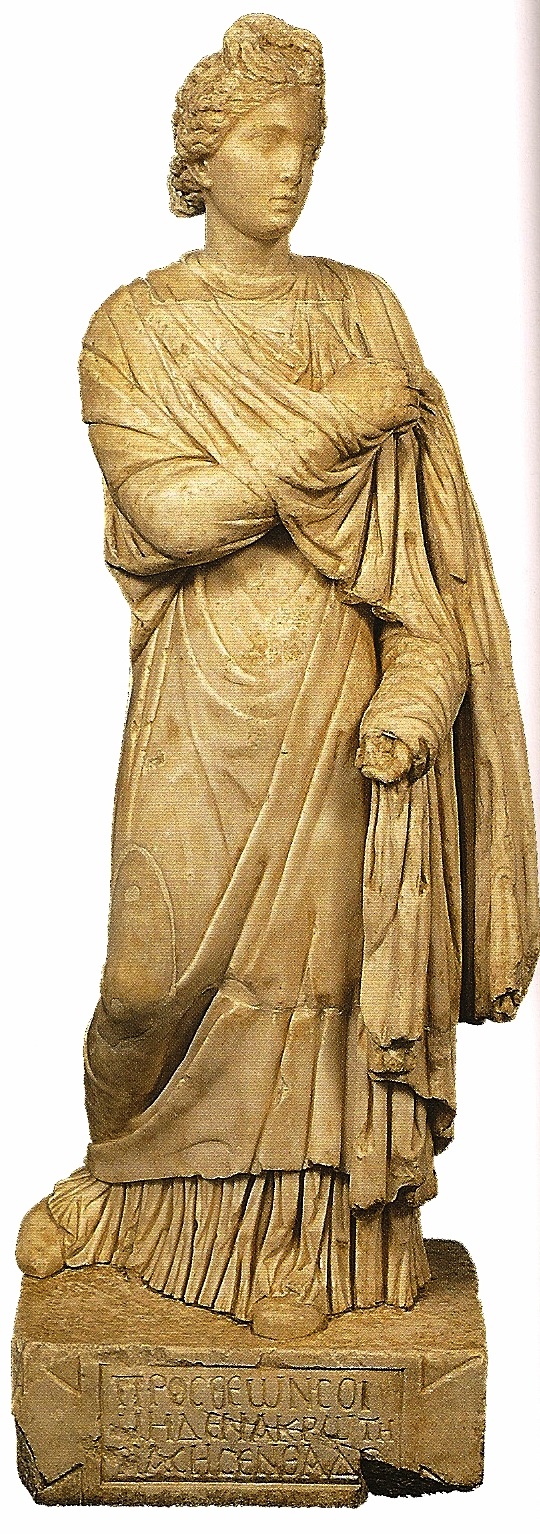
The statue is well preserved, together with the inscribed base. Put back together from two main fragments joined at about knee level. The head and part of the left leg at knee level are missing. The missing parts were restored in the 16th c. The head is ancient, but does not belong to the statue (the rectangular 16th c. cutting for its insertion is evident between the shoulders). It probably comes from a statue of Aphrodite of the “Capitol-Dresden” type, to which resembles the coiffure with the two tentacles forming a loop at the front part of the head (see LIMC II [1984], s.v. Aphrodite, 52-53, nos. 409-418; see also Traversari 1986, 37-38). Smaller breaks and chipping are evident sporadically on the surface of the marble, especially along the ridges of the folds of the garments and the fingers. Parts of the lower front edge of the base are also broken. The statue depicts a standing, frontal young woman, wearing a foot-long chiton, a wide himation that covers almost the entire body, including the hands, and closed leather shoes (calcei muliebres). It reproduces the “Small Herculaneum Woman” statuary type. Based on the stylistic rendering of the drapery (cf. the portrait statue of the priestess Zopyrina from the sanctuary of Artemis Aulideia in Boeotia {Γ13}) it can be dated to the end of the 2nd - the beginning of the 3rd c. CE. The shape of the lunate letters of the inscription with the tabula ansata (πρὸς θεῶν σοι | μηδὲν ἀκρωτη| ριάσῃς ἐνθάδ[ε]; see also Traversari 1986, 37) also agrees with this dating. The back of the statue is roughly worked, indicating that it would not have been visible, probably standing within a funerary naiskos (the relatively good condition of the surface of the marble indicates some kind of protection from element erosion).
CIG 6855; IG ΙΙ2, 13228 (the Attic provenance is dubious); G. Traversari, La statuaria ellenistica del Museo archeologico di Venezia, Roma 1986, 37-38, cat. no. 9; I. Favaretto, M. De Paoli, M.C. Dossi, Museo archeologico nazionale di Venezia. Catalogo, Milano 2004, 44, cat. no. I.19 (M. De Paoli).