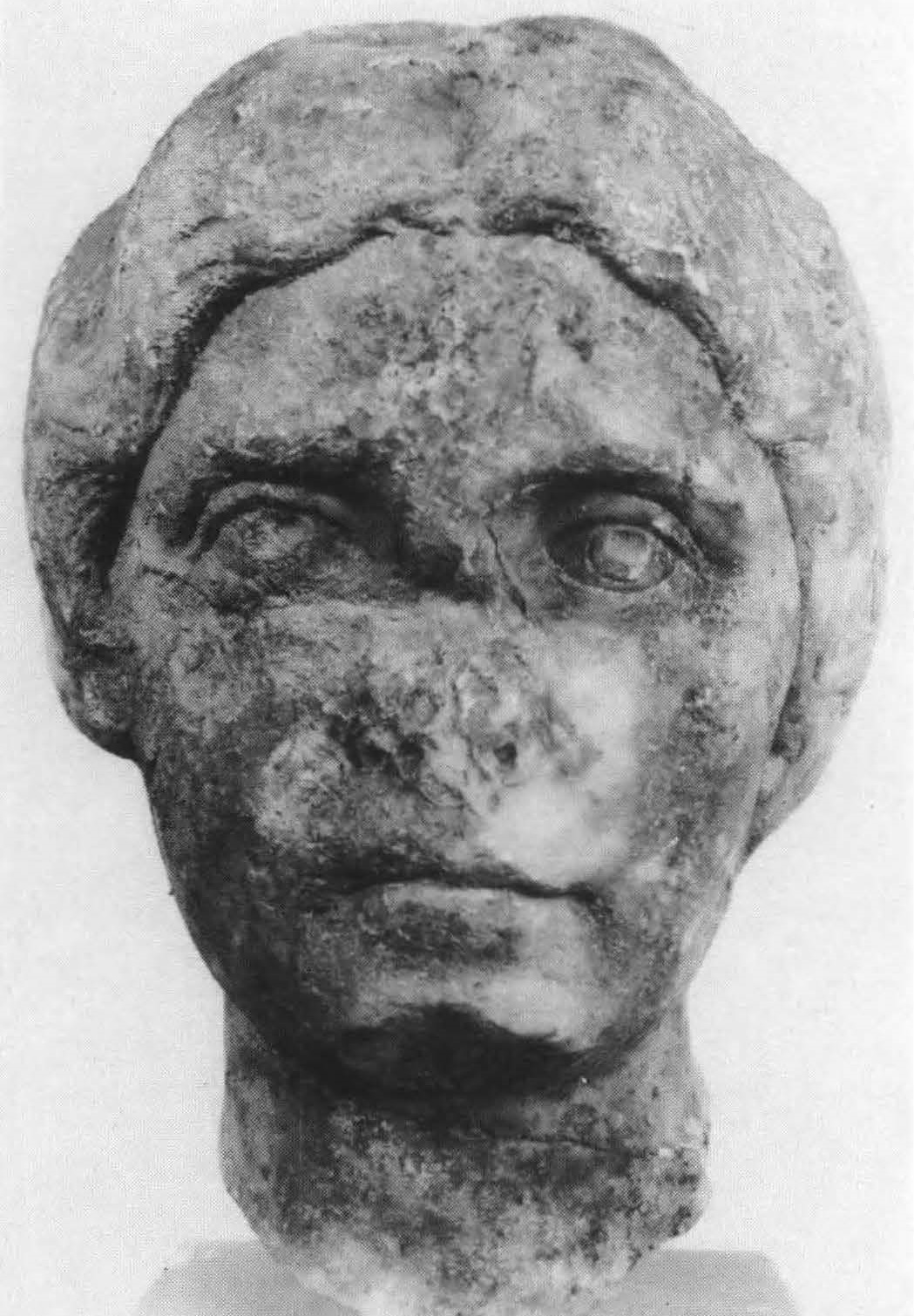
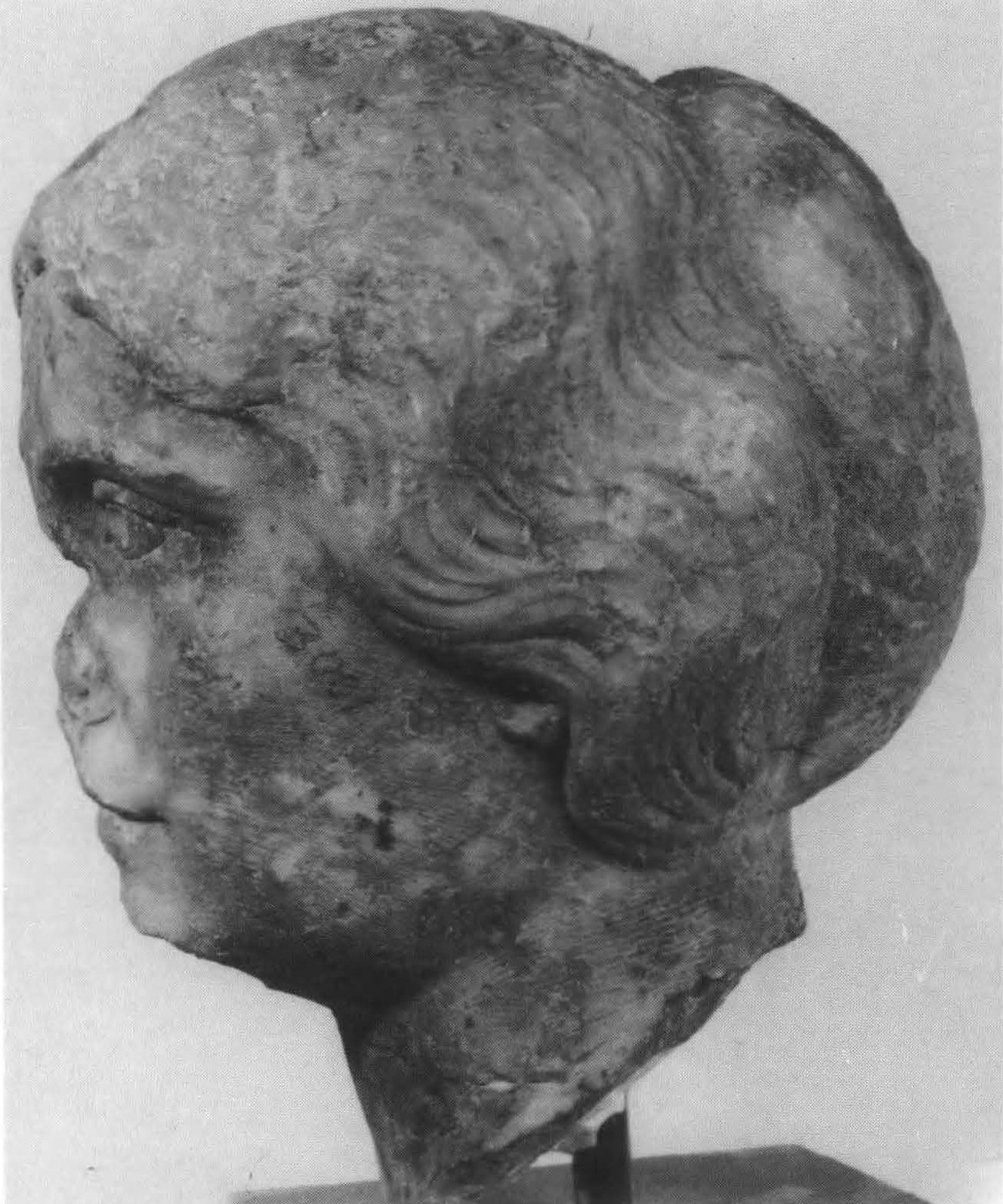
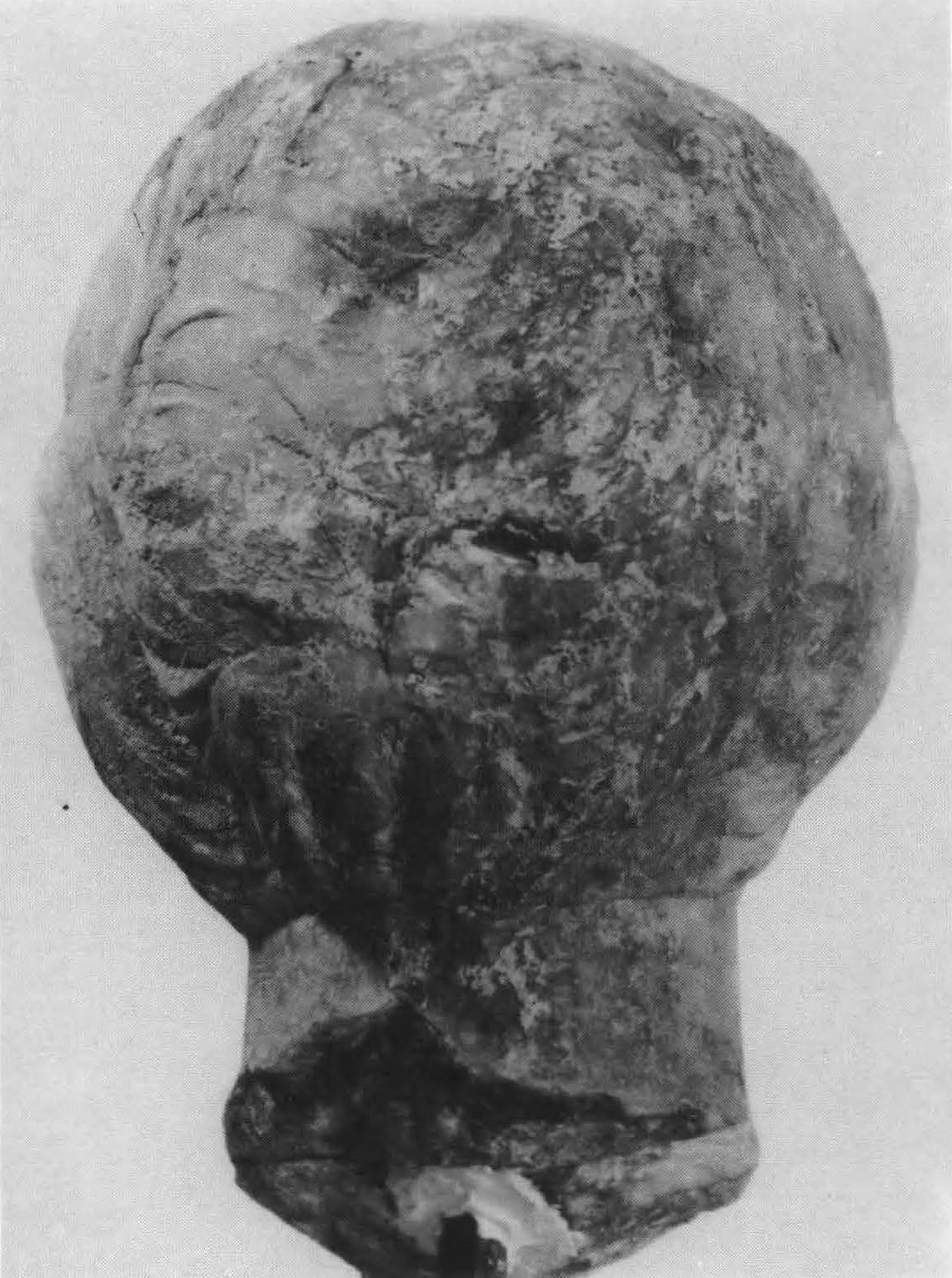
The head is preserved together with the neck (its lower part is mended). The nose (only the nostrils are preserved) and the chin are broken off. Smaller breaks and abrasions are evident on the neck, right eye, right cheek, eyebrows and headdress. Rasp marks remain on the face. It depicts a mature woman with an oval plump face, a thin mouth, broad eyebrows, and almond-shaped eyes with wide lids, and iris, pupil (heart-shaped), and tear-duct marked. The nasolabial folds are prominent. Wrinkles are present under the eyes, and diagonally at the corners of the mouth. The hair is parted at the center of the forehead and combed with gentle waves towards the sides and back, covering along the way the ears, except for the lobes (the texture of the individual locks of hair is given by shallow parallel grooves worked with the point). At the back of the head, a wide roughlyworked bun is formed from interlocking strands of hair. As I. Chioti (2012, 169) observes, the general shape of the headdress, and especially the size of the bun, is influenced by the second portrait type of Crispina, and indicates a dating in the decade 180-190 CE for the head (for the second portrait type of Crispina see K. Fittschen, Die Bildnistypen der Faustina minor und die Fecunditas Augustae, Göttingen 1982, 86-87, pls. 53-56).
K. Kourouniotis, “Εξ Αττικής”, ArchEph 1911, 256, fig. 32; A. Datsouli-Stavridi, “Πορτραίτα του Εθνικού Αρχαιολογικού Μουσείου”, ArchEph 1983, 205, no. 3001, pl. 72 (late Antonine period); Ι. Chioti, Αυτοκρατορικά και ιδιωτικά πορτρέτα της εποχής των Αντωνίνων στην Ελλάδα (PhD thesis Aristotle University of Thessaloniki), Thessaloniki 2012, 169, 365, cat. no. 221, pl. 178 (influenced by the second portrait type of Crispina).