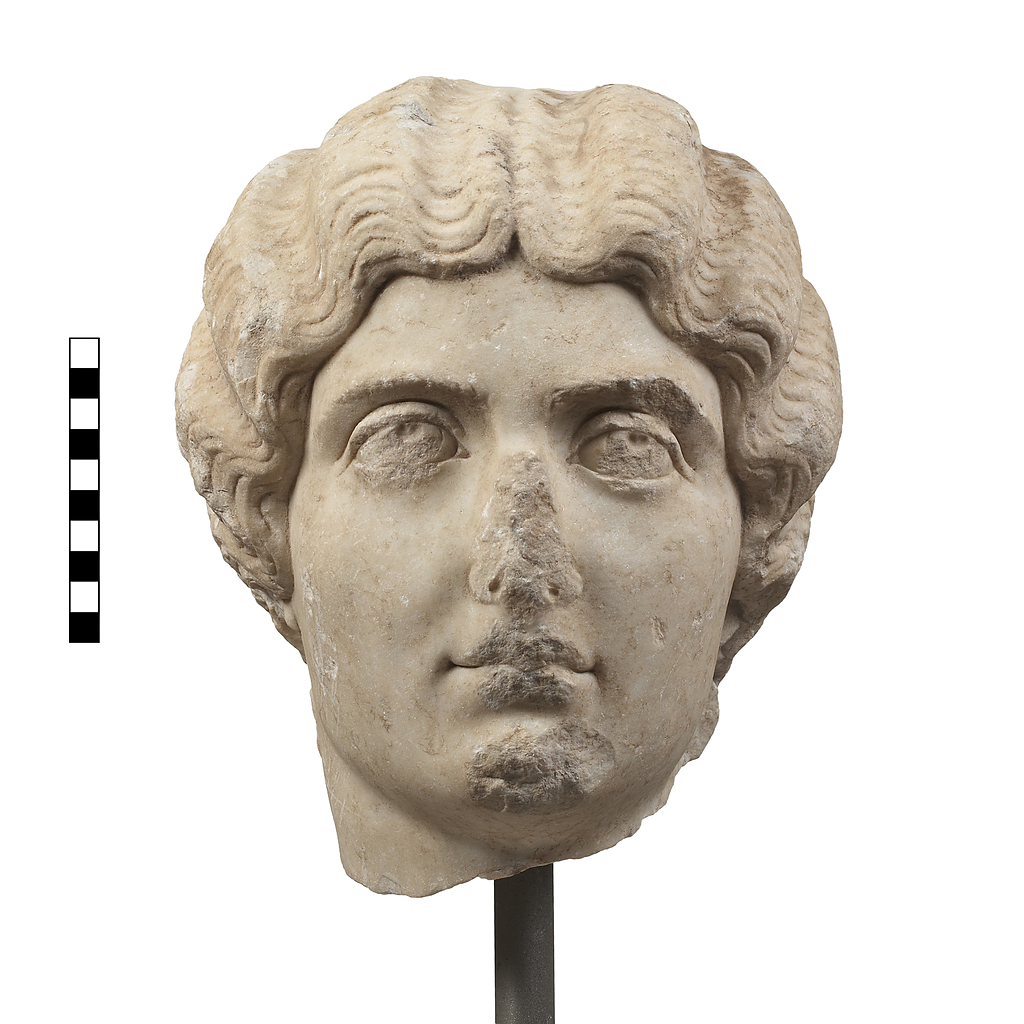
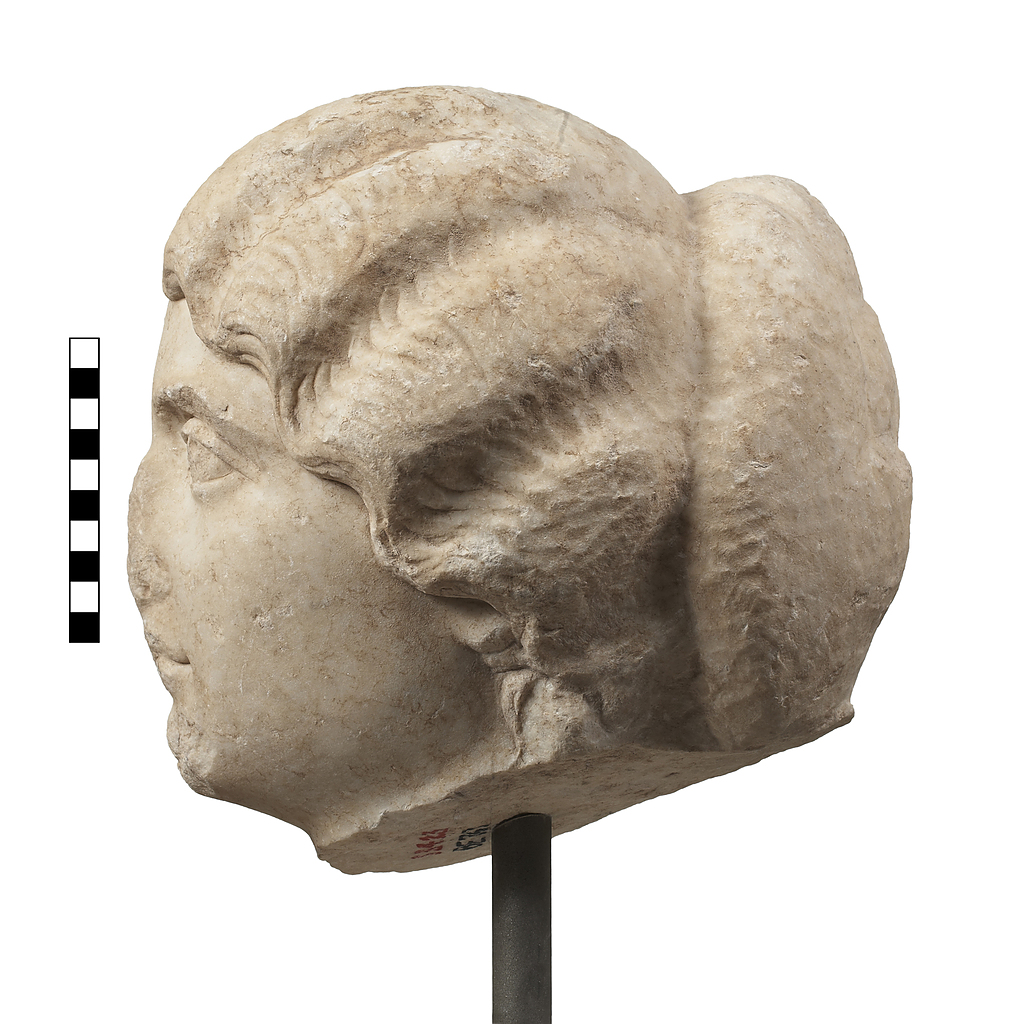
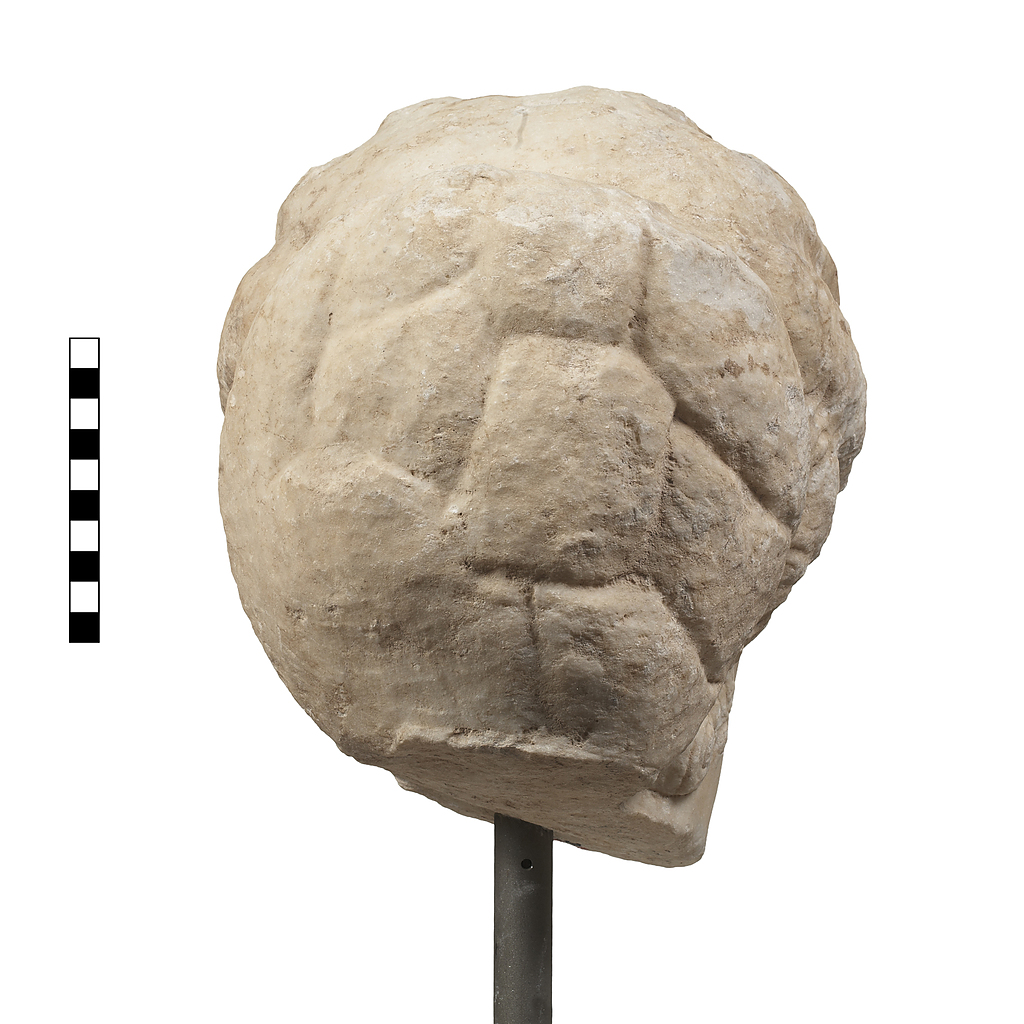
The head is well preserved; a small part of the neck also survives on the left. The nose, the central part of the mouth and the chin are broken off. Smaller breaks and chipping are evident on the surface of the left eyebrow, the eyes, as well as sporadically on the surface of the cheeks and coiffure. The head depicts a mature woman sporting an oval plump face and a robust neck. The eyes are almond-shaped, with wide upper eyelids (and overlapping lower eyelids at the outer edges) and marked iris and pupil (the latter by means of a small drill-hole). The eyebrows are thin with the texture of the individual hairs rendered by engraving. The drill has also been used to define the nostrils (two small drill-holes are just visible on the broken surface of the marble) and to delineate the corners of the mouth. The coiffure is divided at the top of the forehead into two equal parts that are combed in wide waves towards the nape (covering almost completely the ears), where they are woven into a wide bun that occupies the entire back of the skull. Quadrangular shapes chiseled out on the surface of the bun indicate the texture of the individual locks of hair, while the latter on the front part of the coiffure is indicated by the engraving of parallel lines with the point. The coiffure is left rough-worked at the back and upper part of the head, indicating that they were not meant to be seen. On the left part of the neck, below the ears, three small spiral locks of hair are left free on the surface of the marble. The coiffure draws upon mid and late-Antonine iconographic protypes. The undulating hair mass with the raised parting along the central upper part of the head are featured in Lucilla’s second iconographic type, dated to ca. 166 CE (see K. Fittschen, Die Bildnistypen der Faustina minor und die Fecunditas Augustae, Göttingen 1982, 70, 78-79), while the wide woven bun that covers the whole of the back of the head follows the second portrait type of Crispina, dated to ca. 180 CE. (Fittschen 1982, 86-87, pls. 53-56). As already noted by S. Dillon (2023, 18), the coiffure is also close to the portrait of an Antonine princess (possibly the sister of Lucius Verus), as exemplified in the Capitoline portraits inv. nos. Sala delle Colombe 62 (inv. 336) and Antiquarium 6269 (K. Fittschen, P. Zanker, Katalog der römischen Porträts in der Capitolinischen Museen und den anderen kommunalen Sammlungen der Stadt Rom III, Mainz am Rhein 1983, 26-27, cat. nos. 26-27, pls. 35-37, mid-Antonine period).
L.A. Riccardi, “Roman Portraits from the Athenian Agora: Recent Finds”, in J.McK. Camp, C.A. Mauzy eds., The Athenian Agora: New Perspectives on an Ancient Site, Mainz am Rhein 2009, 57, fig. 56 (last quarter of the 2nd c. CE, late Antonine or early Severan period; the eyes were intentionally damaged); L. Gawlinski, Η Αρχαία Αγορά της Αθήνας. Οδηγός του Μουσείου, Athens 2014, 85; L.A. Riccardi, “Homage and Abuse: Three Portraits of Roman Women from the Athenian Agora”, in K. Daly, L.A. Riccardi eds., Cities Called Athens: Studies Honoring John McK. Camp II, London 2015, 326-329 (200-210 CE; the eyes were intentionally damaged); S. Dillon, “Female Portrait Statuary in Roman-period Athens: The Epigraphic and Sculptural Evidence”, Eugesta 13 (2023), 18, figs. 15-18; https://agora.ascsa.net/id/agora/object/s%203423?q=S3423&t=&v=list&sort=&s=2