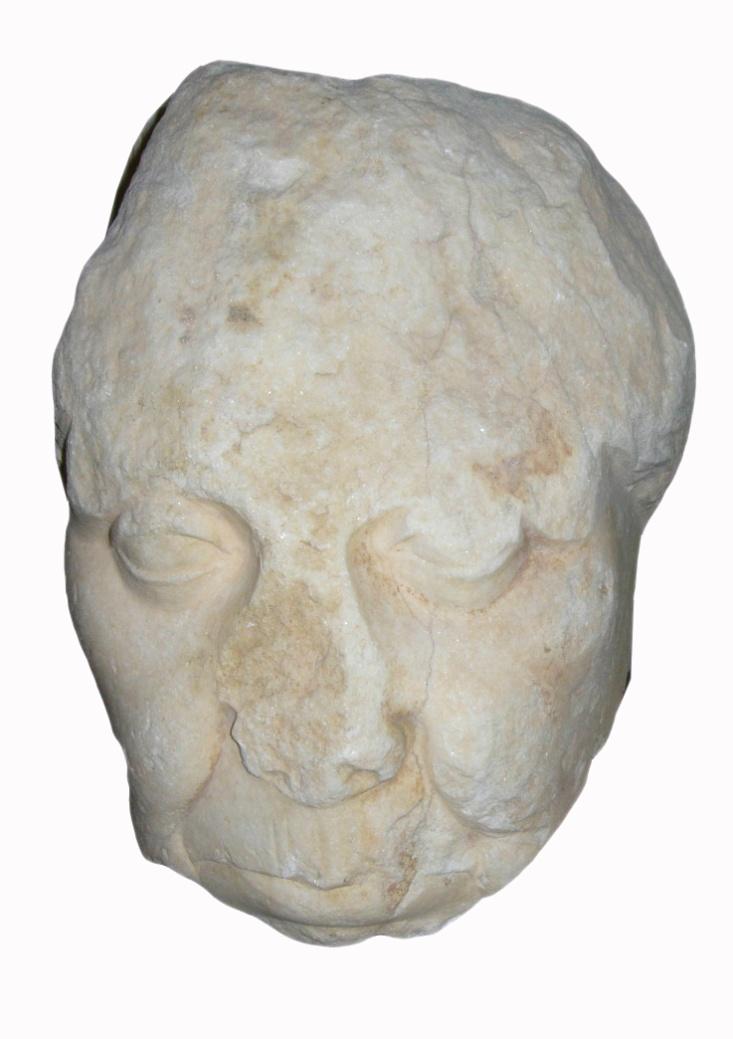
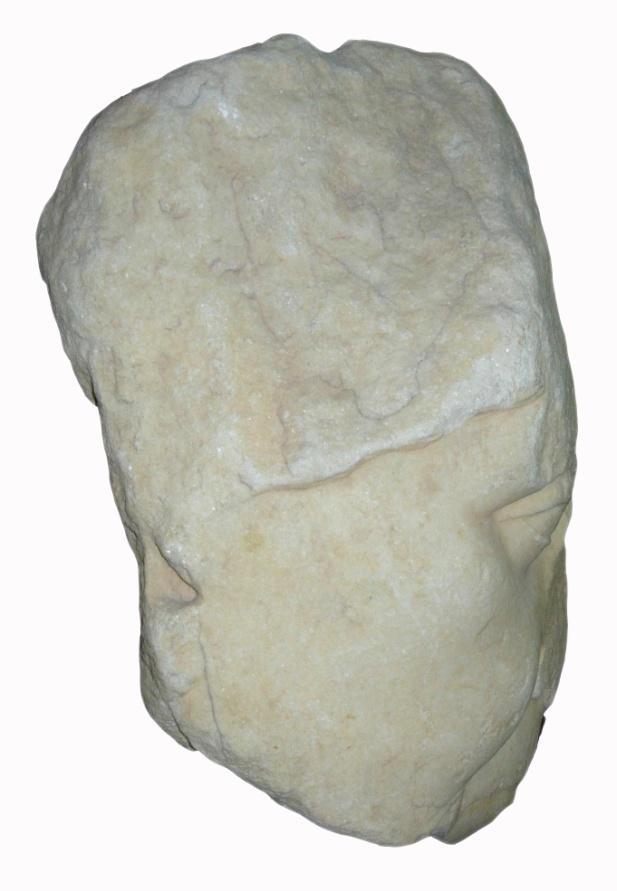
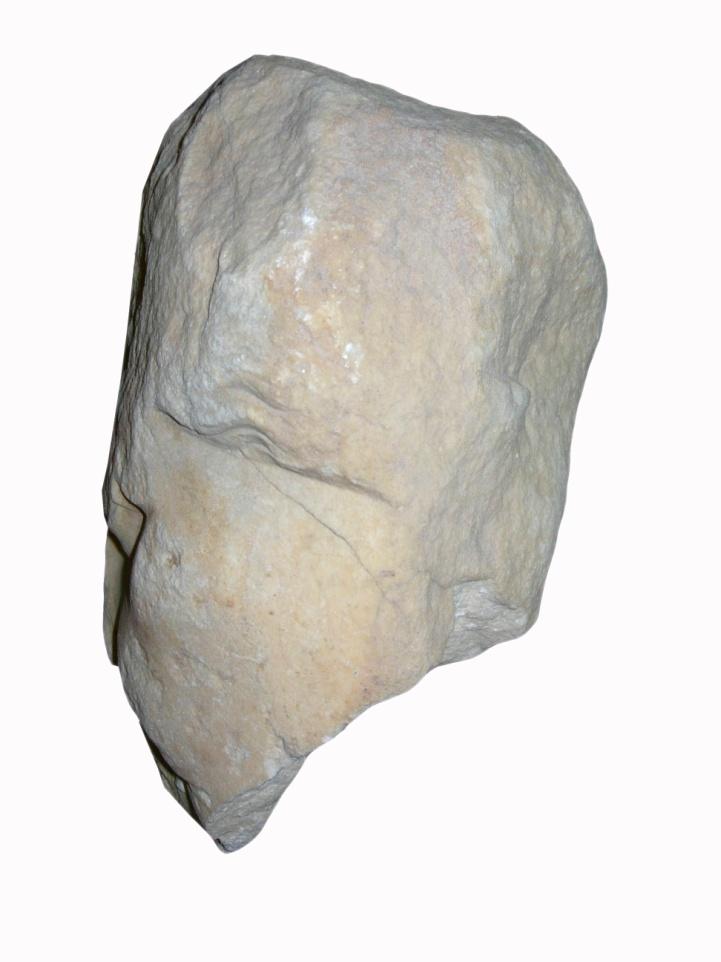
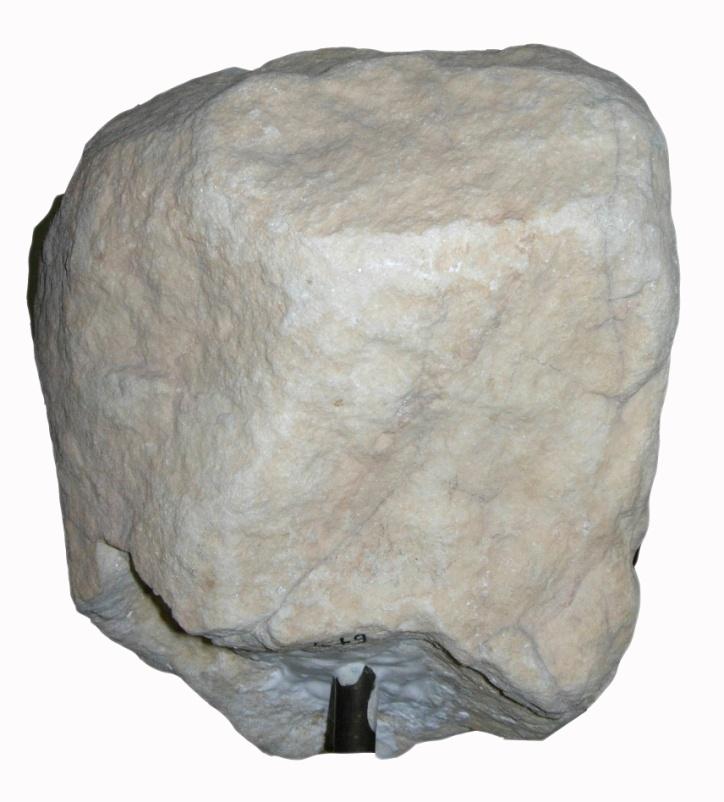
Only the face survives, from eye level to below the mouth. The rest of the head is broken (all breakage surfaces are heavily weathered). The upper part of the nose is also broken off. The eyes are large and bulging, with wide lids. Features of advanced age are particularly accentuated. Wrinkles are present at the outer corners of the eyes, and on the upper lip, just below the nostrils, while the nasolabial folds are prominent. The drill has been used for the rendering of the nostrils, while the iris and pupil of the eyes would be rendered in paint. Only a small part of the hair is preserved just above the left ear; it consists of parallel wavy locks. The portrait belongs to the so-called “veristic” tradition of self-representation (for this trend, which at large characterizes the portrait tradition of Italy, see M. Papini, Antichi volti della reppublica. La ritrattistica in Italia centrale tra IV e il II secolo a.C., Roma 2004 [BullCom Suppl. 9]; W.R. Megow, Republikanische Bildnis-Typen, Frankfurt am Main/New York 2005 [ibid. for specific “types” within the tradition]). Given that in Greece portraits of this type are not common, and are usually encountered in the 1st c. BCE in areas with important Italian communities, such as in Delos or Athens (for “veristic” portraits from Greece see J.F. Croz, Les portraits sculptés des Romains en Grèce et en Italie de Cynoscéphales à Actium (197-31 av. J.-C.). Essai sur les perspectives idéologiques de l'art du portrait, Paris 2002; see also P. Konstantinidis, “Ο γλυπτός διάκοσμος της Βασιλικής Στοάς στη Θήρα”, in D. Damaskos, P. Karanastasi, Th. Stephanidou-Tiveriou eds., Πλαστική στη ρωμαϊκή Ελλάδα: νέα ευρήματα και νέες έρευνες, διεθνές αρχαιολογικό συνέδριο, Αθήνα, 12-14 Δεκεμβρίου 2019, Athens 2022, 168-169, figs. 8-9 [male bust]), the depicted is probably a Roman or a descendant of Romans. The findspot of the piece, within the sanctuary of Demeter and Kore, indicates that it was probably part of a portrait statue of an eminent initiate of the Mysteries (for Roman initiates in Eleusis from the late Hellenistic period onwards, see K. Clinton, “The Eleusinian Mysteries: Roman Initiates and Benefactors, Second Century B.C. to A.D. 267,” ANRW II [1989], 1499-1539). Although the possibility of her identification as a priestess of Demeter and Kore cannot be ruled out, it nevertheless does not seem very likely, since priestesses could only come from certain Athenian gene (see K. Clinton, “The Sacred Officials of the Eleusinian Mysteries”, TAPS 64 (1974), 74; ibid. 72-74 for the attested priestesses of the 1st c. BCE, where the head also belongs). Based on the best parallels, the head can be dated to the early principate of Augustus (see Kalavria 2015, 256-257). Hence, it is possible, due also to her advanced age, that the woman depicted chose a veristic portrait, i.e. an older form of self-representation, which also reflected her Italian origins.
P. Kavvadias, “Αρχαία εισαχθέντα εις το Εθνικόν Μουσείον», ArchDelt 1888, 177, no. 5; P. Kavvadias, Γλυπτά του Εθνικού Μουσείου: κατάλογος περιγραφικός, Athens 1890, 277, no. 472; P. Kastriotis, Γλυπτά του Εθνικού Μουσείου: κατάλογος περιγραφικός, Athens 1908, 80, nos. 470-472; G.M.A. Richter, “The Origin of Verism in Roman Portraits”, JRS 45 (1955), 36 with note 53, 45, pl. 9; E. Kalavria, Αττικά πορτρέτα κατά την εποχή της ρωμαιοκρατίας (1ος αι. π.Χ. - αρχ. 2ου αι. μ.Χ.), ζητήματα τυπολογίας, λειτουργίας και παραγωγής (PhD thesis National and Kapodistrian University of Athens), Athens 2015, 256-257, 481, cat. no. 81, pl. 81 (early principate of Augustus).