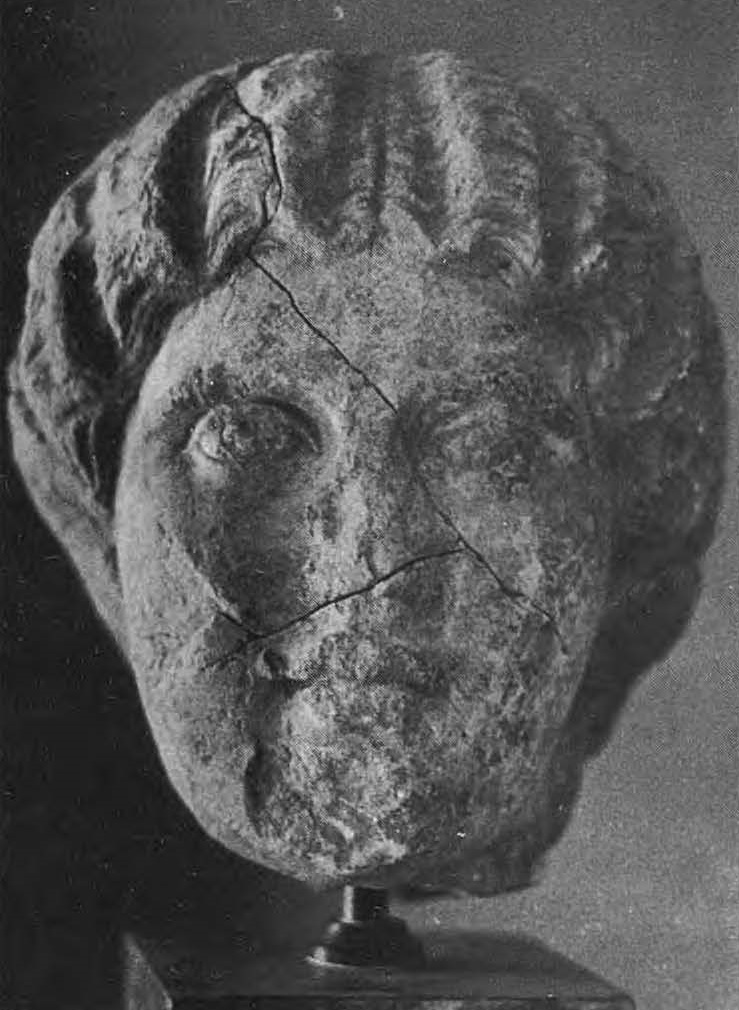
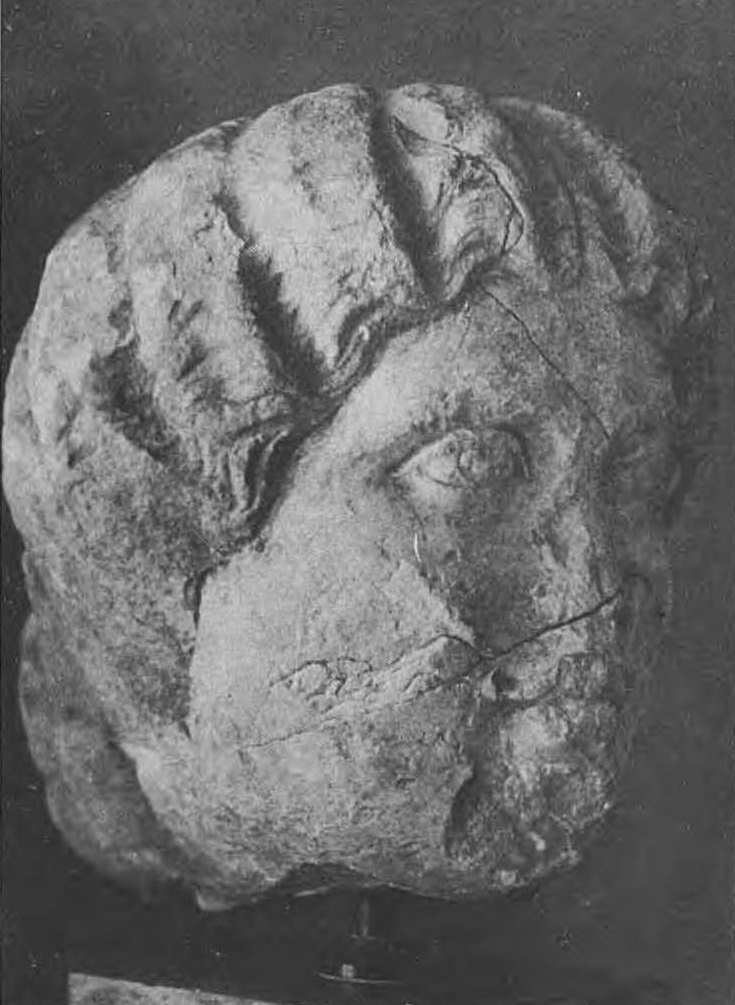
The head (put back together from three fragments) is preserved with a small part of the neck. The nose, chin, eyebrows and partially the eyes and mouth are broken. Smaller breaks and chipping are evident on the cheeks and coiffure, especially on the right side and bun at the back. It depicts a young woman with an oval plump face, broad forehead and smooth cheeks. The mouth is narrow, with fleshy lips. The eyebrows are long, the eyes large, almond-shaped with thin lids. The pupil and tear-duct are indicated by shallow grooves, the iris is incised. The hair is divided at the top of the forehead into two equal parts, which are combed with strong waves to the sides and back, leaving only the earlobes uncovered. Small lunate locks of hair are left free on the surface of the neck, behind each ear. A large round bun is formed low at the back of the head, surrounded by a thin twisted braid. Based on the analysis of I. Chioti, the coiffure follows contemporary imperial protypes, in particular the fifth portrait type of Faustina the Younger but with a more intense wavy pattern, as in the portraiture of Lucilla, while other elements, such as the thin twisted braid that surrounds the bun, are found in the ninth portrait type of Faustina the Younger and in the portraiture of Crispina, indicating a dating in the period 166-180 CE for the head. According to K. Fittschen, the head shows a physiognomic (plump oval face, broad forehead, large almond-shaped eyes, long eyebrows, small fleshy mouth and a tendency to a double-chin) and typological affinity to the bust in the Capitoline Museum, Palazzo Nuovo, Sala X 34 inv. no. 203 (Fittschen - Zanker 1983, 79 cat. no. 105 pls. 132-133). Hence, the sculptor, working in a Roman colony, must have had in mind metropolitan protypes. I. Chioti (2012, 195) also observes influences from metropolitan workshops in other portraits from the city of Patras. In our opinion, the similarity between the two sculptures lies not so much in the physiognomy, which appears quite generic (the oval face with puffy cheeks is quite common in female portraiture from southern Greece), but in the combination of similar iconographic elements in the coiffure.
M. Wegner, Das Römische Herrscherbild II.4. Die Herrscherbildnisse in antoninscher Zeit, Berlin 1939, 25; A. Datsouli-Stavridi, “Εικονιστική κεφαλή Φαυστίνας της νεωτέρας εις το Μουσείον Πατρών”, ΑΑΑ 6.1 (1973), 163-169, figs. 1-2 (ca. 161 CE); A. Datsouli-Stavridi, “Πορτραίτα της εποχής των Αντωνίνων”, ΑrchΕph 1982, 224, 225; M. Wegner, R. Unger, “Verzeichnis der Kaiserbildnisse von Antonimus Pius bis Commodus II”, Boreas 3 (1980), 25; Κ. Fittschen, Die Bildnistypen der Faustina minor und die Fecunditas Augustae, Göttingen 1982, 81, note 44o; K. Fittschen, P. Zanker, Katalog der römischen Porträts in der Capitolinischen Museen und den anderen kommunalen Sammlungen der Stadt Rom III, Mainz am Rhein 1983, 79 note 7 in cat. no. 105 (K. Fittschen); I. Chioti, Αυτοκρατορικά και ιδιωτικά πορτρέτα της εποχής των Αντωνίνων στην Ελλάδα (PhD thesis Aristotle University of Thessaloniki), Thessaloniki 2012, 150, 155, 195, 344-345, cat. no. 187, pl. 153 (166-180 CE, influenced by portraits from the city of Rome); L. Kolonas, M. Stavropoulou-Gatsi, Το Αρχαιολογικό Μουσείο Πατρών, Athens 2017, 119, no. 39; P. Konstantinidis, Γυναικείοι δυναστικοί εικονιστικοί ανδριάντες αυτοκρατορικής περιόδου από την Ελλάδα (τέλη 1ου αι. π.Χ. – 5ος αι. μ.Χ.), Athens 2024, 223 note 187β.