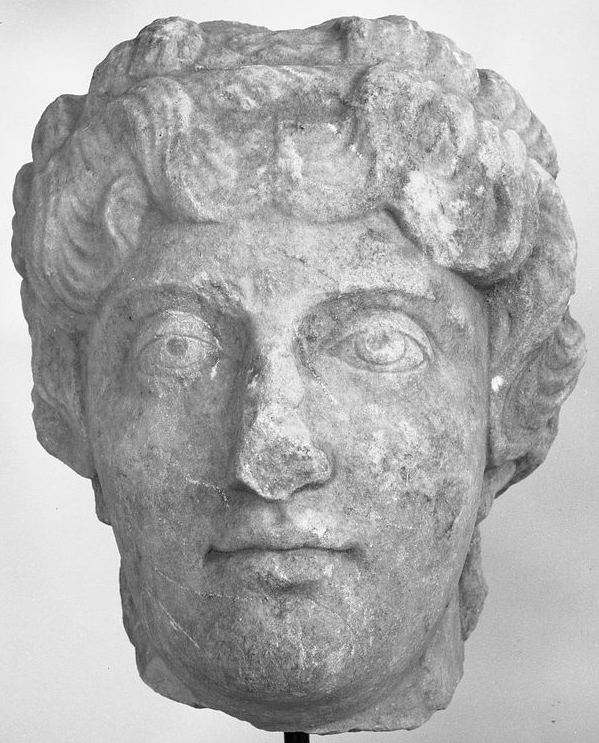
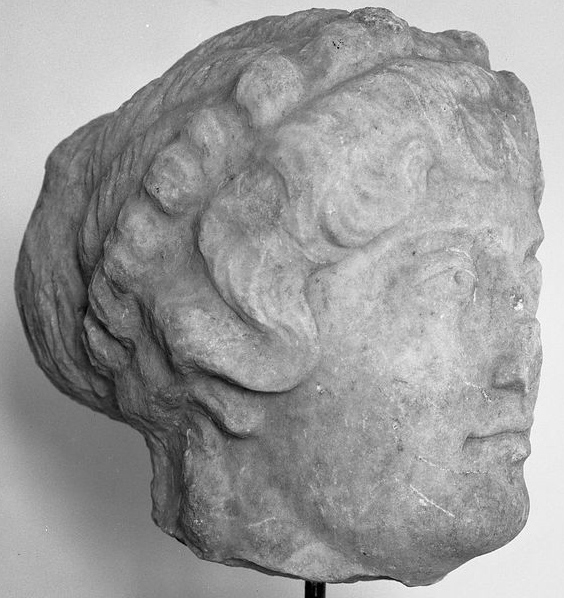
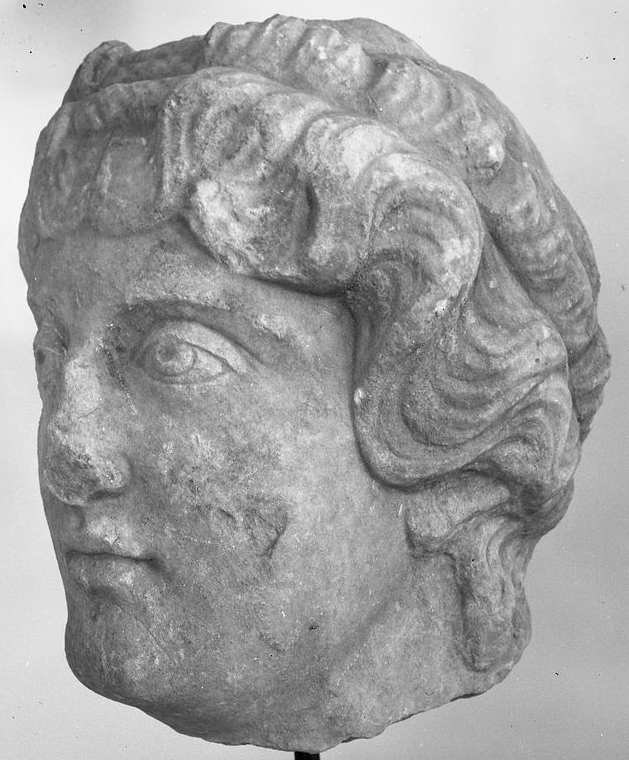
The head is well preserved, with part of the neck. Small breaks are evident on the tip of the nose, the forehead, cheeks, eyebrows and crown. It depicts a young woman with a plump oval face, smooth cheeks, a wide mouth with fleshy lips and large almond-shaped eyes with wide upper lids. The eyebrows are thin. The pupil, iris and lacrimal gland are indicated. There is a tendency to a double-chin. The hair is divided at the top of the forehead into two equal parts consisting of wide flat locks, which are directed to the sides and back covering the upper part of the ears (the outer edge of each lock is slightly raised and partially covers the next locks of hair on the right and left). Two thin braids around which other locks of hair are wrapped form the next part of the coiffure, while “slices” that are reminiscent of the “melon” hairstyle, ending in a wide bun, cover the back of the head. Two curly locks of hair are left free on the surface of the nape. The texture of the individual hairs is rendered with shallow incisions worked with the point on the surface of the marble. The structure of the broad locks of hair on the front part of the head, as well as the “slices” on the back of the skull, are reminiscent of the first portrait type of Faustina the Younger (cf. for example the head inv. no. 449 of the Capitoline Museum in Rome from Hadrian’s villa in Tivoli, Fittschen 1982, 44, no. 1, pl. 8.1-4), and the first portrait type of Lucilla (ca. 165 CE), while the structure of the middle section of the coiffure draws upon the seventh portrait type of the Faustina the Younger (ca. 161 CE; for the first and seventh portrait types of Faustina the Younger and the first of Lucilla see Fittschen 1982, 38, 42, 43, 44-48, 55-59, 75-77), dating the piece – based on the latest portrait type, to ca. 165 CE.
H. Robinson, “American Excavations at Corinth”, ArchDelt 19 (1964) Β1, 100, pl. 104a; G. Daux, “Chronique des fouilles et découvertes archéologiques en Grèce en 1963”, BCH 88 (1964), 702-703, εικ. 3; Α. Datsouli-Stavridi, “Εικονιστική κεφαλή της Φαυστίνας της νεότερης στο Μουσείο Πατρών”, ΑΑΑ 6 (1973), 168; C. De Grazia Vanderpool, Excavations of the American School of Classical Studies at Corinth. The Roman Portraiture (PhD thesis Columbia University), New York 1973, 28-29, 163-167, cat. no. 32, pls. 44-45 (Faustina the Younger); M. Wegner, R. Unger, “Verzeichnis der Kaiserbildnisse von Antoninus Pius bis Commodus II”, Boreas 3 (1980), 19; K. Fittschen, Die Bildnistypen der Faustina minor und die Fecunditas Augustae, Göttingen 1982, 59 note 42; C. De Grazia Vanderpool, “Roman Portraiture. The Many Faces of Corinth”, in C.K. Williams II, N. Bookidis eds., Corinth XX. Corinth, The Centenary, 1896-1996, Princeton 2003, 374 fig. 22.6 (Faustina the Younger); I. Chioti, Αυτοκρατορικά και ιδιωτικά πορτρέτα της εποχής των Αντωνίνων στην Ελλάδα (PhD thesis Aristotle University of Thessaloniki), Thessaloniki 2012, 357-358, cat. no. 209, pl. 170 (influenced by the seventh iconographic type of Faustina the Younger, 160-170 CE); P. Konstantinidis, Γυναικείοι δυναστικοί εικονιστικοί ανδριάντες αυτοκρατορικής περιόδου από την Ελλάδα (τέλη 1ου αι. π.Χ. – 5ος αι. μ.Χ.), Athens 2024, 246-247, no. 3, figs. 57-59; https://corinth.ascsa.net/research?q=2702&t=&v=list&sort=&s=17