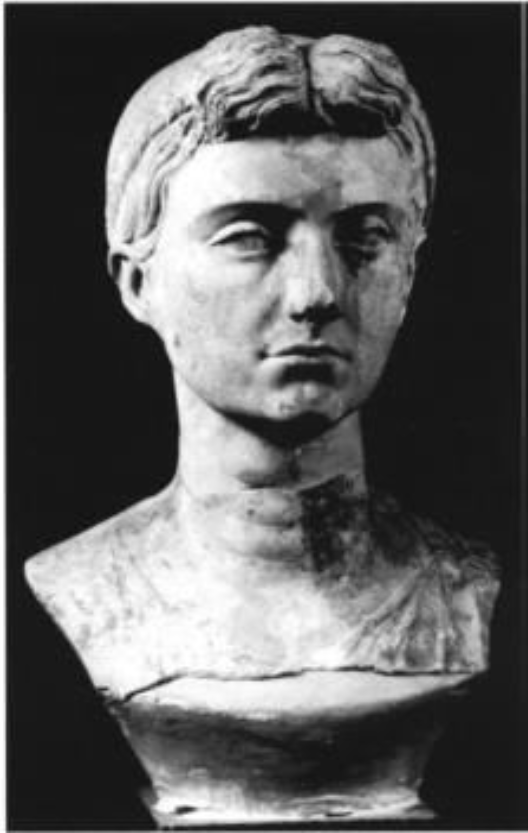
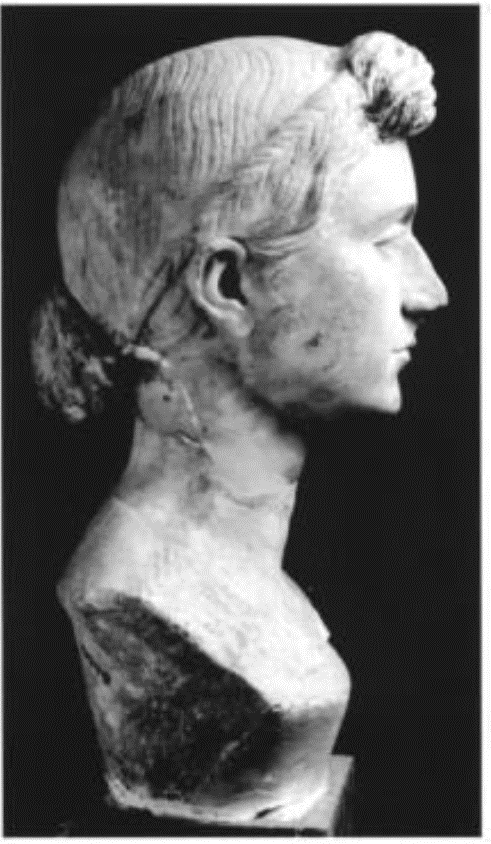
Most of the bust is preserved, with the exception of the front part of the chest and part of the neck. Put together from several fragments and completed with plaster. Smaller breaks and chipping are evident sporadically on the surface of the marble. It depicts a young woman wearing a chiton, fastened at the shoulders with four small circular buttons (two on either shoulder). The face is oval, the eyebrows are thin (ending in sharp ridges), the eyes are almond-shaped with wide lids. The mouth is wide with a fleshy lower lip. The neck is thin and tall, bearing “rings of Venus”, indicated by parallel shallow incisions. The face is smooth. The coiffure sports at the top of the forehead two wide contrasting tufts, clearly inspired by the nodus, typical of female coiffure of the Late Republic and Early Empire (see in brief Raftopoulou 2010, 185). From the sides of the tufts, start elongated, curved locks of hair, rendered flat on the surface of the marble, ending at the ears. Also from the tufts, but from a bit higher, start two thin braids which are directed towards the back of the head, where they form a small round bun, placed low at the nape. The rest of the coiffure is combed in slightly curved, rendered flat on the surface of the marble, locks. Two small, lunate locks of hair fall freely on the surface of the temples. A dating at the end of the 1st c. BCE or the beginning of the 1st c. CE is also indicated by the size and shape of the bust (cf. T.A. Motz, The Roman Freestanding Portrait Bust: Origins, Context and Early History [Ph.D. Thesis, University of Michigan], Ann Arbor 1993, 45-49; on the dating of busts based on form see also R.R.R. Smith ed., Aphrodisias II. Roman Portrait Statuary from Aphrodisias, Mainz am Rhein 2006, 227 with note 10 [R.R.R. Smith]). The lack of a tenon on the back of the bust and the rough treatment of the rear surface do not necessarily indicate that the work was intended for insertion into a herm shaft, although this possibility cannot be excluded (cf. e.g. the herm portrait busts from the sanctuary of Diana Nemorensis in Nemi, J. Fejfer, Roman Portrait in Context, Berlin 2008, pls. 34c-d, 35c-d; although the inclination of the body is quite different from the Sparta bust). However, it is also possible that the bust was free-standing, as is the case with the almost contemporary bust of a young man from the Basilike Stoa of Thera, which is essentially the same size, and where the tenon at the back is also absent, being solid (see P. Konstantinidis, “Ο γλυπτός διάκοσμος της Βασιλικής Στοάς στη Θήρα”, in D. Damaskos, P. Karanastassi, Th. Stepahanidou-Tiveriou eds., Πλαστική στη ρωμαϊκή Ελλάδα: νέα ευρήματα και νέες έρευνες, διεθνές αρχαιολογικό συνέδριο, Αθήνα, 12-14 Δεκεμβρίου 2019, Thessaloniki 2022, 168-169, figs. 8-9, second half of the 1st c. BCE).
A. Datsouli-Stavridi, “Ρωμαϊκά πορτραίτα στο Μουσείο Σπάρτης”, in Πρακτικά του Α’ Τοπικού Συνεδρίου Λακωνικών Μελετών, Μολάοι 5-7 Ιουνίου 1982 (Peloponnesiaka Suppl. 9), Athens 1982-1983, 301-302, fig. 1 (the fig. is misplaced); A. Datsouli-Stavridi, Ρωμαϊκά πορτραίτα στο Μουσείο της Σπάρτης, Athens 1987, 16, without inv. no., figs. 5-8 (period of Plautilla); S. Raftopoulou, “A Maiden from Sparta”, in F. McFarlane, C. Morgan eds., Exploring Ancient Sculpture. Essays in Honour of Geoffrey Waywell, London 2010, 181-194 (product of an Attic workshop; destined to be inserted into a herm shaft; last quarter of the 1st c. BCE; possibly a portrait of Julia the Elder, the daughter of Augustus); P. Konstantinidis, Γυναικείοι δυναστικοί εικονιστικοί ανδριάντες αυτοκρατορικής περιόδου από την Ελλάδα (τέλη 1ου αι. π.Χ. – 5ος αι. μ.Χ.), Athens 2024, 32 note 79, 219 note 157β.