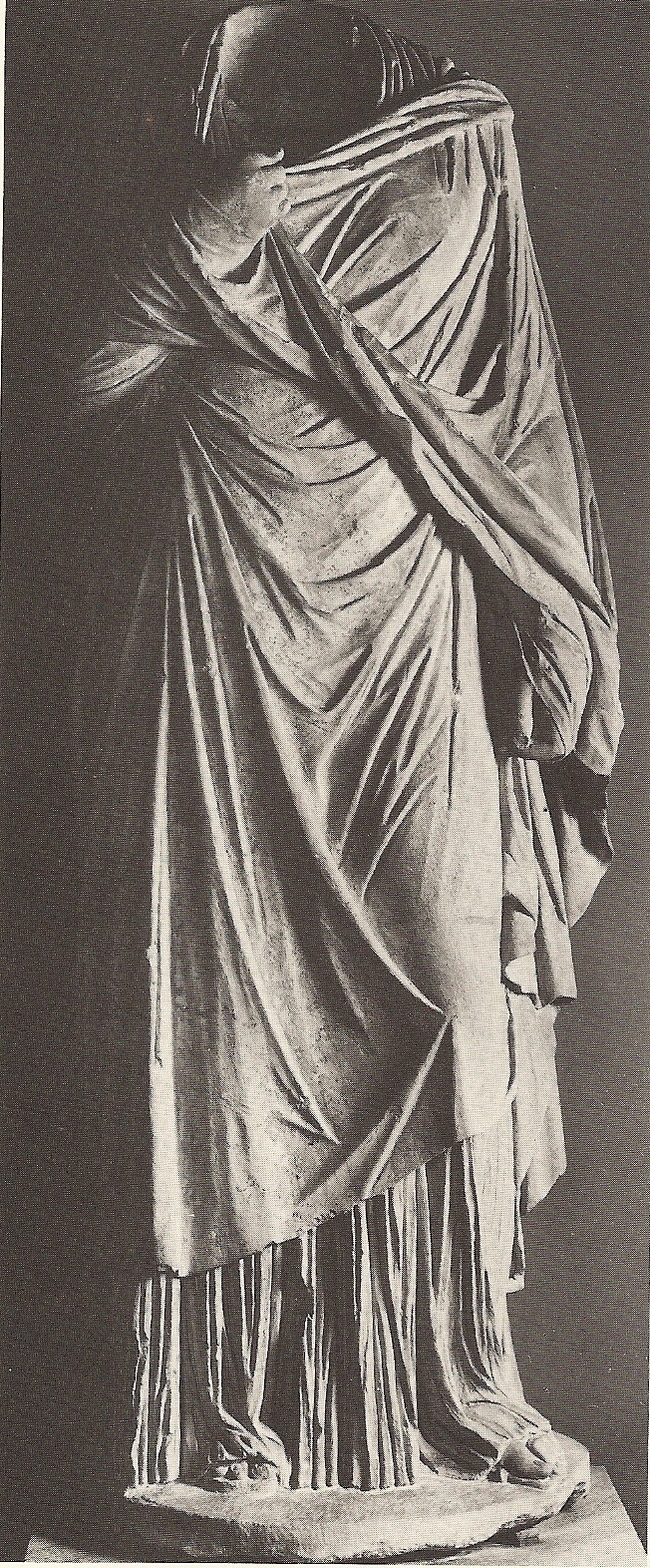
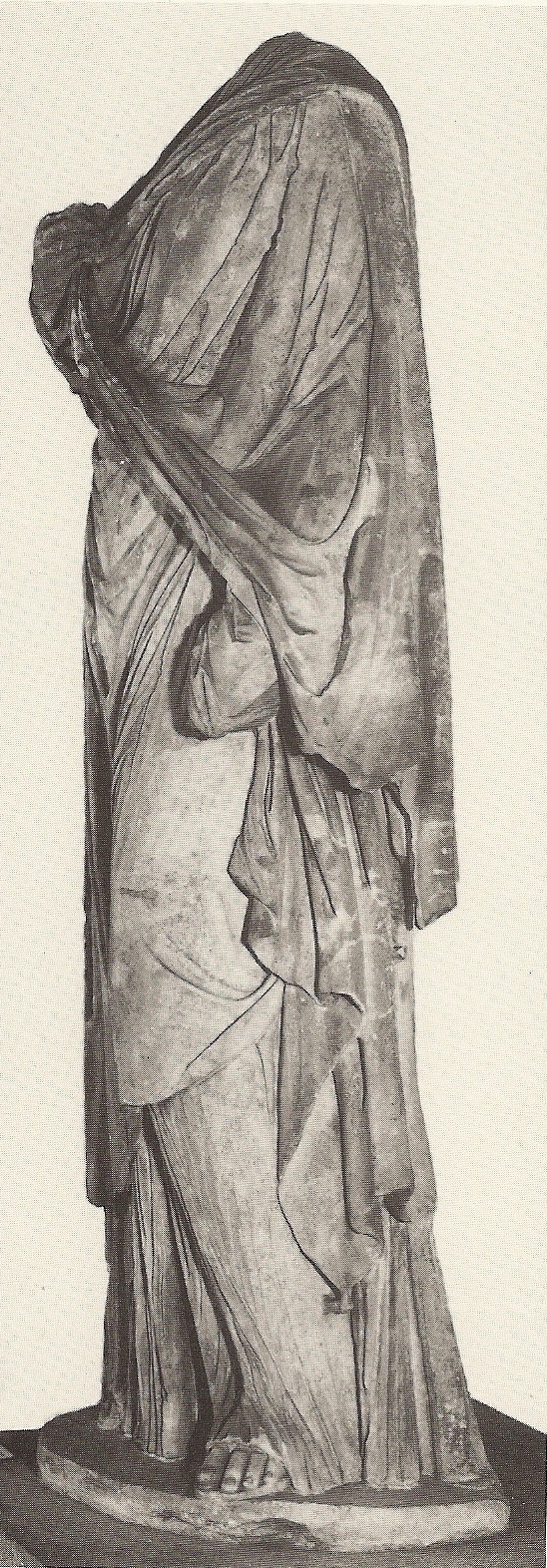
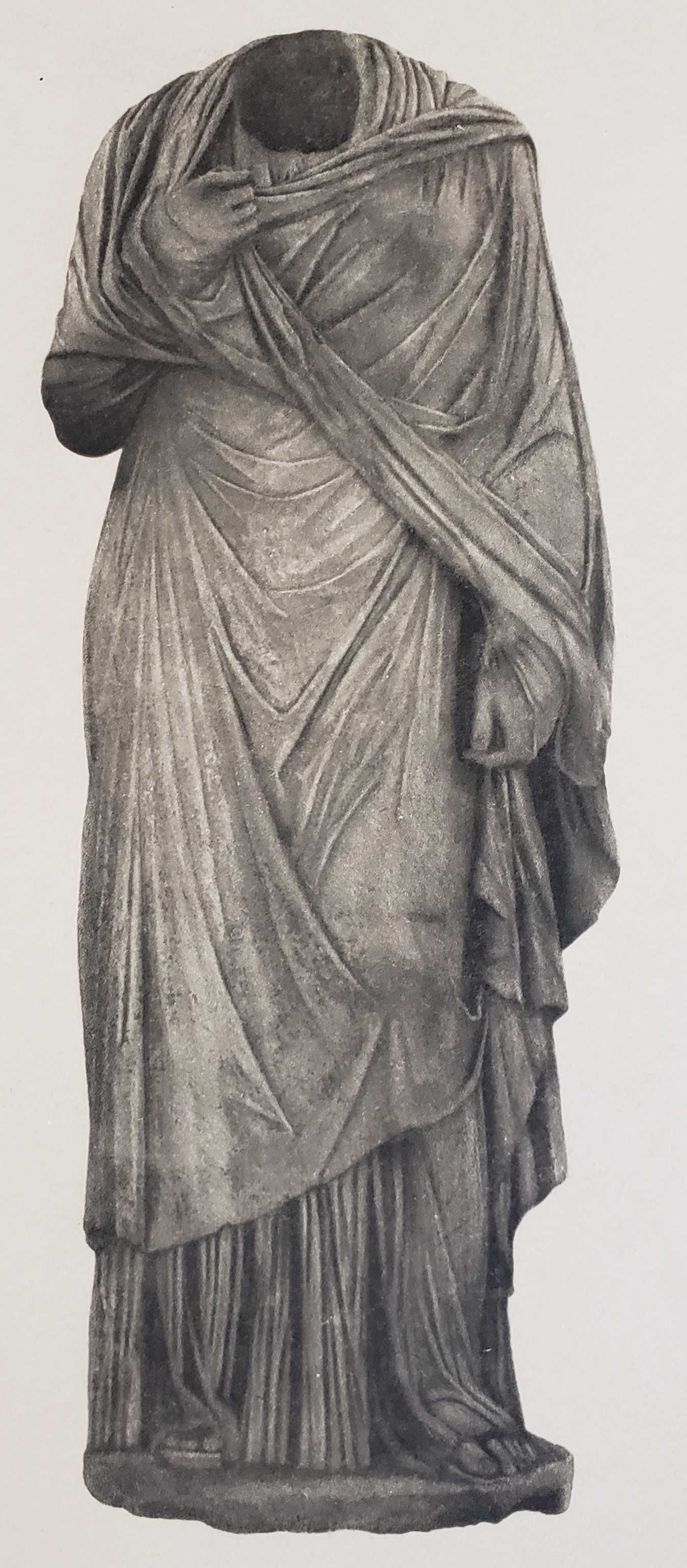
The statue is very well preserved (only the inset head is missing). Minor breaks and chipping are evident on the fingers of the hands, as well as sporadically on the drapery of the garments. The back surface is coarsely worked. It depicts a standing (on a circular plinth) frontal female figure who wears a long chiton, a wide himation that wraps tightly around the body and sandals. The himation does not cover the head. The weight of the body is carried on the right leg, while the left is slightly bent. The lowered left hand holds the himation. The statuary type of the “Large Herculaneum Woman” is faithfully replicated. The edges of the himation are held by the hands of the figure forming the characteristic of the statuary type triangle on the right side of the torso. R. Bol identifies the figure with the empress Sabina, the wife of Hadrian (an inscribed base for the empress is not preserved; for the empress’ iconography see P. Konstantinidis, Γυναικείοι δυναστικοί εικονιστικοί ανδριάντες αυτοκρατορικής περιόδου από την Ελλάδα [τέλη 1ου αι. π.Χ. – 5ος αι. μ.Χ.], Athens 2024, 382), and places it in the fourth niche from the right of the ground floor of the Nymphaeum’s exedra. Conversely, K. Hitzl and A. Kropp (2013) place the statue in the fourth from the left niche of the upper floor of the Nymphaeum’s exedra.
G. Treu, Olympia III. Die Bildwerke von Olympia in Stein und Thon, Berlin 1894, 261 fig. 293, 274, pl. 67.2; C. Blümel, Römische Kopien griechischer Skulpturen des vierten Jahrhunderts v. Chr., Berlin 1938, 30 cat. no. Κ248, pl. 67; H. Kruse, Römische weibliche Gewandstatuen des zweiten jahrhunderts n.Chr., Göttingen 1975, 56-57, 176, 260 no. 29, 285 cat. no. B31; R. Bol, Das Statuenprogramm des Herodes-Atticus-Nymphäums, OlForsch 15, Berlin 1984, 175, cat. no. 38, pl. 38 (Sabina); A. Alexandridis, Die Frauen des römischen Kaiserhauses: eine Untersuchung ihrer bildlichen Darstellung von Livia bis Iulia Domna, Mainz am Rhein 2004, 188-189 note 1, 239, no. 27; J. Trimble, Women and Visual Replication in Roman Imperial Art and Culture, Cambridge 2011, 125-126, 366-367, no. 7; Κ. Hitzl, A. Kropp, “Das Heiligtum von Olympia im 2. Jh. n. Chr. - Alte und neue Impressionen”, Boreas 36 (2013), 53-89; A. Scholl ed., Katalog der Skulpturen in der Antikensammlung der Staatlichen Museen zu Berlin, I: Griechische und römische Bildnisse, Berlin 2016, 319-321, cat. no. 215 (R. Bol); P. Konstantinidis, Γυναικείοι δυναστικοί εικονιστικοί ανδριάντες αυτοκρατορικής περιόδου από την Ελλάδα (τέλη 1ου αι. π.Χ. – 5ος αι. μ.Χ.), Athens 2024, 171, note 268;
https://arachne.dainst.org/entity/1120914?fl=20&q=Sk%201398&resultIndex=1