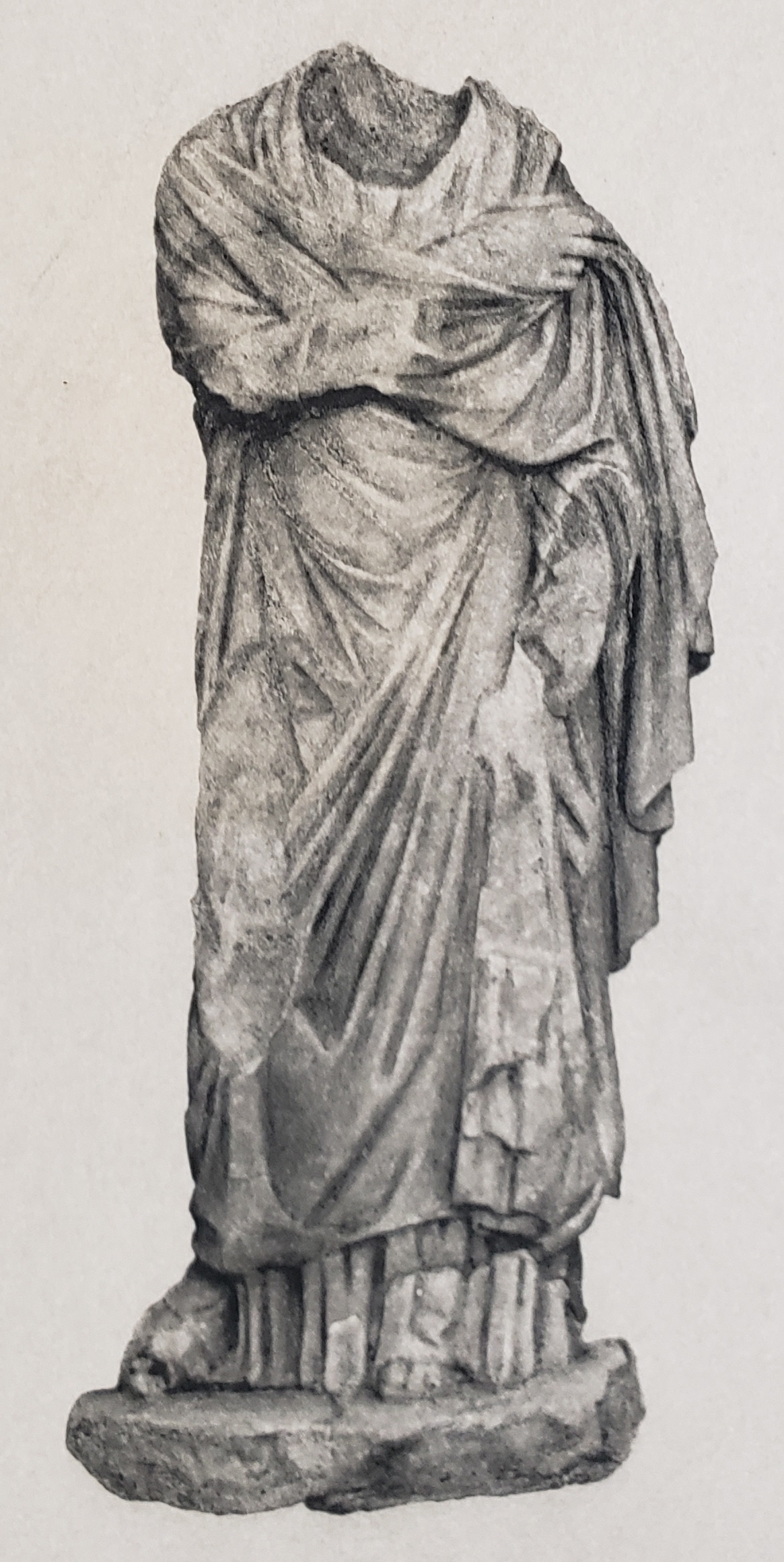
The body of the figure is preserved, put together from several fragments. Missing are the inset head, part of the right arm in the elbow area, as well as a small part of the right knee and of the himation along the left thigh. Smaller breaks and chipping are evident sporadically on the surface of the marble. It depicts a standing (on a rectangular plinth) frontal female figure, wearing a long chiton, a wide himation that is wrapped tightly around the body, and sandals. It faithfully replicates the statuary type of the so-called “Small Herculaneum Woman”. The statue was originally attributed to the sculptural decoration of the Nymphaeum of Herodes Atticus by G. Treu, who identified it as a portrait of Athenais, Herodes’ daughter (Treu 1894, 275; see also Schleif - Weber 1944, 58, pl. 25b). However, the style and workmanship of the statue does not seem to match the rest of the portrait-statues of the Nymphaeum, probably indicating that the statue was not part of the latter’s statuary program.
G. Treu, Olympia III. Die Bildwerke von Olympia in Stein und Thon, Berlin 1894, 275, pl. 68.3 (Athenais); H. Schleif, H. Weber eds., “Das Nymphaeum des Herodes Atticus”, OlForsch I, Berlin 1944, 58, pl. 25b; A. Alexandridis, Die Frauen des römischen Kaiserhauses: eine Untersuchung ihrer bildlichen Darstellung von Livia bis Iulia Domna, Mainz am Rhein 2004, 246, no. 72.