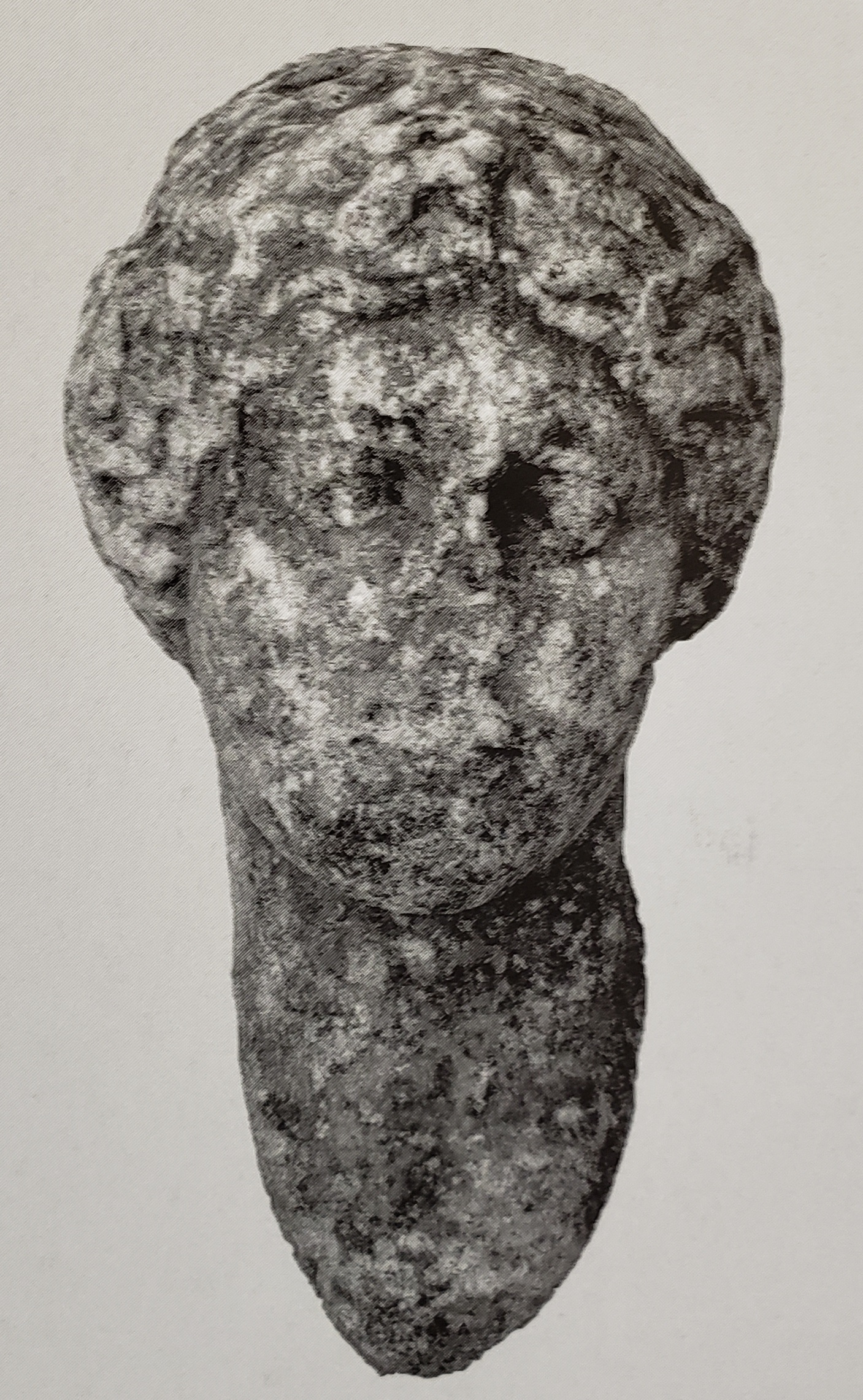
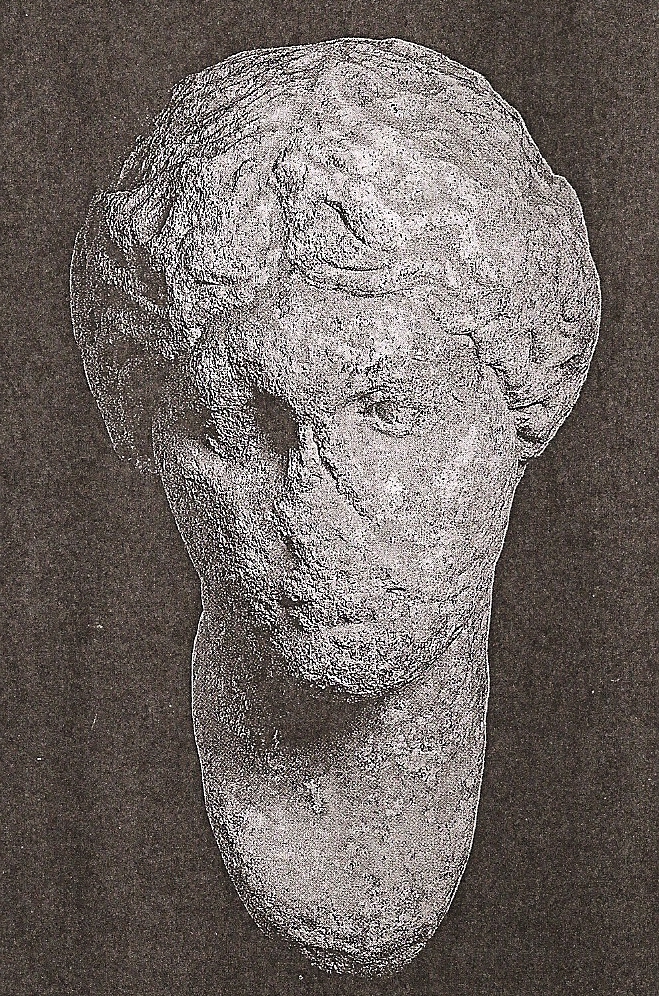
The head is preserved almost intact with the neck and the tenon. The nose and mouth are broken, while extensive weathering is observed on the entire surface of the marble. It depicts a young woman with a long, oval face and almond-shaped, wide-lidded eyes. The hair is combed at the front of the head around the face in flat, slightly intertwined wavy locks, which continue to the sides (covering the ears except for the lobes), and are gathered in a bun in the middle of the back of the head. The same type of strands of hair covers the upper part of the skull. The wavy locks that are slightly intertwined around the face and cover the ears at the sides (except for the lobes) are reminiscent of private portraits that simplify the headdress of Agrippina the elder, such as the two portraits from Mytilene, P. Konstantinidis, “Τρία γυναικεία πορτρέτα αυτοκρατορικής περιόδου από τη Μυτιλήνη”, in H.R. Goette, I. Leventi eds., Excellence. Studies in honor of Olga Palagia, Rahden 2019, 278-280, figs. 3-6, although elements such as the flattened locks of hair on either side of the parting at the top of the forehead, and the looped bun at the nape of the Mytilene portraits are absent (for the official iconography of Agrippina the Elder see D. Boschung, “Die Bildnistypen der iulisch-claudischen Kaiserfamilie: ein kritische Forschungsbericht”, JRA 6 [1993], 61-62; P. Konstantinidis, Γυναικείοι δυναστικοί εικονιστικοί ανδριάντες αυτοκρατορικής περιόδου από την Ελλάδα (τέλη 1ου αι. π.Χ. – 5ος αι. μ.Χ.), Athens 2024, 319-320). Conversely, the arrangement of the locks on either side of the parting at the top of the forehead, the placement of the bun high in the middle of the skull, and the idealized face are close to the iconography of goddesses of the Classical period, such as the “Aspremont-Leyden” type of Aphrodite; here the bun is clearly simplified and smaller (cf. e.g. the head of Aphrodite Athens, National Archaeological Museum of Athens inv. 1762: N. Kaltsas, Εθνικό Αρχαιολογικό Μουσείο, Τα γλυπτά, Κατάλογος, Athens 2001, 244, cat. no. 510, 1st c. CE; A. Pasquier, J.L. Martinez eds., Praxitèle. Paris Musée du Louvre, Paris 2007, 156-157, cat. no. 27 [A. Pasquier], 1st c. CE).
N. Gialouris, Αρχαία Ήλις: Το λίκνο των Ολυμπιακών αγώνων, Athens 1996, 185, fig. 185; I. Andreou, “Ο ναός των Ρωμαίων αυτοκρατόρων στην Ήλιδα”, ΑΑΑ 42 (2018), 336-337, 340, fig. 29 (Agrippina the Younger, part of the sculptural assemblage of the temple of imperial cult of the city of Elis).