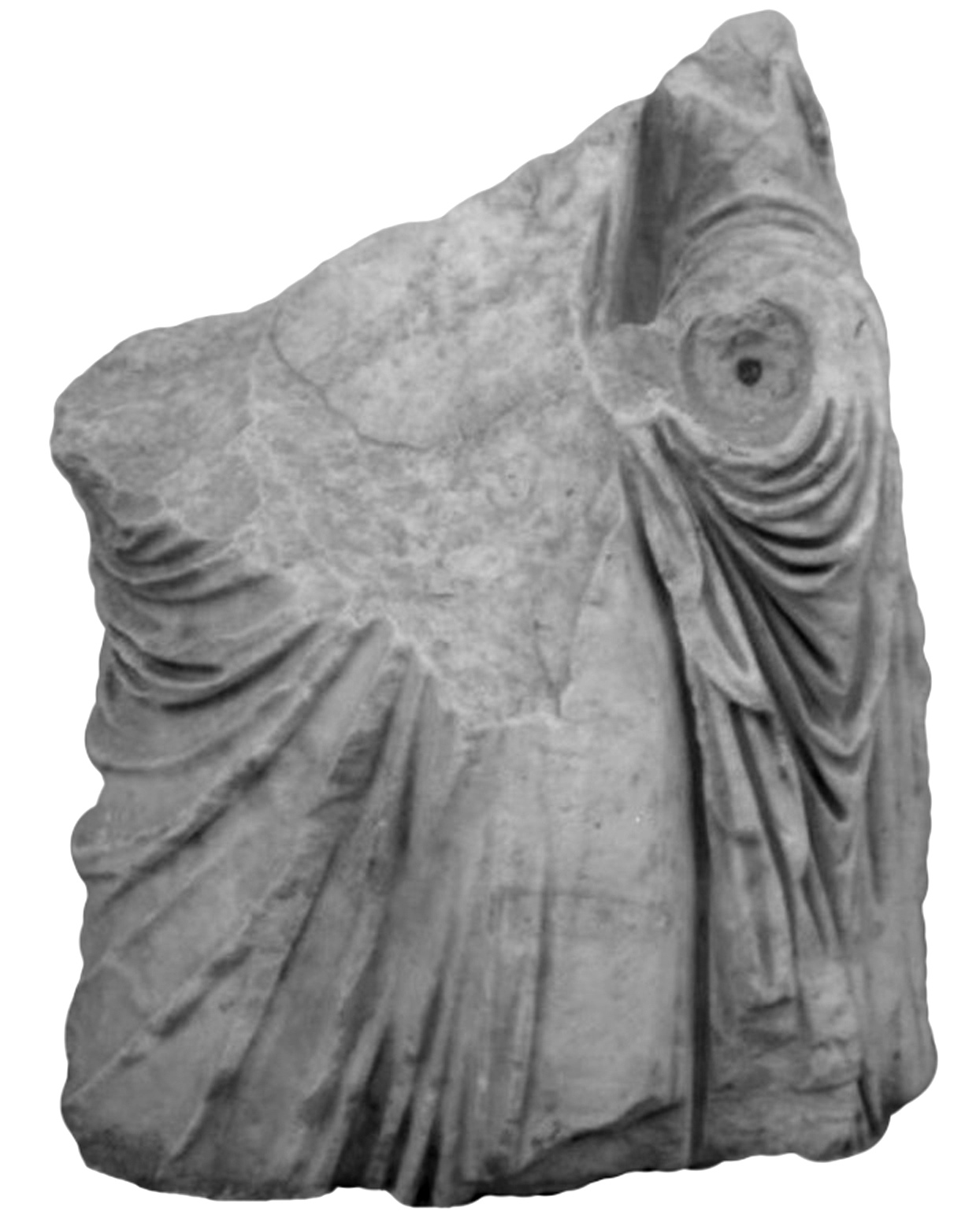
The figure is preserved fragmentarily, approximately from the breasts to the knees. Part of the left arm is also preserved up to the middle of the forearm, where a circular socket for the attachment of the inset part of the latter is also preserved. The upper and lower part, as well as most of the right front part of the statue are broken off. The figure is depicted standing, frontal, wearing a long chiton and a long himation that covers most of the body and forms on the left, between the body and the elbow, the characteristic round gathering of folds of the statuary type (today partially broken). The statuary type is also confirmed by the upward direction of the folds of the himation at the surface of the right hip. It can be dated to the second half of the 2nd century CE, probably in the Antonine period, based on the closest stylistic parallels, the portrait-statue of Numisia Teisis ({Γ106}), and, in particular, the portrait-statue Olympia Archaeological Museum, inv. Λ 165, usually identified as a portrait of Elpiniki, daughter of Herodes Atticus ({Γ111}). Good quality of workmanship.
P. Konstantinidis, M. Mylonas, “Economic and Commercial Aspects of Portrait Statuary from the City of Epidauros and the Sanctuary of Apollo Maleatas and Asklepios (146 BC-3rd century AD), in M. Bentz, M. Heinzelmann eds., Proceedings of the 19th International Congress of Classical Archaeology Cologne/Bonn 22-26 May 2018, vol. 53. Archaeology and Economy in the Ancient World, Heidelberg 2022, 264, fig. 3 (P. Konstantinidis).