
 Museum/Current place of storage:
 |
Olympia, Archaeological Museum. |
 Inv. no:
 |
Λ 165 |
 Dimensions:
 |
|
 Material:
 |
H. 1,64m. |
 Findspot:
 |
On the 1st of April 1877 in the upper basin of the Nymphaeum of Herodes Atticus inside the sacred precinct of Olympia. |
 Original Display Location:
 |
In a niche of the exedra of the Nymphaeum of Herodes Atticus inside the sacred precinct of Olympia. |
 Date:
Date: |
149-153 CE. |
 Statuary Type (body) :
 |
“Kore/Persephone” of the “Ephesos” type. |
 Mode of Self-Representation (head):
 |
- |
 Civic Presence (Social Role Represented):
 |
Priestess (either a member of the family of Herodes Atticus or a member of the imperial house of the Antonines). |
 Inscribed Base:
 |
Yes (see below). |
 Author:
 |
Panagiotis Konstantinidis |
 Added:
 |
2024-09-28 |
 Edited:
 |
Description - Comments:
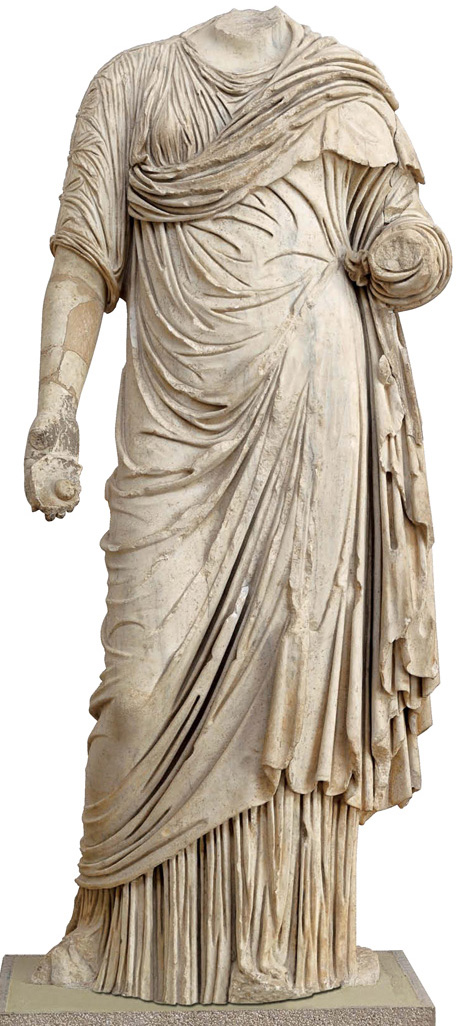
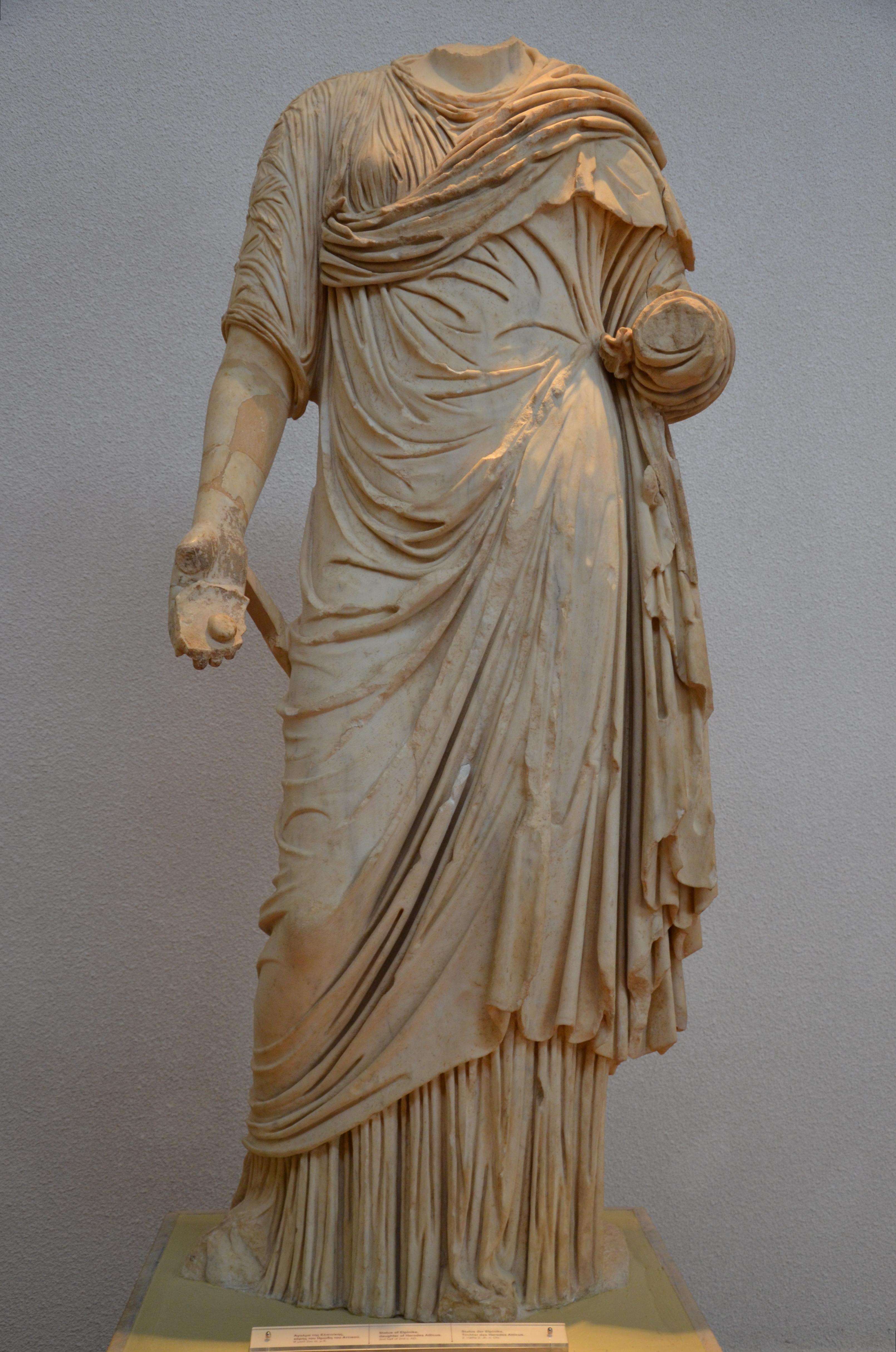
The statue is in a good state of preservation. The right arm and left shoulder are put back together from several fragments. The head from the middle of the neck, the left wrist and partially the tips of the feet that project underneath the chiton are broken. Smaller breaks and chipping are evident sporadically on the surface of the marble, especially on the folds of the garments. The statue depicts a standing, frontal female figure wearing a long chiton, a himation covering almost the entire chest and left shoulder, and closed leather shoes (calcei muliebres). In her right hand she holds a patera (partially broken). The right breast is left uncovered, while the S-shaped mass of the himation is carried diagonally across the chest from the right armpit to the left shoulder, where it is partially unfolded. On the left part of the body, at the height of the waist, there is a circular mass of folds, characteristic of the statuary type, held by the elbow. The statuary type of the so-called “Ephesos Kore/Persephone” is faithfully reproduced. The statue can be dated fairly precisely to the period 149-153 CE, during the principate of Antoninus Pius, based on the surviving inscriptions on the bases of the statues of the Nymphaeum’s sculptural program (Bol 1984, 98-100). The identity of the figure is uncertain. It is the same size as the portrait statue {Γ109}, and similar in scale to the portrait statue {Γ108}, placing it among the young figures of the Nymphaeum’s sculptural decoration. It could therefore depict either Elpinike or Athenais, daughters of Herodes Atticus or Faustina the younger. R. Bol identifies the figure with the first-born daughter of Herodes Atticus, Elpinike (attributing to it the inscribed base IvO 624; Bol 1984, 130-132 cat. no. 15, fig. 58, pl. 10), and places it in the first from the left niche of the upper floor of the Nymphaeum’s exedra. Conversely, K. Hitzl and A. Kropp (2013) place the statue in the first from the left niche of the ground floor of the Nymphaeum’s exedra. The presence of the patera identifies the figure as a priestess. In the inscription on the bull that belonged to the sculptural decoration of the Nymphaeum (Olympia Archaeological Museum, inv no. Λ 164: Bol 1984, 109-110, cat. no. Ι.Α.1 with note 371, Beil. 5, pls. 2-3) Regilla is mentioned as a priestess of Demeter Chamyne, the most prominent female priestly office in Olympia (see also {Γ107}). Based on this information, G. Treu had recognized the portrait of Regilla in the statue (it is the only female figure of Nymphaeum holding a patera; of the male figures, only the cuirassed portrait statue of Hadrian, and the male figure identified by R. Bol with Tiberius Claudius Atticus, Herode’s father hold paterae: Bol 1984, 151-153, cat. no. 28, 169-171, cat. no. 35). Given its uncertain identification, the priestly office held by the woman portrayed is equally uncertain.
Bibliography:
G. Treu, Olympia III. Die Bildwerke von Olympia in Stein und Thon, Berlin 1894, 268, 276, pl. 68.5; H. Kruse, Römische weibliche Gewandstatuen des zweiten jahrhunderts n.Chr., Göttingen 1975, 374-375, cat. no. D87; R. Bol, Das Statuenprogramm des Herodes-Atticus-Nymphäums, OlForsch 15, Berlin 1984, 130-132, no. 15, fig. 58, pl. 10 (base), 177-179, cat. no. 41, pls. 44-45 (Elpinike); S. Schmidt, “Uber den Umgang mit Vorbildern. Bildhauerarbeit im 4. Jahrhundert v. Chr.”, AM 111 (1996), 192, note 2 no. 9, note 3; Κ. Hitzl, A. Kropp, “Das Heiligtum von Olympia im 2. Jh. n. Chr. - Alte und neue Impressionen”, Boreas 36 (2013), 53-89; P. Konstantinidis, Γυναικείοι δυναστικοί εικονιστικοί ανδριάντες αυτοκρατορικής περιόδου από την Ελλάδα (τέλη 1ου αι. π.Χ. – 5ος αι. μ.Χ.), Athens 2024, 86, note 44, 171, note 268;
https://arachne.dainst.org/entity/1083483?fl=20&q=%22Olympia,%20Griechenland%22&resultIndex=46