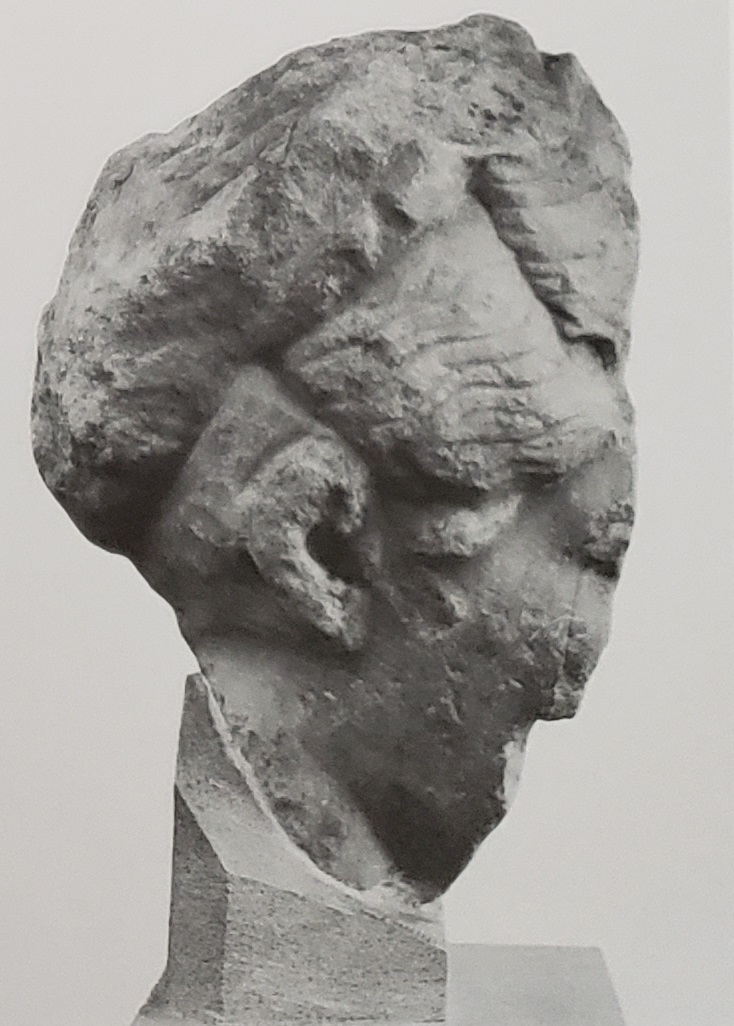
Only a section of the right and upper part of the head, with the beginning of the neck, is preserved, retaining part of the headdress, the cheek, the beginning of the eye and the ear. The drill was used for the opening of the ear cavity. The carving of the ear and of the coiffure just behind it, as well as that of the preserved upper part of the head remain unfinished. The woman depicted wears the “melon” hairstyle (the texture of the individual strands of hair is indicated by parallel incised lines worked with the point), as well as a quite broken crown (the type of its leaves cannot be determined). The “melon” headdress points to the young age of the woman depicted, while the crown indicates her priestly or initiate status (see in {Γ25}). G. Dontas (2004, 60) proposes an identification as an arrephoros for the head. Possibly dated to the Antonine period (cf. the rendering of the texture of the coiffure on the portrait head of a young daughter of M. Aurelius from the Olympia Nymphaeum, P. Konstantinidis, Γυναικείοι δυναστικοί εικονιστικοί ανδριάντες αυτοκρατορικής περιόδου από την Ελλάδα [τέλη 1ου αι. π.Χ. – 5ος αι. μ.Χ.], Athens 2024, 465-466, cat. no. Γ34, figs. 708-709, 149-153 CE).
G. Dontas, Corpus Signorum Imperii Romani. Greece I.1 Les portraits attiques au Musée de l'Acropole, Athènes 2004, 59-60, cat. no. 34, pl. 27 (reign of Trajan?).