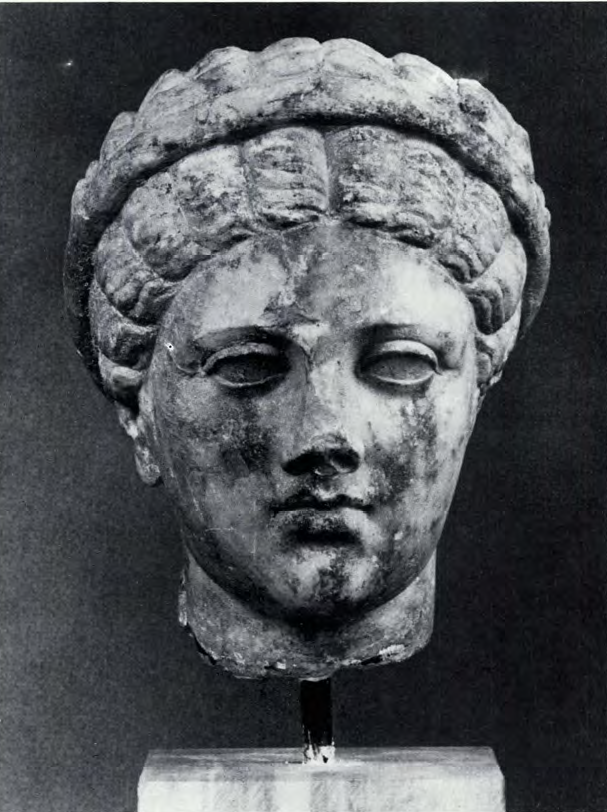
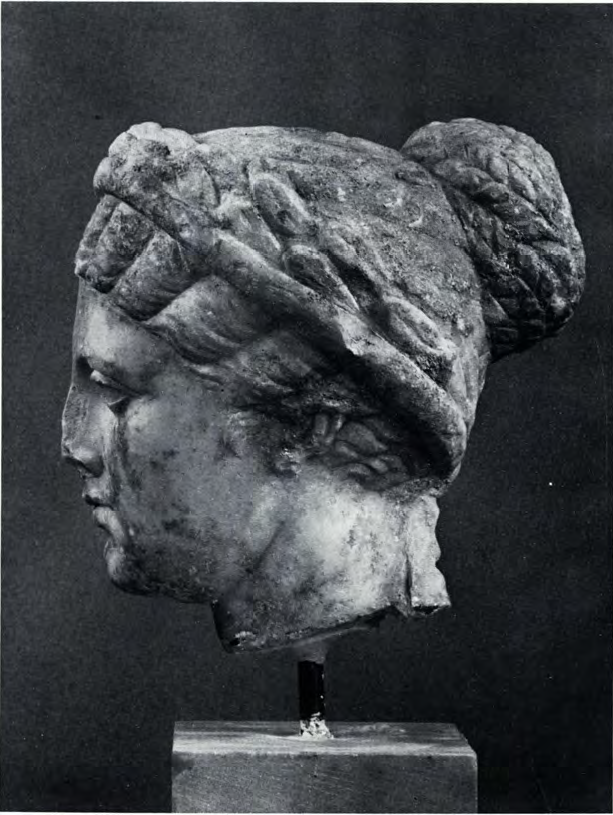
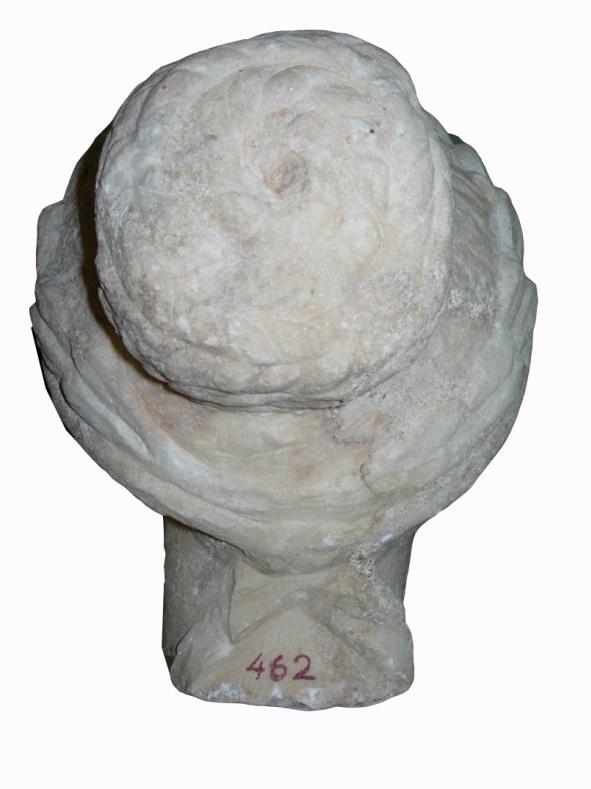
The head is preserved essentially intact along with the greater part of the neck. Only the tip of the nose and part of the ears are broken off. Abrasions and chipping are present sporadically on the surface of the marble. Rasp marks are evident on the neck. The head depicts a girl with an oval plump face, smooth cheeks, almond-shaped eyes with wide lids (the iris and pupil were rendered in paint) and a small mouth with fleshy lips, turning slightly to the left. The eyebrows are plastically rendered ending in sharp ridges on the surface of the marble. She wears a “melon” headdress with six “slices” on each side, ending in a bun made of braids place high at the back of the skull (the texture of the individual strands of hair at the front is rendered with parallel incisions, while on the surface of the braids with diagonal ones. The whole part of the coiffure behind the crown is more roughly worked). Good quality of workmanship. The girl wears a strophion and an olive crown, placed directly above it (the free ends of the binding of the strophion are summarily rendered on the surface of the nape). The “melon” headdress ending in a bun of braids has been a typical coiffure for the depiction of young women since its appearance in the 4th c. BCE and up to the late imperial period. The young age of the girl, the type of coiffure, and the presence of the strophion and the crown, all point to priestly or initiate status, as we see from several examples (cf. [a] wearing only the strophion: {Γ126}, {Γ102}, as well as the portrait head of unknown provenance Athens National Museum inv. 4914, A. Datsouli–Stavridi, “Πορτραίτα της ρωμαϊκής εποχής το Εθνικό Αρχαιολογικό Μουσείο Αθηνών”, ΑΑΑ 12 (1979), 114-116, figs. 3-4, [b] wearing only a crown: {Γ26}, as well as the portrait heads Athens National Museum inv. 456 [Ι. Chioti, Αυτοκρατορικά και ιδιωτικά πορτρέτα της εποχής των Αντωνίνων στην Ελλάδα [PhD thesis Aristotle University of Thessaloniki], Thessaloniki 2012, cat. no. 227), 3056 [A. Datsouli-Stavridi, “Παιδικά και νεανικά πορτραίτα της ρωμαιοκρατίας στο Εθνικό Αρχαιολογικό Μουσείο Αθηνών”, ΑΑΑ 13 (1980), 339-340, figs. 37-38], 4917 [K. Fittschen, Privatporträts mit Repliken. Zur Sozialgeschichte römischer Bildnisse der mittleren Kaiserzeit, Wiesbaden 2021, 197-198, no. 121a], 5266 and 5267 [Tasopoulou 2018, cat. nos. 56-57]. For the meaning and symbolism of the strophion and the crown, but also the combination of both, perhaps in official events, see M. Bonanno-Aravantinos, “Un ritratto di sacerdotessa da una casa sull'Areopago”, in L. Bacchielli, M. Bonanno-Aravantinos ed., Scritti di antichità in memoria di Sandro Stucchi I, Roma 1996 [Studi Miscellanei 29], 346, 348; J. Rumscheid, Kranz und Krone. Zu Insignien, Siegespreichen und Ehrenzeichen der römischen Kaiserzeit, Tübingen 2000; Katakis 2002, 272-274, with notes 1209-1210). Regarding the crown, the identification of its leaves often indicates the deity worshipped (e.g. the myrtle is typically associated with the Eleusinian Mysteries – cf. {Γ61}, with bibliography). The olive is directly related to the cult of Athena (cf. the proposal of G. Dontas [ Corpus Signorum Imperii Romani. Greece I.1 Les portraits attiques au Musée de l'Acropole, Athènes 2004, 58, 60] to identify analogous portraits of young girls, possibly from the Acropolis, as arrhephoroi).
P. Kavvadias, Γλυπτά του Εθνικού Μουσείου: κατάλογος περιγραφικός, Athens 1890, 275, no. 462; P. Kastriotis, Γλυπτά του Εθνικού Μουσείου: κατάλογος περιγραφικός, Athens 1908, 79, no. 462; A. Datsouli-Stavridi, “Παιδικά και Νεανικά Πορτραίτα της Ρωμαιοκρατίας στο Εθνικό Αρχαιολογικό Μουσείο Αθηνών”, ΑΑΑ 13 (1980), 324, figs. 12-13; S. Katakis, Τα γλυπτά των ρωμαϊκών χρόνων από το ιερό του Απόλλωνος Μαλεάτα και του Ασκληπιού, Athens 2002, 272; E. Kalavria, Αττικά πορτρέτα κατά την εποχή της ρωμαιοκρατίας (1ος αι. π.Χ. - αρχ. 2ου αι. μ.Χ.), ζητήματα τυπολογίας, λειτουργίας και παραγωγής (PhD thesis, National and Kapodistrian University of Athens), Athens 2015, 242-243, 490-491, cat. no. 96, pl. 96; M. Tasopoulou, Το πορτρέτο της εποχής του Τραϊανού στην Ελλάδα (MA thesis Aristotle University of Thessaloniki), Thessaloniki 2018, 65, cat. no. 53, pl. 48α-β (late Trajanic – early Hadrianic period); S. Dillon, “Female Portrait Statuary in Roman-period Athens: The Epigraphic and Sculptural Evidence”, Eugesta 13 (2023), 18-19, figs. 19-20 (“παῖς αφ’ἐστίας”).