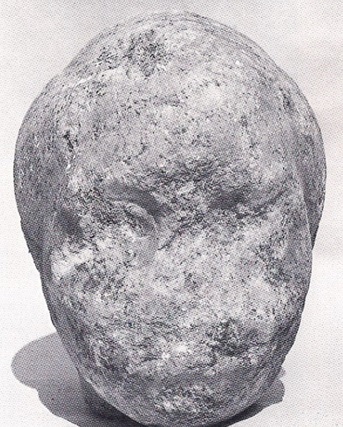
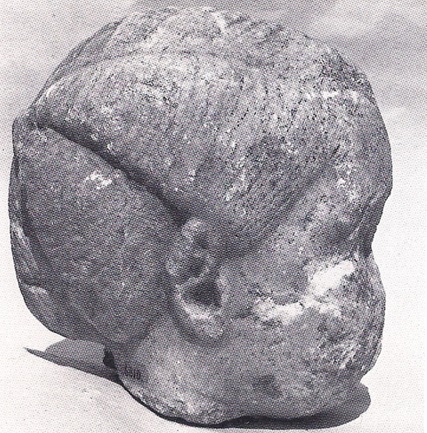
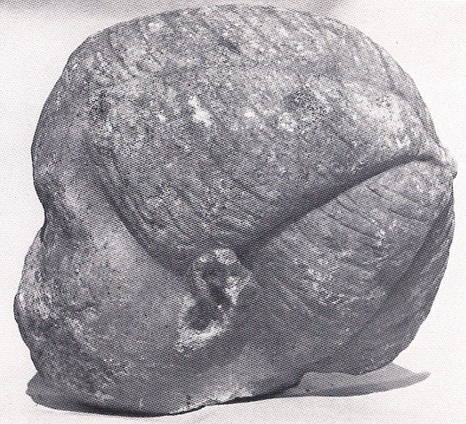
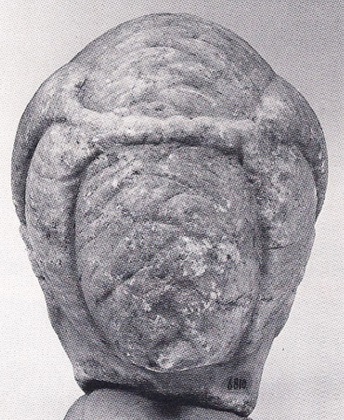
The head is preserved up to the beginning of the neck. The front part of the face is broken and heavily eroded (only the right almond-shaped eye and the inner corner of the left one are more or less discernible). The sides of the face preserve the puffy smooth cheeks; the small ears are also preserved. Small breaks and chipping are observed sporadically on the surface of the marble (especially on the ears). The headdress is preserved in a relatively good condition. The area along the upper part of the skull, from the center of the forehead to the nape, is occupied by a broad plait (the texture of the individual locks of hair is indicated by incised interlocking lateral lines). At the sides, the headdress is structured in “slices”, following the well-known “melon” coiffure arrangement (the texture of the individual strands of hair is rendered by shallow engraving of parallel lines). At the back of the head a thin braid, placed above the central wide braid along the upper part of the skull, joins the “melon” side parts. To my knowledge, the coiffure does not find exact parallels. The overall configuration of the headdress, with a central braid starting from the parting and along the upper part of the skull combined with a “melon” side part, is a typical feature of young age, attested as early as the Classical period (for numerous examples see G. Despinis, Άρτεμις Βραυρωνία. Λατρευτικά αγάλματα και αναθήματα από τα ιερά της θεάς στη Βραυρώνα και την Ακρόπολη της Αθήνας, Athens 2010, 115-117; see also the headdress of the two young daughters of Marcus Aurelius from the Nymphaeum of Olympia, P. Konstantinidis, Γυναικείοι δυναστικοί εικονιστικοί ανδριάντες αυτοκρατορικής περιόδου από την Ελλάδα [τέλη 1ου αι. π.Χ. – 5ος αι. μ.Χ.], Athens 2024, 465-468, cat. nos. Γ34-Γ35, figs. 706-709, 717-719). Hence, the wider coiffure type is perfectly suited to the young person depicted, a girl of about ten years old. A. Pantos, on the basis of the closest parallels of the coiffure, dates the head to the beginning of the reign of Augustus, and recognizes in it, due also to the proximity of its findspot to the sanctuary of Demeter and Kore, a hearth-initiate, thus attributing the peculiarities of the headdress at the back of the skull (including the special rendering of the broad central braid) to the religious significance of the coiffure (see in detail Pantos 1989, 198-201; the portrait stood either within the sanctuary or in the girl’s funerary monument near the Iera Odos). Although the coiffure does not find exact parallels, the identification of the girl as a hearth-initiate is not in our opinion probable, due to the absence of the myrtle wreath (or even the strophion). As written sources inform us, the παίδες ἀφ’ἐστίας were boys and girls, two each year, who were chosen to represent the whole city of Athens in the Eleusinian Mysteries (the cost of their initiation was covered by the city). Nevertheless, all surviving (boy) portraits bear without exception a myrtle wreath (see in detail with all available sources K. Clinton, “The Sacred Officials of the Eleusinian Mysteries”, TAPS 63 [1974], 98-114; cf. also K. Fittschen, Privatporträts mit Repliken. Zur Sozialgeschichte römischer Bildnisse der mittleren Kaiserzeit, Wiesbaden 2021, 197-198 no. 121 for the identification of the early Severan portrait of a young girl Athens National Museum inv. 4917 sporting a “melon” coiffure and a myrtle wreath, as a παῖς ἀφ’ἐστίας). We may be able to recognize in the head from Eleusis a portrait of a girl from an eminent local family whose statue was either dedicated to the sanctuary, or, just as likely, stood inside her funerary monument along the Iera Odos, located very close to the head’s findspot.
A. Lianguras, “Ελευσίνα, οδός Κελεού 8”, ArchDelt 29 [1973/1974], Β1, 70; P. Pantos, “Der Kopf einer Mädchenstatuettea aus Eleusis”, AM 104 (1989), 197-201, pls. 32-33 (early Augustan period; either part of a funerary monument or erected in the sanctuary of Demeter and Kore; hearth-initiate).