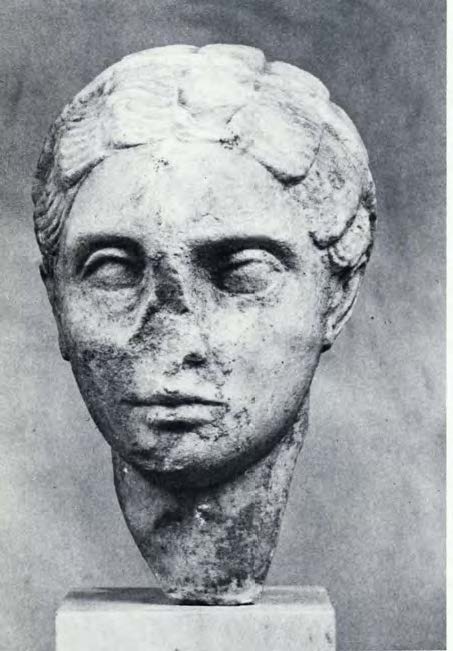
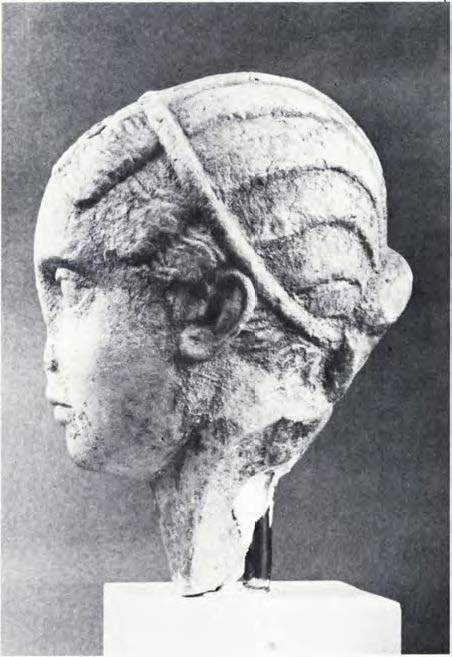
The head is well preserved, along with much of the neck. The nose, part of the bun and the back of the neck are missing. Smaller breaks are evident on the chin, cheeks and neck. The head depicts a young female turning slightly to the right. The ears are rendered with detail. The face is oval and thin, the eyebrows thin, the eyes almond-shaped with wide lids (as attested by M. Tasopoulou, the right is slightly smaller compared to the left). The mouth is elongated with a fleshy upper lip, the chin small and round. The area underneath the eyes is sunken (probably all individual physiognomic characeristics). The girl wears the “melon” coiffure (wide bands of hair run from the forehead to the top of the head) ending in a small cylindrical bun. The texture of the hair is indicated by small parallel, slightly wavy, incisions. The figure wears a thin circular
strophion
, the ends of which are schematically indicated on the surface of the neck, just below the bun. The fact that the detailing of the coiffure does not continue beyond the
strophion
(evidently to save labor) indicates that the back of the head was not meant to be visible. Good quality of workmanship. The presence of the
strophion
probably indicates that the figure must be identified as a priestess or initiate (see also {Γ25} for the combination of the
strophion
with the melon coiffure). Pausanias (II.36,7–8 and 37) informs us that in Lerna there was a mystery cult of Demeter
Prosymna
(i.e. (Q)of Hymns(Q)), as well as that of Dionysos, during which nocturnal rituals took place.
ArchDelt 1890, 139, no. 13; P. Kavvadias, Γλυπτά του Εθνικού Μουσείου: κατάλογος περιγραφικός, Athens 1890, 288, no. 534; P. Kastriotis, Γλυπτά του Εθνικού Μουσείου: κατάλογος περιγραφικός, Athens 1908, 86, no. 534; A. Datsouli – Stavridi, «Παιδικά και νεανικά πορτραίτα της ρωμαιοκρατίας στο Εθνικό Αρχαιολογικό Μουσείο Αθηνών», ΑΑΑ 13 (1981), 326-327, figs. 14-15; M. Tasopoulou, Το πορτρέτο της εποχής του Τραϊανού στην Ελλάδα, Θεσσαλονίκη 2018 (MA thesis Aristotle University of Thessaloniki), 65, 74, 118-119, cat. no. 54, pl. 48γ-δ (reign of Trajan).