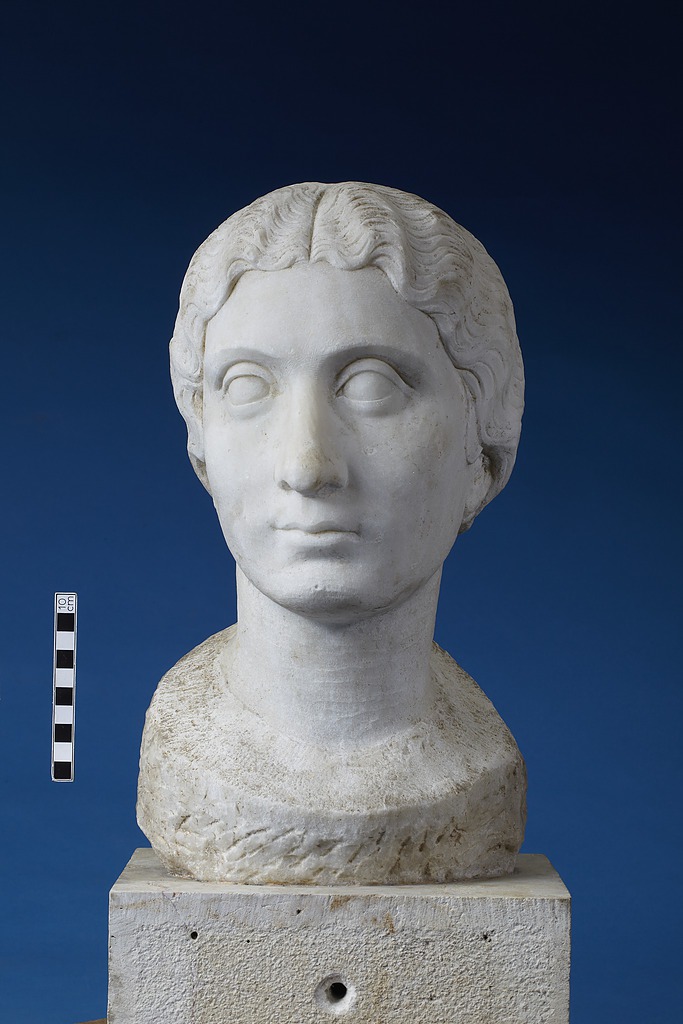
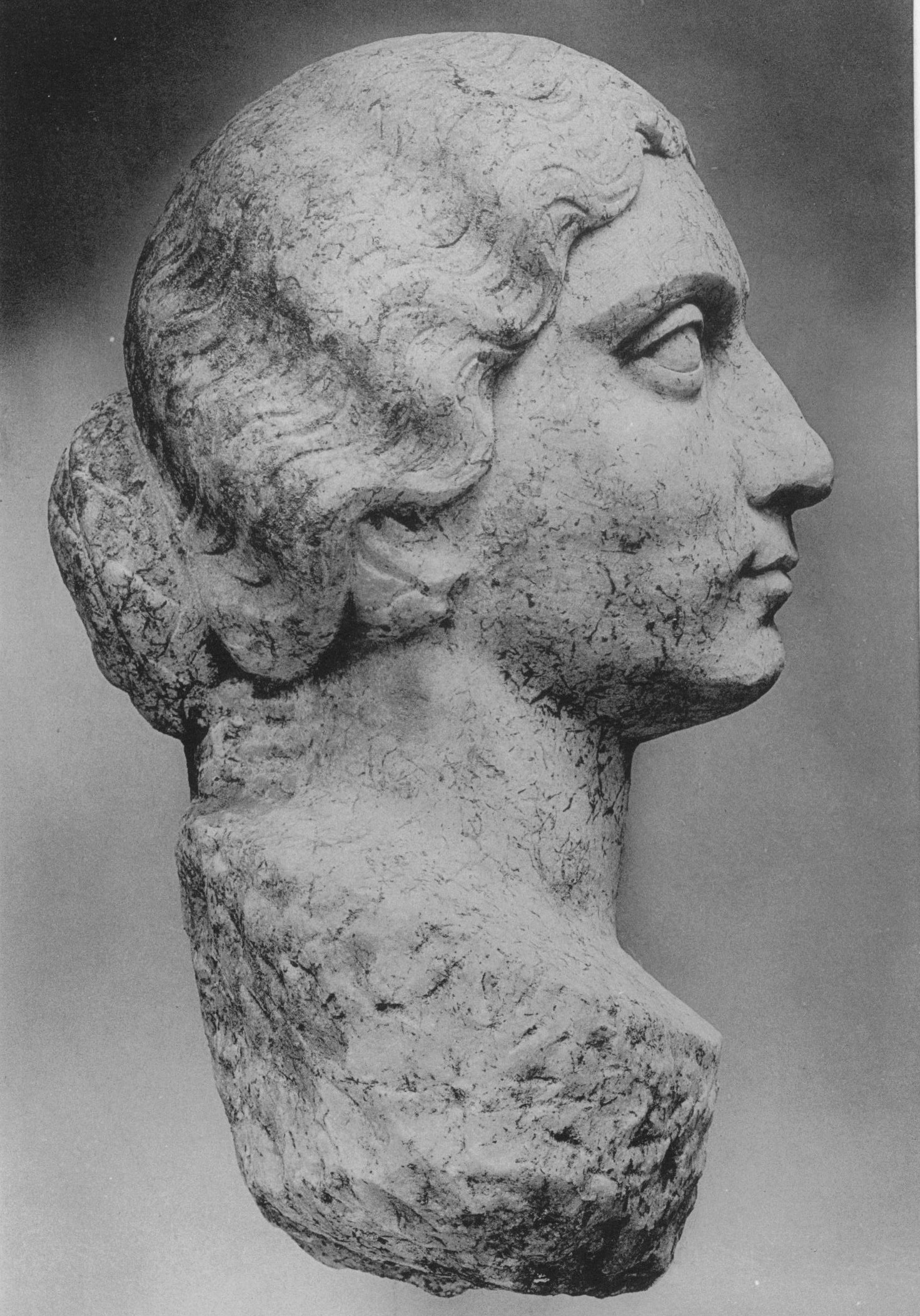
The head is almost intact, preserved with the neck and tenon for the insertion into the body. A small break is evident in the middle of the right eyebrow, as well as minor chipping sporadically on the surface of the face. Various technical details, such as parts of the mass of marble on the left of the tenon, the neck and behind the ears that have not yet been chiseled away, the rough flat chisel marks on the neck and chest area on the upper front part of the tenon, the rough rasp marks on the forehead, under the mouth and under the chin, and lastly the measurement points at the center of the chin and on either side of the parting of the hair, all indicate that the head is left unfinished by the sculptor. It depicts a mature woman with a plump oval face, robust neck, high forehead, thick nose and full lips. The long and thin eyebrows end in sharp ridges on the surface of the marble, while their outline is defined in relief. The eyes are large, almond-shaped and framed by wide lids. The lower eyelids are thick. The sculptor has marked the tear-duct, but not the iris and pupil of the eyes. The head turns slightly to the right. The hair is parted in the middle of the forehead and directed in waves to the sides and back, where it is braided to form a large bun at the nape of the neck (the texture of the braids is rendered by incised triangles on the surface of the marble). There are lunate locks of hair on the surface of the marble in front of the left ear. The coiffure follows contemporary official imperial protypes, in particular the fifth portrait type of Faustina the Younger and the second portrait type of her daughter, Lucilla (for the portrait types see K. Fittschen, Die Bildnistypen der Faustina minor und die Fecunditas Augustae, Göttingen 1982, 42-43, 51-53 [ca. 152 CE] and 70, 78-79 [ca. 166 CE] respectively); the head should therefore be dated to the period 152-166 CE (see also Chioti 2012, 156).
T.L. Shear, “The Latter Part of the Agora Campaign of 1933”, AJA 37 (1933), 546 fig. 6A; T.L. Shear, “The Sculpture Found in 1933”, Hesperia 4 (1935), 415-416 figs. 37-38; E.B. Harrison, The Athenian Agora I. Portrait Sculpture, Princeton N.J. 1953, 48-49, cat. no. 36, pl. 23 (160-180 CE); Ε.Β. Harrison, Ancient Portraits from the Athenian Agora, Princeton NJ 1960, Excavations of the Athenian Agora Picture book no. 5, fig. 25; M. Bergmann, Marc Aurel, Frankfurt 1978, 37-38 note 31; K. Tsakalou-Tzanavari, “Δύο γυναικείες εικονιστικές κεφαλές από τη Βέροια”, ArchEph 1985, 122-123; E.J. Walters, Attic Grave Reliefs That Represent Women in the Dress of Isis, Princeton N.J. 1988, Hesperia Suppl. 22, 65 note 68; M. Pfanner, “Über das Herstellen von Porträts. Ein Beitrag zu Rationalisierungsmassnahmen und Produktionsmechanismen von Massenware im späten Hellenismus und in der römischen Kaiserzeit”, JdI 104 (1989), 239 no. 12; C. Lawton, Marbleworkers in the Athenian Agora, Princeton N.J. 2006, Excavations of the Athenian Agora Picture book no. 27, fig. 23; E. Chioti, Αυτοκρατορικά και ιδιωτικά πορτρέτα της εποχής των Αντωνίνων στην Ελλάδα (Ph.D. thesis Aristotle University of Thessaloniki), Thessaloniki 2012, 150-156, 346-347, cat. no. 191, pl. 157α-β (152-175 CE); L. Gawlinski, Η Αρχαία Αγορά της Αθήνας. Οδηγός του Μουσείου, Athens 2014, 85-86; S. Dillon, “Female Portrait Statuary in Roman-period Athens: Τhe Epigraphic and Sculptural Evidence”, Eugesta 13 (2023), 14-15, figs. 5-6; https://agora.ascsa.net/id/agora/object/s%20362?q=S362&t=&v=icons&sort=&s=3