
 Museum/Current place of storage:
 |
Athens, Ancient Agora Museum (Stoa of Attalos). |
 Inv. no:
 |
S 336 |
 Dimensions:
 |
|
 Material:
 |
H. 0,245m., w. 0,195m., th. 0,155m. |
 Findspot:
 |
On April 6th 1933, during the excavations of the Ancient Agora of Athens by the American School of Classical Studies, incorporated into a byzantine wall, north of the Library of Pantainos. |
 Original Display Location:
 |
In the Athens Agora (the exact place of display is unknown). |
 Date:
Date: |
Antonine period (ca. 140-150 CE). |
 Statuary Type (body) :
 |
- |
 Mode of Self-Representation (head):
 |
The coiffure follows contemporary imperial fashion protypes (“Modefrisur”), while the face is idealized with certain individual physiognomic traits. |
 Civic Presence (Social Role Represented):
 |
Member of a local elite family (of Herodes Atticus). |
 Inscribed Base:
 |
No. |
 Author:
 |
Panagiotis Konstantinidis |
 Added:
 |
2024-09-08 |
 Edited:
 |
Description - Comments:
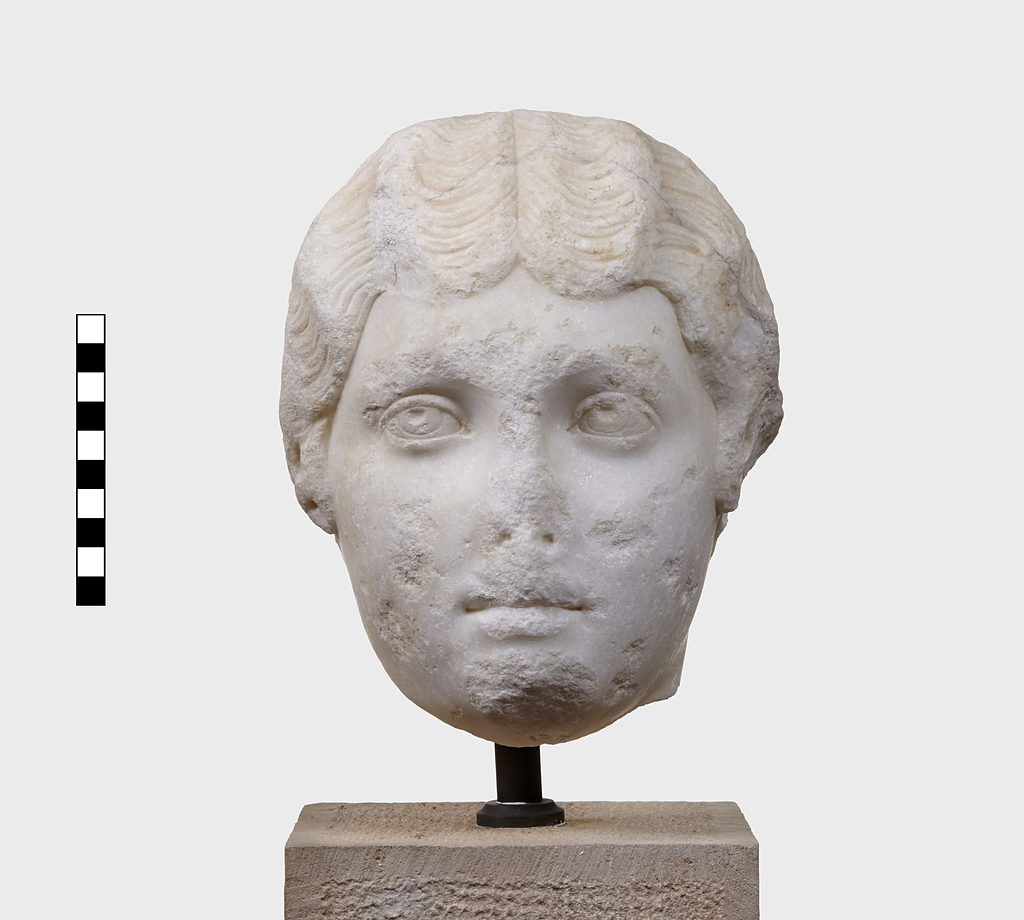
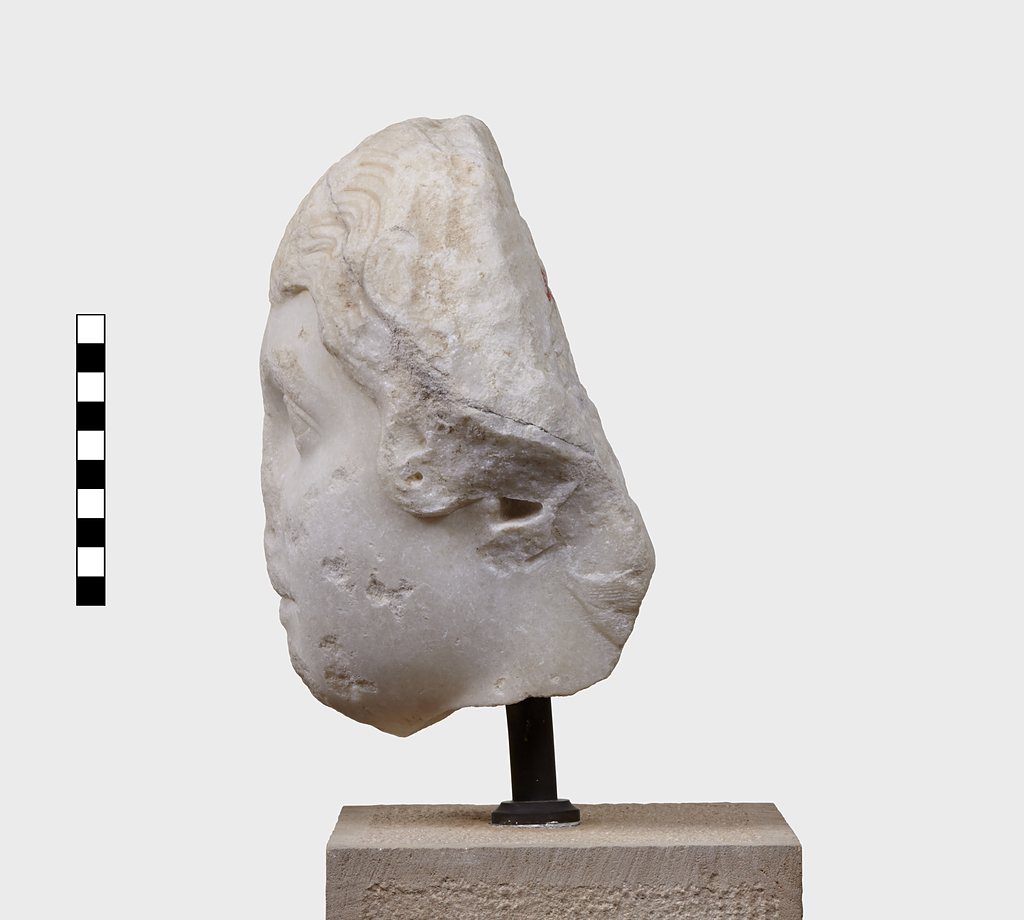
Small breaks and chipping are evident sporadically on the surface of the marble. Separately carved part of the head (face) of a portrait statue, attached to the rest of the head - covered with the himation - by means of two metal pegs, the cavities for the insertion of which are visible on the back, flat surface of the marble (for the technique of piecing the front part of the head from a different piece of marble cf. indicatively the female portrait statues from the Prytaneion of Magnesia on the Maeander - D. Prinkwart, “Weibliche Gewandstatuen aus Magnesia”, AntP 12 [1973], cat. nos. 1, 4–5, 57–59, 62; see also P. Konstantinidis, Γυναικείοι δυναστικοί εικονιστικοί ανδριάντες από την Ελλάδα [τέλη 1ου αι. π.Χ. – 5ος αι. μ.Χ.], Athens 2024, 318-319 note 213. The fact that the right side of the face is left summarily worked probably indicates that the himation completely covered the right side of the head. The face is oval with full cheeks and sports a narrow mouth with fleshy lips (probably individual traits of Athenais). The eyes are small, almond-shaped, with pupil and iris marked, the eyebrows are thin, the chin is round (probably also an individual trait). The headdress draws upon the third portrait type of Faustina the Younger, dated to ca. 150 CE (Fittschen 1982, 39-40, 48-49, pls. 15-16). More specifically, the coiffure is divided at the top of the forehead into two equal parts, which are combed in wide waves to the sides and back, where they would be woven in a large braid that would rise vertically to the top of the skull (here completely covered by the himation), where it would form a bun. The texture of the individual locks of hair is indicated by the flat chisel on the surface of the marble. The ears are half covered by the mass of hair, while a spiral-shaped lock of hair is left free on the surface of each temple. The piece is one of the three surviving portraits of Athenais, daughter of Herodes Atticus, and the second surviving example from Greece (see also the portrait of Athenais from the Nymphaeum of Herodes Atticus in Olympia {Γ108}). The identification of the woman depicted is based on the similarity of the face to the Olympia portrait (for portraits of Athenais see the analysis in Fittschen 2021, 189-190; ibid. 190 note 12 for the surviving statue bases of her portraits). The himation-covered head (capite velato) in the Athens portrait does not necessarily indicate priestly status, since it is also a broader symbol of piety and modesty. We know from epigraphic testimonies that in the city of Athens at least two statues of Athenais were erected (one of them in the sanctuary of Asklepios – cf. {Γ42}), by friends and students of her father (J. Tobin, Herodes Attikos and the City of Athens: Patronage and Conflict Under the Antonines, Amsterdam 1997, 86, nos. 1-2; Fittschen 2021, note 12b-c), while her funeral, which was paid by the city of Athens, must have been another occasion for the erection of her portrait (Philostratos, VS, II1, 10; Tobin 1997, 88; Fittschen 2021, 190 note 12).
Bibliography:
E.B. Harrison, The Athenian Agora I. Portrait Sculpture, Princeton N.J. 1953, 44-45, cat. no. 33, pl. 21; H. Weber, Gnomon 26 (1954), 368; A. Datsouli-Stavridi, “Eικoνιστική κεφαλή Φαυστίνης της Nεωτέρας εις τo Moυσείoν Πατρών”, ΑΑΑ 6 (1973), 167; M. Wegner, R. Unger, “Verzeichnis der kaiserbildnisse von Antoninus Pius bis Commodus II”, Boreas 3 (1980), 13 (Faustina the Younger?); Κ. Fittschen, Die Bildnistypen der Faustina minor und die Fecunditas Augustae, Göttingen 1982, 50 with note 23; K. Fatourou, “Κεφάλι της Φαυστίνας της νεώτερης από την Αντιμάχεια της Κω”, ΑrchDelt 20 (1965), Α´, 175-176; R. Bol, Das Statuenprogramm des Herodes-Atticus-Nymphäums, OlForsch 15, Berlin 1984, 181 note 572; R. Bol, “Die Porträts des Herodes Atticus und seiner Tochter Athenais”, AntK 41 (1998), 127 no. 3; I. Chioti, Αυτοκρατορικά και ιδιωτικά πορτρέτα της εποχής των Αντωνίνων στην Ελλάδα (Ph.D. thesis – Aristotle University of Thessaloniki), Thessaloniki 2012, 401, no. 1; L. Gawlinski, Η Αρχαία Αγορά της Αθήνας. Οδηγός του Μουσείου, Athens 2014, 84-85 (Faustina the Younger; Thasian marble?); H.R. Goette, “The Portraits of Herodes Atticus and His Circle”, in O. Palagia ed., Handbook of Greek Sculpture, Berlin/Boston 2019 (Ancient Greek and Roman Art and Architecture 1), 236 note 37 (uncertain identification); Th. Stephanidou-Tiveriou, N. Kaltsas ed., Εθνικό Αρχαιολογικό Μουσείο. Κατάλογος γλυπτών IV.1. Γλυπτά των ρωμαϊκών χρόνων: Αυτοκρατορικά πορτρέτα, Athens 2020, 165, note 5 (in cat. no. IV.1.43 [K. Fittschen]); K. Fittschen, Privatporträts mit Repliken. Zur Sozialgeschichte römischer Bildnisse der mittleren Kaiserzeit, Wiesbaden 2021, 189-190, cat. no. 113a, pl. 122.1-3; S. Dillon, “Female Portrait Statuary in Roman-period Athens: The Epigraphic and Sculptural Evidence”, Eugesta 13 (2023), 15-16, figs. 7-8; https://agora.ascsa.net/id/agora/object/s%20336?q=S336&t=&v=icons&sort=&s=3.