
 Museum/Current place of storage:
 |
Athens, Acropolis Museum (formerly in the National Archaeological Museum of Athens). |
 Inv. no:
 |
EAM 358 |
 Dimensions:
 |
|
 Material:
 |
H. 0,29m., w. 0,26m. |
 Findspot:
 |
In 1876 in Athens, south of the Acropolis (in the so-called “Serpentzes”, part of the Ottoman fortification system of the rock along its southern slope – see A. Vavylopoulou-Charitonidou, I. Makri, K. Tsakos, “Το Ριζόκαστρο. Σωζόμενα υπολείμματα: Νέες παρατηρήσεις και επαναχρονολόγηση”, Deltion Christianikis Archaiologikis Etaireias 14 [1989], 330, 332, 353, 358, 362, figs. 3ε, 4ε, 5). |
 Original Display Location:
 |
Unknown. The findspot of the piece allows for a provenance from either one of the sanctuaries of the south slope of the Acropolis, e.g. the Asklepieion in which portrait statues have been found ({https://achaeanwomen.eie.gr/γλυπτό/?statue_id=534}, {https://achaeanwomen.eie.gr/γλυπτό/?statue_id=587}, and {https://achaeanwomen.eie.gr/γλυπτό/?statue_id=539}), the residential part of the city that started just to the south of the Odeion of Herodes Atticus, or even the Acropolis itself. |
 Date:
Date: |
Late 2nd - early 3rd c. CE. |
 Statuary Type (body) :
 |
- |
 Mode of Self-Representation (head):
 |
The coiffure follows contemporary imperial fashion protypes (“Modefrisur”), while the face is idealized. |
 Civic Presence (Social Role Represented):
 |
Priestess or initiate (due to the strophion). |
 Inscribed Base:
 |
Νο. |
 Author:
 |
Panagiotis Konstantinidis |
 Added:
 |
2024-09-08 |
 Edited:
 |
Description - Comments:
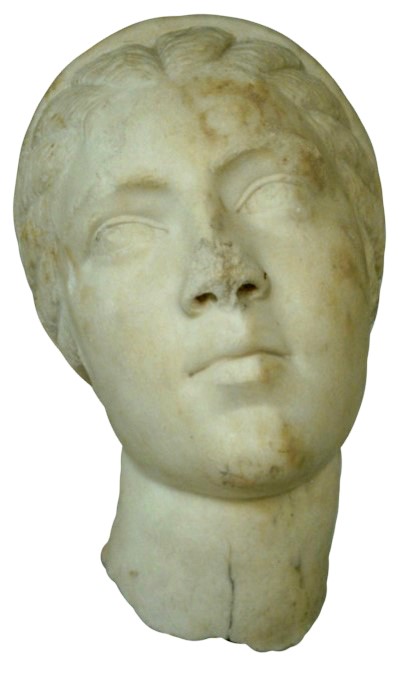
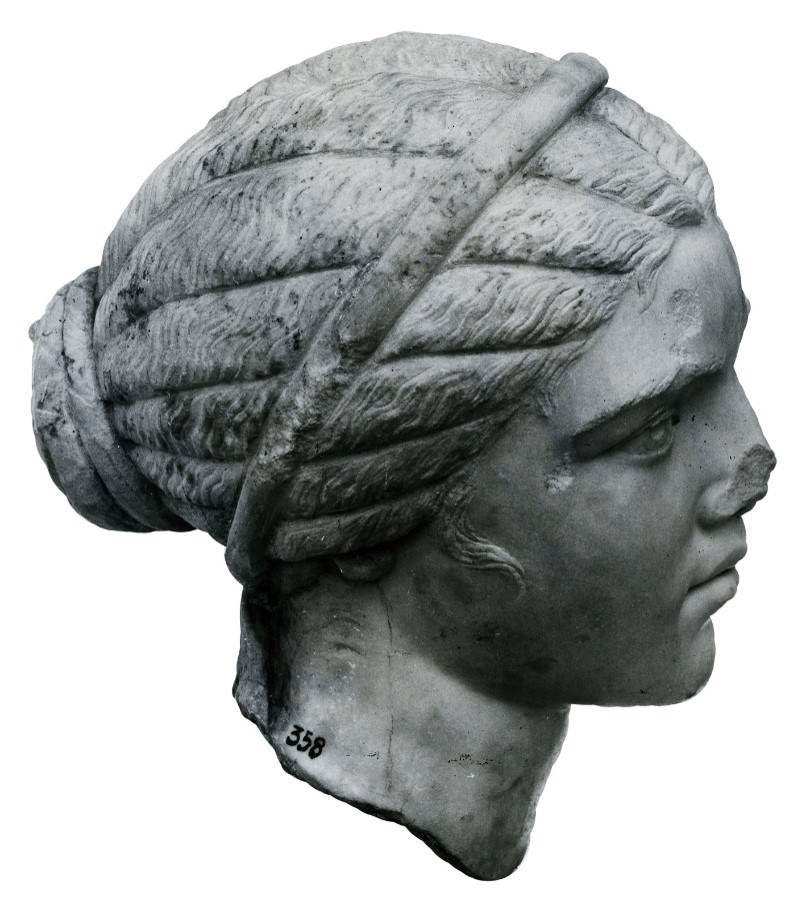
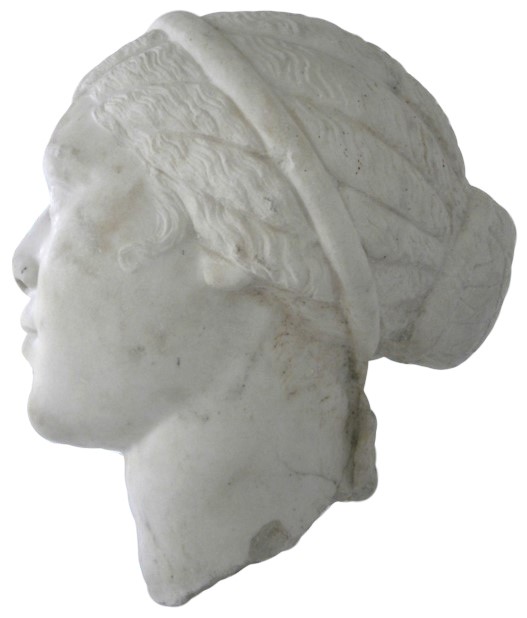
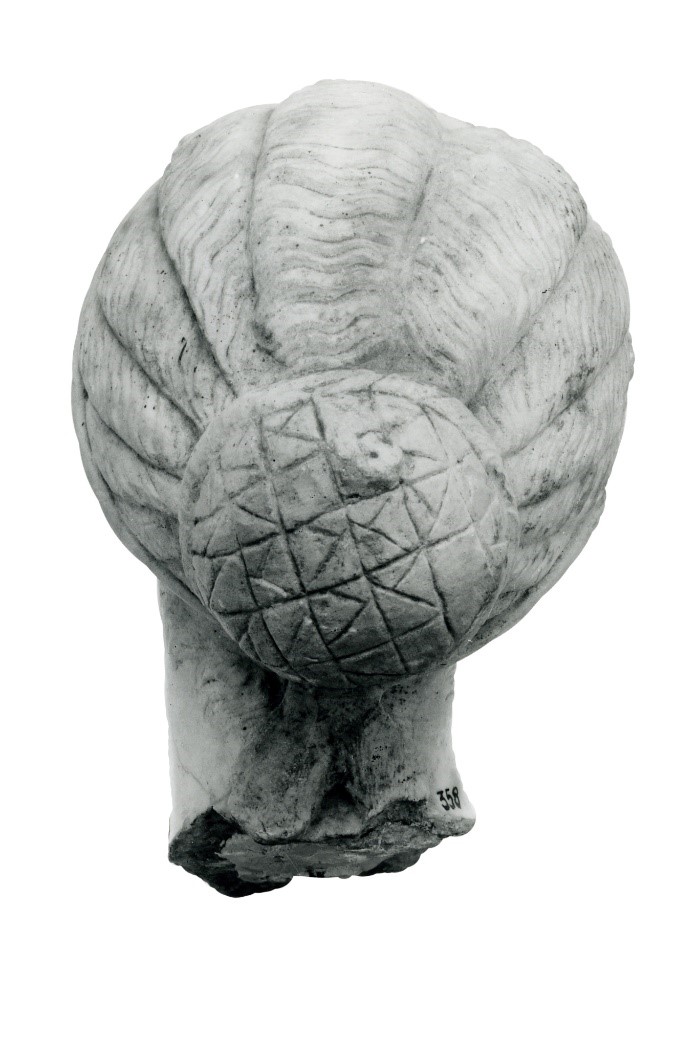
The head is preserved essentially intact, together with the neck. The tip of the nose is broken off, while small breaks and chipping are evident above the right upper eyelid, on the left lower eyelid, at the edge of the right eyebrow, on the right part of the forehead, on the lower left eyebrow, as well as the neck. The surface of the face and neck is polished. On the surface of the nape the two ends of the strophion are left roughly worked. A small protruding mass of marble with a small drill-hole on the surface of the bun probably served as a measuring point and has not been removed by the sculptor (Chioti 2012, 368). The head depicts a young woman tilting her head strongly to the right. She has an oval plump face with long thin eyebrows (their texture is indicated with thick diagonal incisions) and large almond-shaped eyes with thin lids (the tear-duct is indicated by a small drill). The iris and pupil (heart-shaped) of the eyes are marked. The mouth is small, with fleshy lips and marked filter. She wears a “melon” coiffure consisting of twelve “slices” (deep oblong incisions worked with the point separate each “slice” from the next) which cover the ears except for the lobes, while at the back of the skull it is gathered into a small round bun, held in place by a net (the latter is indicated by criss-cross engraved lines on the surface of the marble, while the upper part of the bun ends in a band). Two S-shaped locks of hair are left free on the surface of the temples, while another smaller one is left free on the surface of the forehead on the right of the parting. She wears a strophion, the two broad ends of which are left free on the surface of the nape. The combination of the “melon” coiffure with the small round bun at the back of the head is typical of the Classical period (cf. also the 1st c. BCE head, G. Despinis, Th. Stephanidou-Tiveriou, E. Voutiras eds., Κατάλογος γλυπτών του Αρχαιολογικού Μουσείου Θεσσαλονίκης ΙΙ, Thessaloniki 2003, 22-23, cat. no. 159, figs. 405-408 [G. Despinis]; ibid. in note 1 bibliography on the “melon” coiffure), but also revives in the first iconographic type of Fulvia Plautilla, wife of the emperor Caracalla, known mainly from coins (202 CE; cf. H.B. Wiggers, M. Wegner, Das Römische Herrscherbild III.1. Caracalla, Geta, Plautilla, Macrinus bis Balbinus, Berlin 1971, pl. 28a; Konstantinidis 2024, 248, note 24). Although the basic configuration of the headdress is the same, a closer look makes it clear that the existence of several deviations from the first portrait type of Plautilla, combined with the strong inclination of the head to the right, do not allow for an identification of the head as a portrait of the empress (Konstantinidis 2024, 248-249). The existence on the one hand of a group of female portraits mainly from the Antonine period that bear the same basic classicistic headdress (“melon” coiffure ending in a small round bun; see Fittschen – Zanker 1983, 86, note 4; Chioti 2012, 172; Konstantinidis 2024, 249, note 25), as well as on the other hand the revival of the “melon” coiffure combined with a round bun at the beginning of the 3rd c. CE by the empress Plautilla, probably point to the head being recognized as a private portrait dated to the late 2nd – early 3rd c. CE. The strophion indicates that the woman is a priestess (or initiate). Given her young age, which is confirmed by the use of the “melon” coiffure, her identification as an arrephoros cannot be ruled out (for the arrephoroi see also Konstantinidis 2024, 249; two portrait heads of young girls found in the area of the Acropolis have been tentatively interpreted by G. Dontas as portraits of arrephoroi, erected on the Acropolis - cf. {Γ25}, {Γ26}, and {Γ27}).
Bibliography:
L. von Sybel, Katalog der Skulpturen zu Athen, Marburg 1881, 206 no. 2903; P. Kavvadias, Γλυπτά του Εθνικού Μουσείου: κατάλογος περιγραφικός, Athens 1890, 250 no. 358; P. Kastriotis, Γλυπτά του Εθνικού Μουσείου: κατάλογος περιγραφικός, Athens 1908, 74 nos. 358-361; A. Datouli-Stavridi, “Εικονιστική κεφαλή της Πλαυτίλλης εις τo Eθνικóν Aρχαιoλoγικóν Moυσείoν Αθηνών”, ΑΑΑ 7 (1974), 396-406, figs. 1-3; A. Datsouli-Stavridi, “Πορτραίτα της ρωμαϊκής εποχής στο Εθνικό Αρχαιολογικό Μουσείο Αθηνών”, ΑΑΑ 12 (1979), 112, 116; K. Fittschen, P. Zanker, Katalog der römischen Porträts in der Capitolinischen Museen und den anderen kommunalen Sammlungen der Stadt Rom III, Mainz am Rhein 1983, 86 note 4b (in cat. no. 118; Antonine period); A. Datsouli-Stavridi, Ρωμαϊκά πορτραίτα στο Εθνικό Αρχαιολογικό Μουσείο της Αθήνας, Athens 1985, 75-76, cat. no. 358, pls. 99-100 (Plautilla?; Parian marble); H.R. Goette, “Beobachtungen zu römischen Kinderportraits”, AA 1989, 458 note 26; M. Bonanno-Aravantinos, “Un ritratto di sacerdotessa da una casa sull’Areopago”, in L. Bacchielli, M. Bonanno-Aravantinos eds., Scritti di antichità in memoria di Sandro Stucchi I, Roma 1996 (Studi Miscellanei 29), 346 note 33 (Antonine period); M. Bonanno-Aravantinos, “Due ritratti di età antoniniana nel museo archeologico di Tebe”, in J. Bouzek, I. Ondřejova eds., Roman Portraits Artistic and Literary. Acts of the Third International Conference on Roman Portraits, Prague 25-29 September 1989, Mainz 1997, 60 note 44 (Antonine period); K. Romiopoulou, Ελληνορωμαϊκά γλυπτά του Εθνικού Αρχαιολογικού Μουσείου, Athens 1997, 111 cat. no. 115 (late 2nd – early 3rd c. CE; Parian marble); K. Romiopoulou, Εθνικό Αρχαιολογικό Μουσείο. Συλλογή ρωμαϊκών γλυπτών, Athens 1997, 74 cat. no. 115 (late 2nd – early 3rd c. CE; Parian marble); C. Saletti, “Un problema di ritrattistica severiana: l’immagine di Plautilla”, RdA 21 (1997), 100 figs. 10-12 (Plautilla); N. Katsas ed., Εθνικό Αρχαιολογικό Μουσείο. Τα γλυπτά. Κατάλογος, Athens 2001, 356, cat. no. 755 (following the iconography of Fulvia Plautilla; Parian marble); I. Chioti, Αυτοκρατορικά και ιδιωτικά πορτρέτα της εποχής των Αντωνίνων στην Ελλάδα (PhD thesis Aristotle University of Thessaloniki), Thessaloniki 2012, 172-173, 368-369, cat. no. 226, pl. 182 (private portrait with "melon" coiffure; Antonine period, ca. 147-166/9 CE); K. Fittschen, Privatporträts mit Repliken. Zur Sozialgeschichte römischer Bildnisse der mittleren Kaiserzeit, Wiesbaden 2021, 198, note 1a (with wrong inv. no.); P. Konstantinidis, Γυναικείοι δυναστικοί εικονιστικοί ανδριάντες αυτοκρατορικής περιόδου από την Ελλάδα (τέλη 1ου αι. π.Χ. – 5ος αι. μ.Χ.), Athens 2024, 247-249, no. 4, figs. 60-65 (private portrait, early 3rd c. CE).