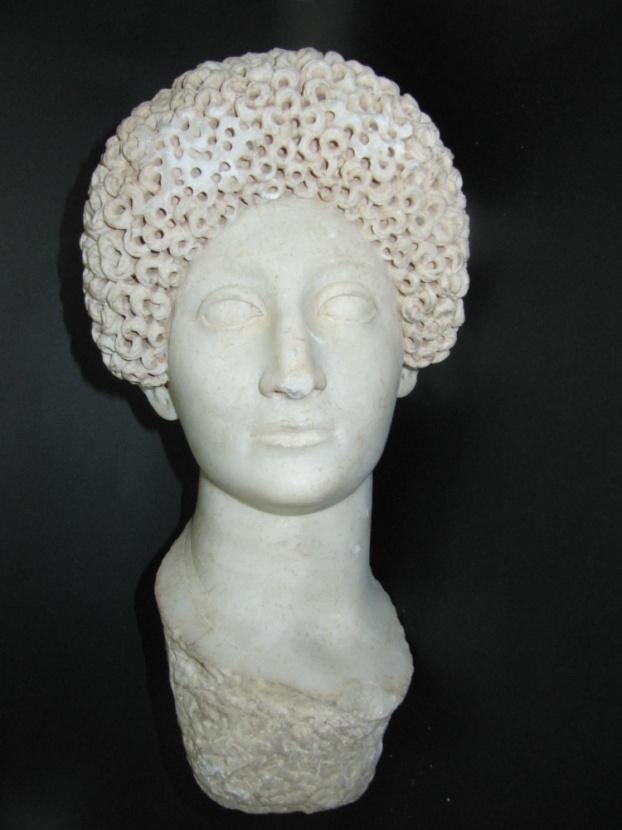
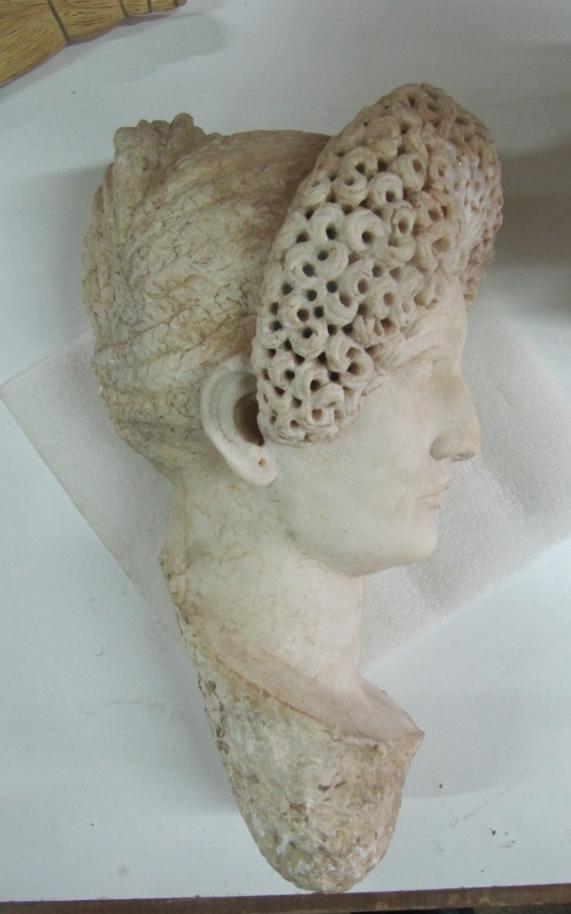
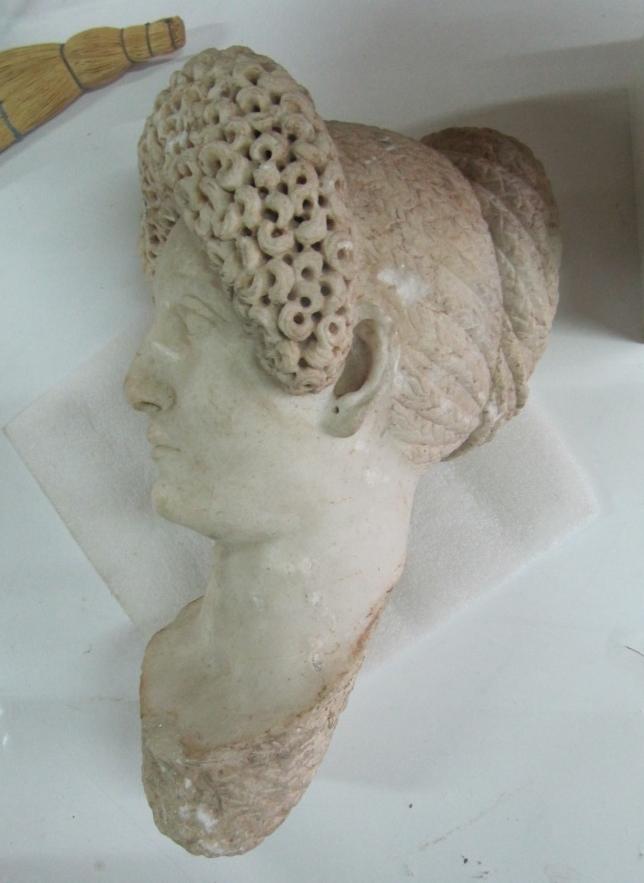
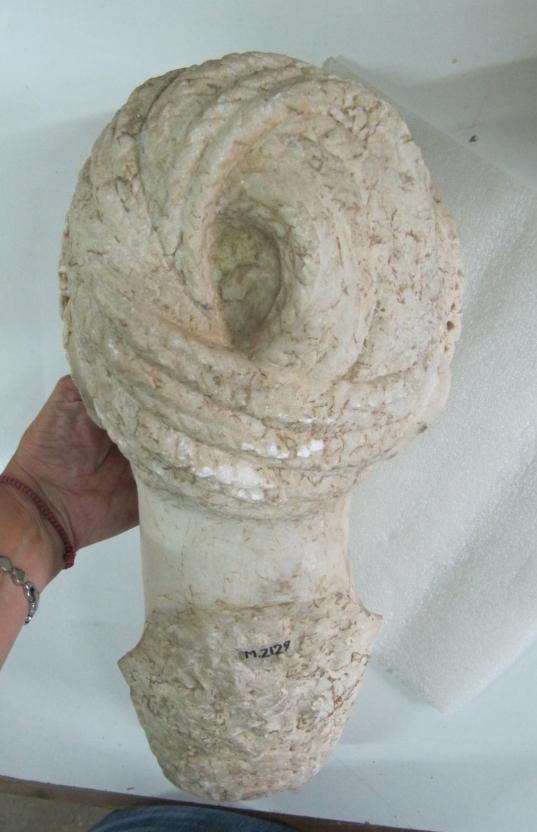
The excellent quality head is preserved essentially intact, together with the neck and tenon for the insertion into the body. The tenon is roughly worked all around with the point. Minor breaks and chipping are evident at the tip of the nose, the headdress above the right eye, and the back of the head. It depicts a young woman turning slightly to the right. She has a smooth oval face, with large almond-shaped eyes with wide lids (the iris and pupil were rendered in paint), eyebrows defined by sharp ridges on the surface of the marble, and a thin mouth. The drill has been used to define the nostrils, to delineate the corners of the mouth, as well as extensively in the coiffure. The neck bears two “Venus rings”. The earlobes sport holes for the attachment of metal earrings. The coiffure consists of two parts. A voluminous lunate mass of spiral, worked with the drill, locks of hair frame the face (half-covering the ears; the texture of the individual strands of hair is rendered by means of engraved parallel lines on the surface of the marble), while the back half of the skull is covered by a pattern of parallel braids. More specifically, the mass of hair at the back of the head consists of narrow tight braids with a diagonal direction that gather at the nape and form a bun in the form of a loop. The texture of the individual strands of hair on the surface of the braids is indicated by detailed engraving of triangles and zigzag lines. The coiffure draws upon the official iconography of Julia, daughter of emperor Titus, and the empress Domitia, placing the portrait in the decade 80-90 CE (see Kalavria 2015, 249-250; cf. also the head from Edessa in the Archaeological Museum of Thessaloniki, G. Despinis, Th. Stefphanidou-Tiveriou, E. Voutiras eds., Κατάλογος γλυπτών του Αρχαιολογικού Μουσείου Θεσσαλονίκης ΙΙ, Thessaloniki 2003, 135-136, cat. no. 256, figs. 755-758 [Th. Stephanidou-Tiveriou].
Th. Karagiorga-Stathakopoulou, “Οδός Προφήτου Δανιήλ 18”, ArchDelt 33 (1978), 21, pl. 12γ; P. Zoridis, “Two new Roman Portraits from Athens”, AJA 88 (1984), 592-594, pl. 79 (Julia Titi); E. Kalavria, Αττικά πορτρέτα κατά την εποχή της ρωμαιοκρατίας (1ος αι. π.Χ. - αρχ. 2ου αι. μ.Χ.), ζητήματα τυπολογίας, λειτουργίας και παραγωγής (PhD thesis, National and Kapodistrian University of Athens), Athens 2015, 249-250, 486-487, cat. no. 90, pl. 90 (shortly after 80 CE).