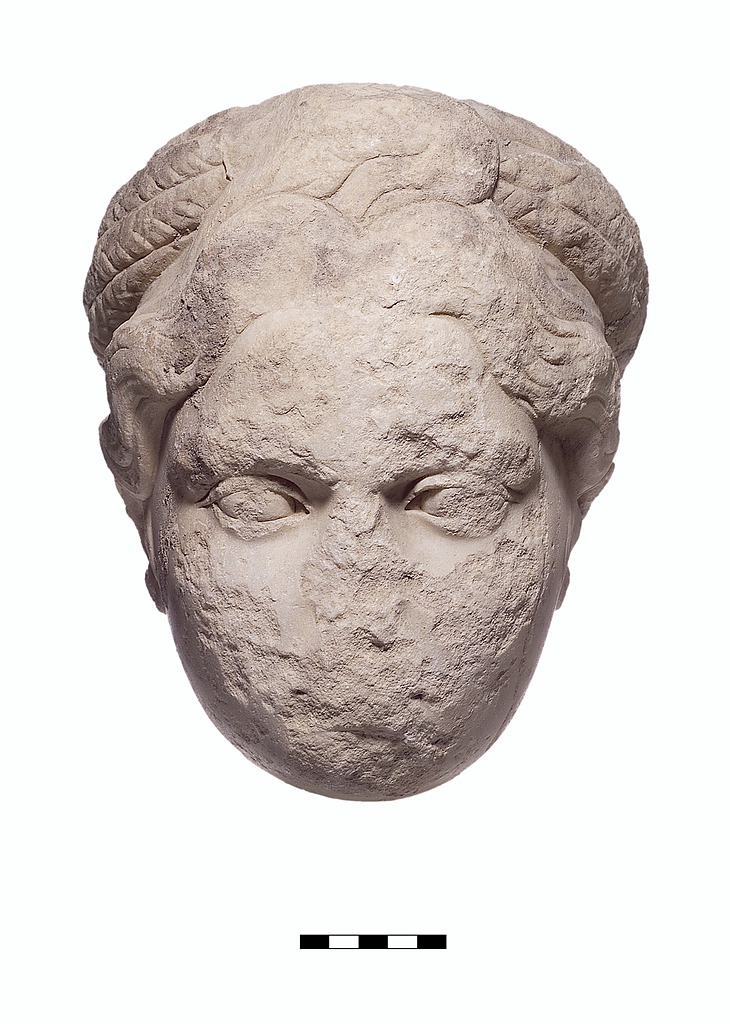
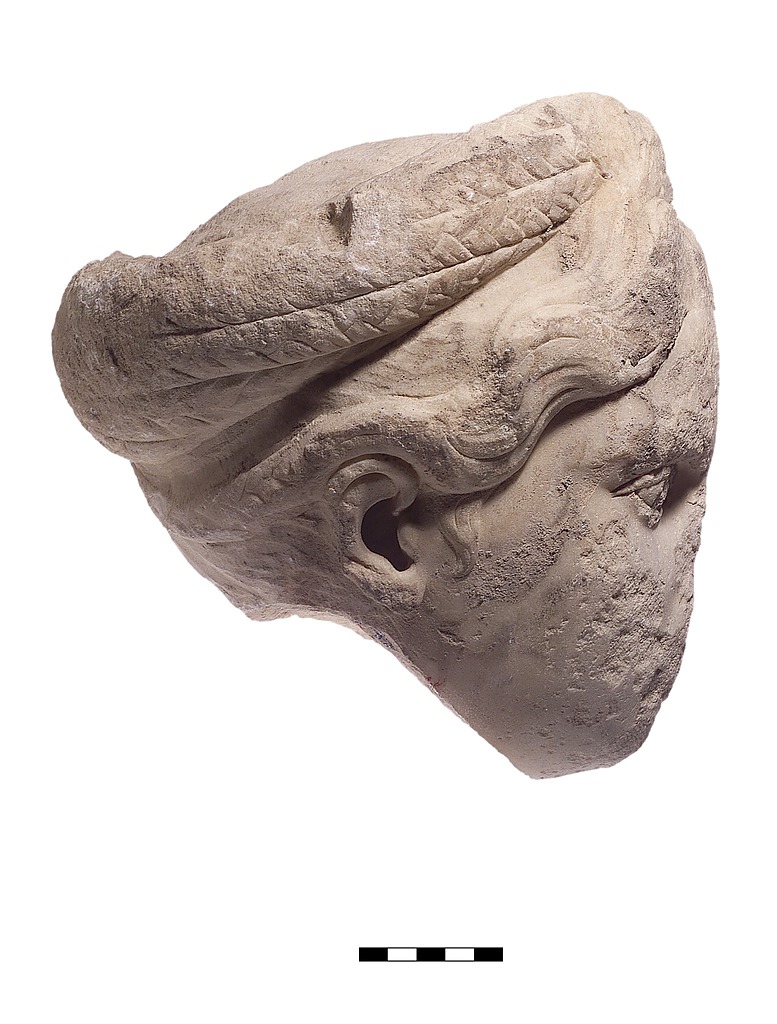
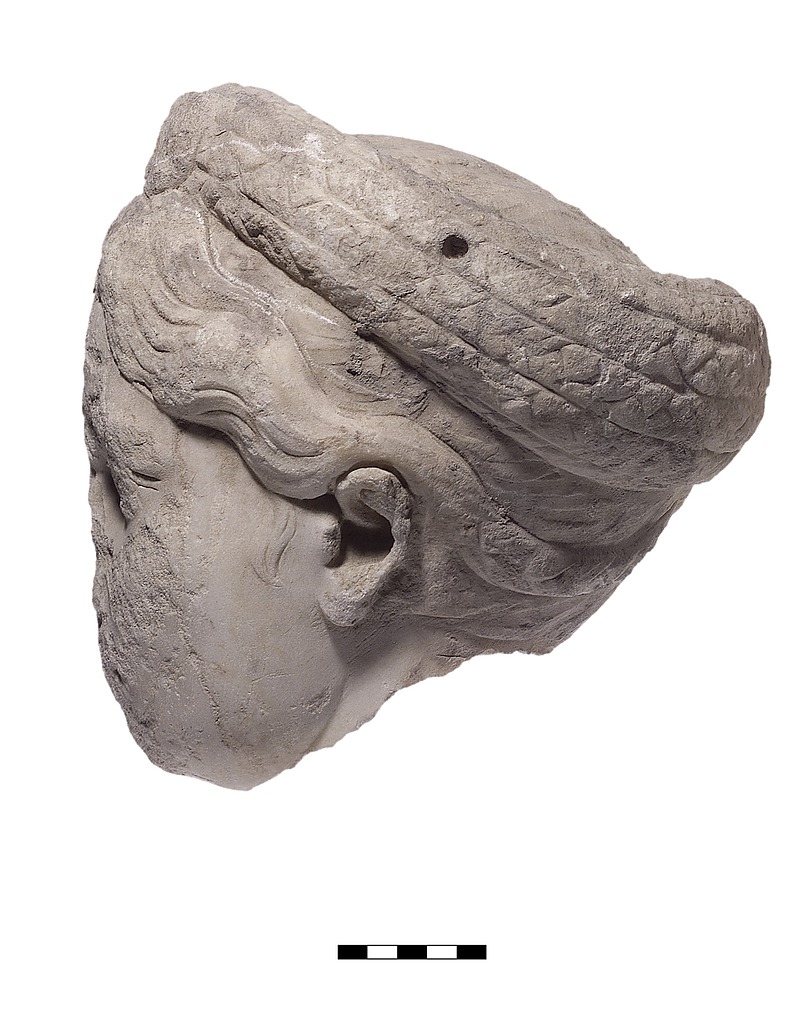
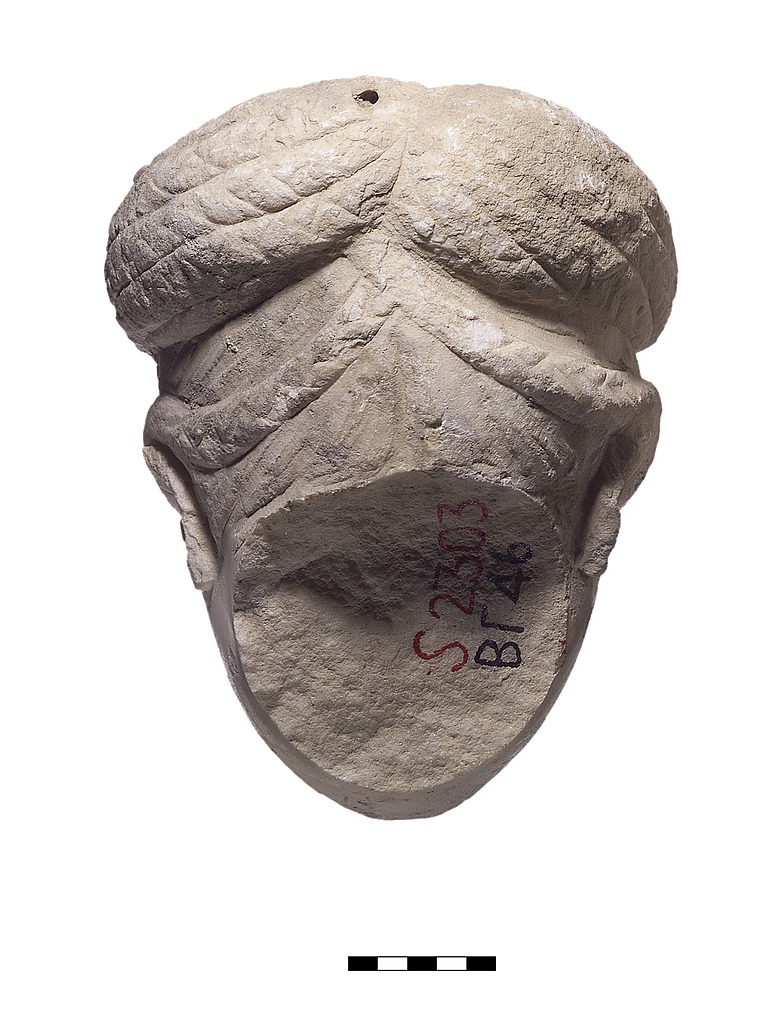
The head is in a relatively good state of preservation. Most of the face is battered, with the part immediately below the chin, as well as the lower back section, broken off. From the face, only the eyes (the left one is in a better state of preservation) and the lateral part of the cheeks with the temples, are preserved. The small drill-holes at the corners of the mouth can also be discerned. It depicts a young woman with a full oval face, almond-shaped eyes with wide upper lids (as far as one can tell the iris and pupil are not indicated), and a smoothly polished face. The headdress is in good condition. The hair is parted at the center and frames the face in undulating waves (the texture of the individual strands of hair is rendered by incised with the point parallel curved lines) directed towards the back of the head (leaving the ears uncovered), where they are woven into braids that wrap around the top of the skull creating a “turban”-like arrangement (also a hook-shaped lock of hair falls freely on the surface of each temple). The “turban” consists of four overlapping braids and starts from the back of the head, where the braids cross to form a kind of double arch resembling a goose’s tail (“Entenschwanz”), as seen also at the back of the head inv. no. 6686 of the Archaeological Museum of Thessaloniki (G. Despinis, Th. Stephanidou-Tiveriou, E. Voutiras eds., Κατάλογος Γλυπτών του Αρχαιολογικού Μουσείου Θεσσαλονίκης ΙΙ, Thessaloniki 2003, 169-171, cat. no. 279 figs. 846–849 [Th. Stephanidou-Tiveriou]). The same type of headdress is attested again on the Hadrianic head {Γ85} from Kenchreai, near Corinth (see in the same entry analysis with bibliography), while from the Athens Agora comes also a slightly earlier version of the same type of coiffure ({Γ50}). The present head S 2303 must also be dated to the Hadrianic period.
L.A. Riccardi, “Roman Portraits from the Athenian Agora: Recent Finds”, in J.McK. Camp, C.A. Mauzy eds., The Athenian Agora: New Perspectives on an Ancient Site, Mainz am Rhein 2009, 55, fig. 55 (late first or early second quarter of the 2nd c. CE); L.A. Riccardi, “Homage and Abuse: Three Portraits of Roman Women from the Athenian Agora”, in K. Daly, L.A. Riccardi eds., Cities Called Athens: Studies Honoring John McK. Camp II, London 2015, 322–325 (115-125 CE; the eyes intentionally damaged); S. Dillon, “Female Portrait Statuary in Roman-period Athens: the Epigraphic and Sculptural Evidence”, Eugesta 13 (2023), 17, figs. 9-12; https://agora.ascsa.net/id/agora/object/s%202303?q=S%202303&t=&v=list&sort=&s=1