
 Museum/Current place of storage:
 |
Corinth, Archaeological Museum. |
 Inv. no:
 |
S 2585 |
 Dimensions:
 |
|
 Material:
 |
H. 0,28m., w. 0,175m., th. 0,215m. |
 Findspot:
 |
Found before 1918 in Kenchreai. Brought to the Corinth Museum from (New) Corinth, where it was originally donated to the municipality by the “Saint Paul” society (A. Philadelpheus, “Ευπρεπισμός και νέα προσκτήματα του Μουσείου Κορίνθου”, ArchDelt 4 (1918), Appendix, 2; according to the Corinth Excavations database, in the area of the Early Christian basilica of Kenchreai - https://corinth.ascsa.net/id/corinth/object/s%202585?q=S%202585&t=&v=list&sort=&s=1; for the basilica see D. Pallas, “Η βασιλική των Κεγχρεών”, Epeteris tis Etaireias Byzantinon Spoudon 47 [1987-1989], 295-309 [formerly an Iseion ?]). |
 Original Display Location:
 |
Unknown. |
 Date:
Date: |
Period of Hadrian. |
 Statuary Type (body) :
 |
- |
 Mode of Self-Representation (head):
 |
The hairstyle follows contemporary imperial fashion protypes (“ModeFrisur”), while the face is idealized. |
 Civic Presence (Social Role Represented):
 |
Unknown. |
 Inscribed Base:
 |
No |
 Author:
 |
Panagiotis Konstantinidis |
 Added:
 |
2024-09-18 |
 Edited:
 |
Description - Comments:
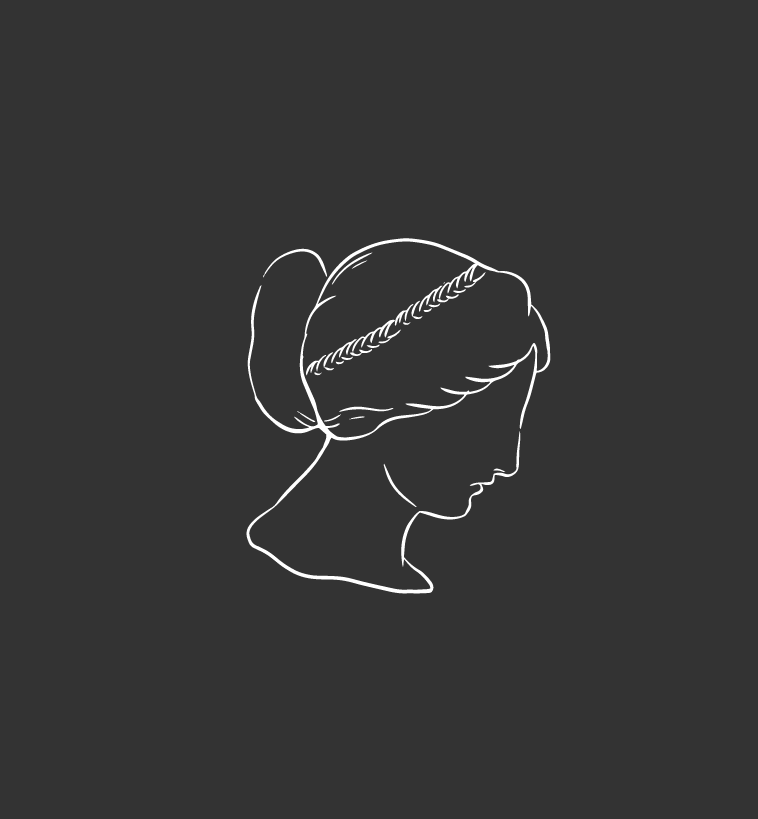
The head is fairly well preserved, with part of the neck. The nose, left eyebrow and upper right part of the coiffure are broken. Smaller breaks and chipping are evident sporadically on the surface of the marble, especially on the cheeks, chin, forehead and coiffure. The entire area behind the ears is coarsely chiseled with no rendering of details, indicating that it was not meant to be seen. It depicts a young woman with an oval, smooth face, small eyes with wide protruding upper lids, and a narrow mouth with fleshy lips. Thin eyebrows end in sharp edges. The iris and the pupil are not marked (for the non-marking of the iris and the pupil in Greek workshops see G. Despinis, Th. Stephanidou-Tiveriou, E. Voutiras eds., Κατάλογος Γλυπτών του Αρχαιολογικού Μουσείου Θεσσαλονίκης ΙΙ, Thessaloniki 2003, 170 note 3 in cat. no. 279 [Th. Stephanidou-Tiveriou]), conversely to the tear-duct, marked with a small drill. The coiffure is organized into two separate parts. Around the face there is a section of flat (worked with the flat chisel) interlocking locks that form a flowing tongue-like pattern, ending on either side in a wide spiral lock on the temples (the ears are left completely uncovered). Above this section, a kind of tower-like “turban” is formed, that consists of five superimposed and partially overlapping braids (the texture of the hair on their surface is rendered by zigzag incisions). The upper part of the skull that is left uncovered by the “turban” is left coarsely chiseled. The type of coiffure (tower-like “turban” combined with an interlocking pattern of free locks of hair around the face), as well as the rendering of the upper eyelids indicate a dating in the principate of Hadrian for the Kenchreai head (for the tower-like “turban” coiffure of the period of Hadrian see Despinis et al. 2003, 170 note 1 in cat. no. 279 [Th. Stephanidou-Tiberiou]; K. Fittschen, “Über die Haartrachten von Kaiserinnen und Bürgerinnen in der mittleren Kaiserzeit”, ÉtTrav 25 [2012], esp. 110-111 with bibliography). More specifically, the configuration present here, with the interlocking pattern of tongue-shaped locks around the face could be construed as a version of the similar intertwined pattern on the Hadrianic portrait-bust of Sozusa, freedwoman of P. Aelius Lycus, from Rome, today at Chatsworth House (see D. Boschung, H. von Hesberg, A. Linfert, Die antiken Skulpturen in Chatsworth sowie in Dunham Massey und Withington Hall, CSIR Great Britain 3.8, MAR 26, Mainz am Rhein 1997, cat. no. 54; Fittschen 2012, 110 note 59, fig. 2, with bibliography), which in turn is influenced by the official iconography of the empress Sabina’s half-sister, Matidia the Younger. Cf. also the coiffure of the Small Herculaneum Woman portrait statue in the Capitoline Museum in Rome (Palazzo Brachi Salla Minore), K. Fittshen, P. Zanker, Katalog der römischen Porträts in den Capitolinischen Museen und den anderen kommunalen Sammlungen der Stadt Rom III, Mainz am Rhein 1983, cat. no. 85, pl. 107 (late period of Hadrian). Good quality of workmanship.
Bibliography:
A. Philadelpheus, “Ευπρεπισμός και νέα προσκτήματα του Μουσείου Κορίνθου”, ArchDelt 4 (1918), Appendix, 2, fig. 2; C. De Grazia, Excavations of the American School of Classical Studies at Corinth. The Roman Portraiture (PhD thesis, Columbia University), New York 1973, 30, 137-140, cat. no. 23, pls. 30-31 (late Hadrianic period); https://corinth.ascsa.net/id/corinth/object/s%202585?q=S%202585&t=&v=list&sort=&s=1