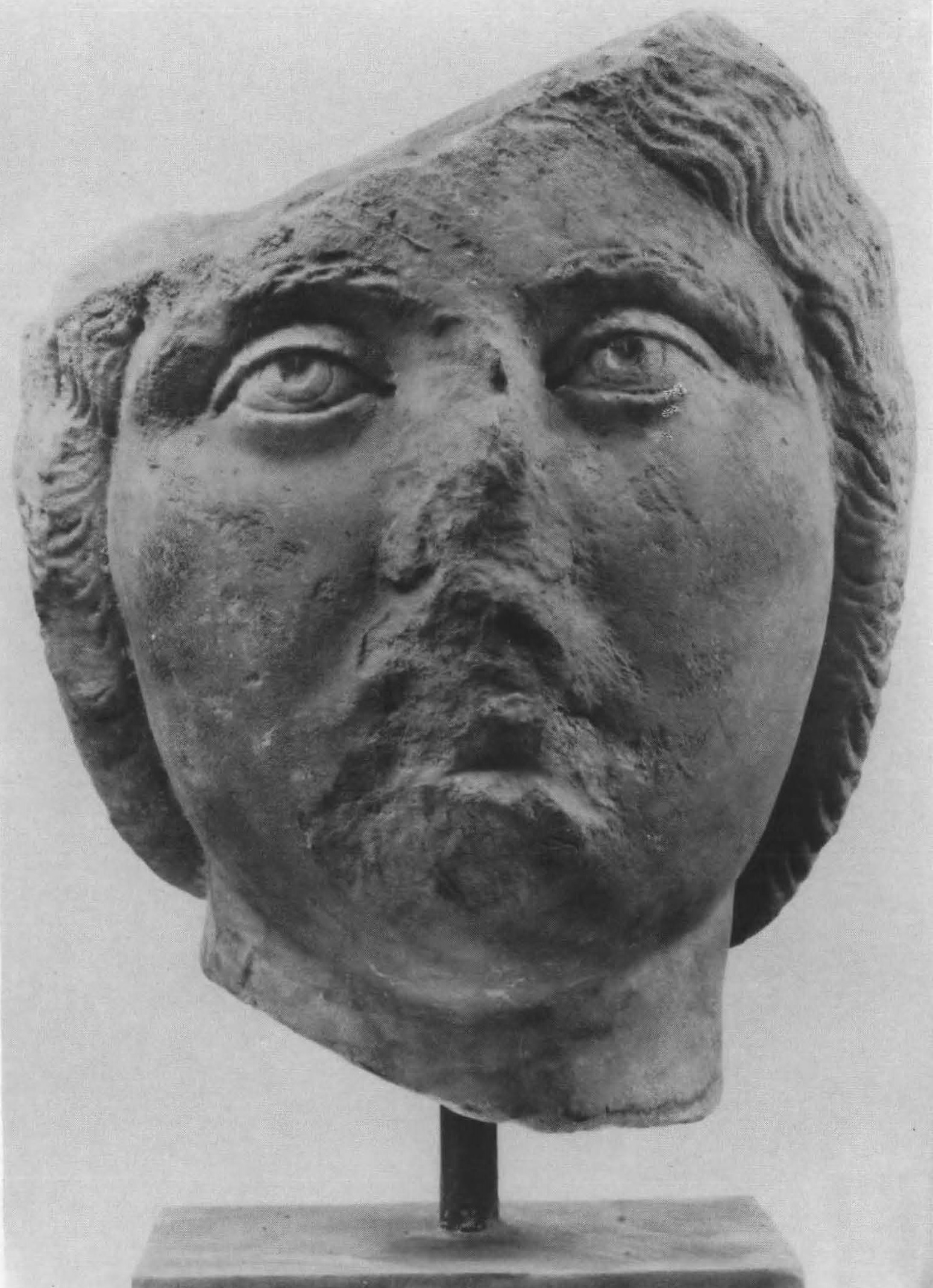
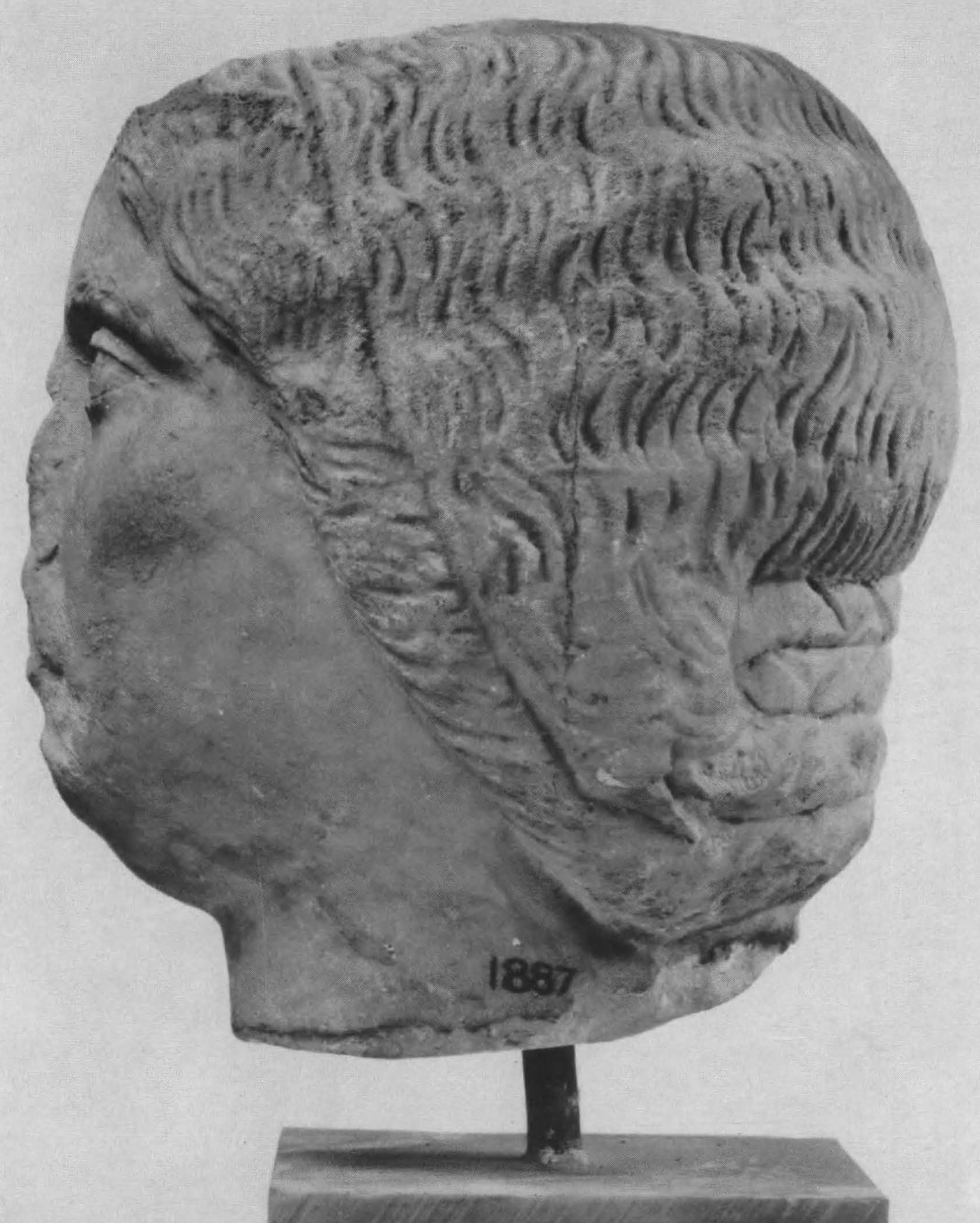
The head is relatively well preserved, together with the beginning of the neck. The upper right part of the head is missing, cut off diagonally. The nose, mouth and chin are also broken off. Smaller breaks and chipping are evident sporadically on the surface of the marble, especially on the forehead, cheeks and headdress. The head depicts a mature woman with a plump face, full cheeks, small eyes with wide lids and slightly accentuated nasolabial folds (individual characteristic?). The iris and (round-shaped) pupil of the eyes, as well as the tear-duct, are marked. The eyebrows are broad, with the texture of the individual hairs indicated by means of engraved overlapping lines on the surface of the marble. The coiffure is divided into two sections. The face is framed by a wavy mass of hair which is further down (at approximately the height of the temples) woven into a twisted braid (an incision separates this part of the coiffure form the rest of the headdress). The entire back of the head is covered by a wavy mass of hair at the top and a rectangular flat bun at the nape, formed by a winding braid. The coiffure draws upon the official iconography of Julia Domna of the period 206-217 CE, and hence should be dated to the same period (cf. K. Wessel, “Römische Frauenfrisuren von der severischen bis zur konstantischen Zeit”, JdI 61/62 [1946/1947], 62-64, pl. I; J. Meischner, Das Frauenporträt der Severerzeit, Berlin 1967, pl. 1, no. 4b).
P. Kastriotis, Γλυπτά του Εθνικού Μουσείου: κατάλογος περιγραφικός, Athens 1908, 331, no. 1887; A. Datsouli-Stavridi, “Γυναικεία πορτρέτα της εποχής των Σεβήρων στο Αρχαιολογικό Μουσείο Αθηνών”, ArchEph 1979, 227-229, pl. 70α-β.