
 Museum/Current place of storage:
 |
Patras, Archaeological Museum. |
 Inv. no:
 |
643 |
 Dimensions:
 |
|
 Material:
 |
H. 1,73m. |
 Findspot:
 |
In the period 1973-1974 in the north cemetery of Patras, incorporated broken into numerous fragments into several walls of an Early-Christian building, built over an earlier Roman funerary building (plot of 139, Kanakari street; Agallopoulou 1973/1974, 400, plan 3). |
 Original Display Location:
 |
Possibly from the mausoleum excavated in the adjacent plot of 80-82 Ermou street, set up on one of the two aisles of the podium of the northwestern part of the mausoleum, that sported one statue base each. |
 Date:
Date: |
First half of the 1st c. CE. |
 Statuary Type (body) :
 |
“Formia” type. |
 Mode of Self-Representation (head):
 |
- |
 Civic Presence (Social Role Represented):
 |
Unknown (probably a member of a local elite family). |
 Inscribed Base:
 |
No |
 Author:
 |
Panagiotis Konstantinidis |
 Added:
 |
2024-09-12 |
 Edited:
 |
Description - Comments:
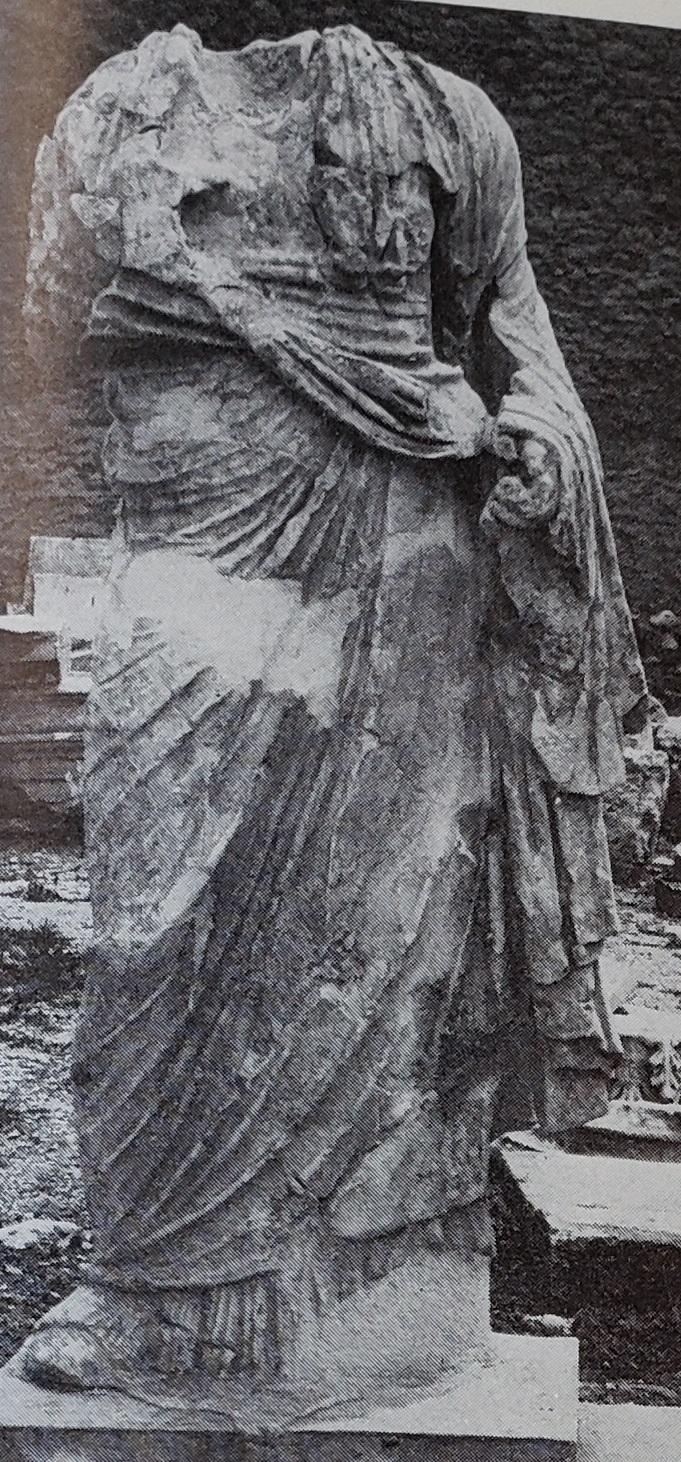
The statue is put back together from several individual fragments. The inset head, the right hand, some fingers from the left hand, the left foot as well as parts of the body, now completed with plaster, are missing. Many smaller breaks and chipping are evident sporadically on the surface of the marble, especially on the drapery of the garments. It depicts a standing, frontal female figure wearing a long chiton, a himation that wraps tightly around the body, and closed leather shoes (calcei muliebres). The weight of the body falls on the left leg, while the right leg is slightly bent. It belongs to the so-called “Formia” statuary type. More specifically, the himation wraps tightly under the chest, while its front edge creates a characteristic triangular shape along its course from the right shoulder (covering the whole of the right arm except for the wrist) to the slightly bent left forearm (its edge falls on the left forearm, leaving the wrist uncovered). The “soft” rendering to the drapery of the garments places the work in the first half of the 1st c. CE (cf. the drapery of the portrait-statues from Sikyon {Γ86}-{Γ87}, dated to the principate of Claudius). The statue most likely does not belong to the Roman funerary building excavated in the 139 Kanakari street plot, which was succeeded by the Early-Christian building into the walls of which the statue was found, since, based on its architectural remains and type, it did not have sculptural decoration, even more so sculptures in the round (I. Dekoulakou, “Monumenti delle necropolis di Patrasso durante il dominio romano”, in Patrasso colonia di Augusto e le trasformazioni culturali, politiche ed economiche della Provincia di Acaia agli inizi dell'età imperiale romana: atti del Convegno internazionale, Patrasso 23 - 24 March 2006, Atene 2009, 180-181 figs. 12-14). Nevertheless, the statue’s findspot and dating (first half of the 1st c. CE), makes its very likely that It originally stood on one of the two wings of the pedestal of the northwest facade of the Roman naiskos-type mausoleum excavated in the immediately adjacent plot, 80-82 Ermou street (it is dated, based on the excavation finds, to the 1st c. CE; Dekoulakou 2009, 191-196, figs. 21-24; see also {Γ68}). More specifically, this building had on its northwest side, where the ancient road of the cemetery passed, a naiskos-type facade with a two-aisled podium; each of the two aisles carried a statue base. The central part of the podium, which formed a kind of rectangular niche, sported low on the street level a bench – a place of resting for the passers-by of the cemetery road and the cemetery’s visitors in general (exedra) - hence indicating the “opening” of the building to the public space of the necropolis. Another statue is said to have been incorporated in fragments in the same Early-Christian building (Agallopoulou 1973/1974, 400), and may have been the statue that stood on the base of the other aisle of the mausoleum’s podium. The woman depicted was probably a member of an eminent family of Patras, whose members were buried successively in the mausoleum of 80-82 Ermou Street, representing the elite-status of her family in the public space of her community (for the possible identification of the family of the mausoleum with that of the freedman Sextus Aequanus, whose daughter, Aequana Musa, was a priestess of Augustus and Livia as Diana Augusta Laphria (CIL III, 510) see I. Dekoulakou, “Ρωμαϊκό μαυσωλείο στην Πάτρα”, in Στήλη. Τόμος εις μνήμην Νικολάου Κοντολέοντος, Athens 1980, 567, 575; for the persons mentioned above, as well as the family in general, see A. Rizakis, S. Zoumbaki, Roman Peloponnese I. Roman Personal Names in Their Social Context, Athens 2001, 54 -56, nos. ACH 14-19).
Bibliography:
P. Agallopoulou, “Πάτρα. Οδός Κανακάρη 139”, ArchDelt 29 (1973/1974) Β2, 400, pl. 257α; A. Filges, Standbilder jugendlicher Göttinnen, Köln-Weimar-Wien 1997, 162 note 640 no. 9; N. Kazakidi, “Ένα οικογενειακό σύνταγμα ανδριάντων της εποχής του Κλαυδίου και το γυμνάσιο στη Σικυώνα”, in Th. Stephanidou-Tiveriou, P. Karanastasi, D. Damaskos eds., Κλασική παράδοση και νεωτερικά στοιχεία στην πλαστική της ρωμαϊκής Ελλάδας. Πρακτικά διεθνούς συνεδρίου, Θεσσαλονίκη, 7-9 Μαΐου 2009, Thessaloniki 2012, 206 note 45 (the possibility should be explored that the present portrait-statue and the portrait-statue {https://achaeanwomen.eie.gr/γλυπτό/?statue_id=662} belong to the same funerary monument); S. Tuccinardi, “Sculture romane da Formia. Una proposta di lettura in contest”, in C. Capaldi, C. Gasparri eds., Complessi monumentali e arredo scultoreo nella Regio I Latium et Campania: nuove scoperte e proposte di lettura in contest. Atti del convegno internazionale, Napoli, 5 e 6 dicembre 2013, Napoli 2017, 61 note 88; P. Konstantinidis, Γυναικείοι δυναστικοί εικονιστικοί ανδριάντες αυτοκρατορικής περιόδου από την Ελλάδα (τέλη 1ου αι. π.Χ. – 5ος αι. μ.Χ.), Athens 2024, 223 note 185.