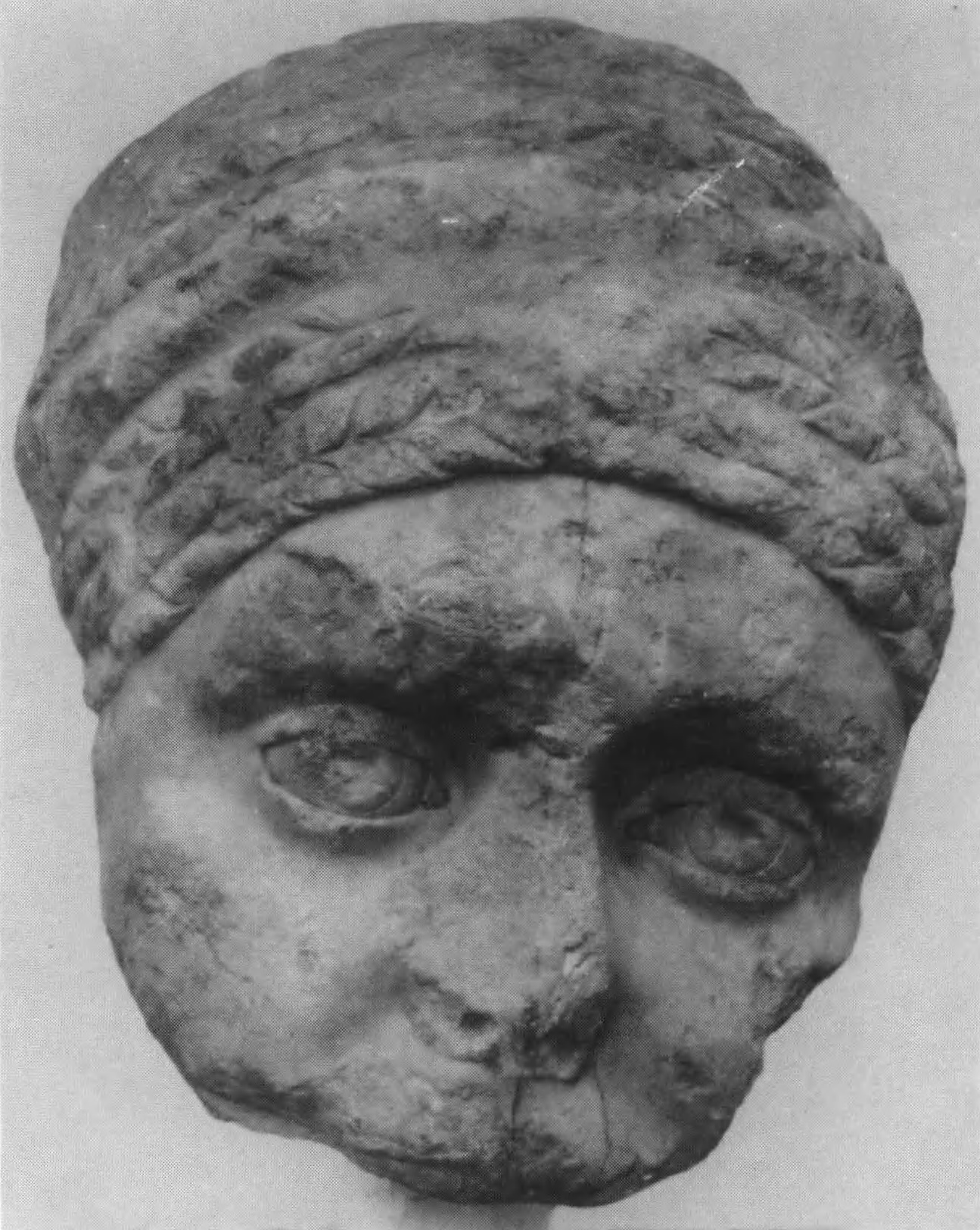
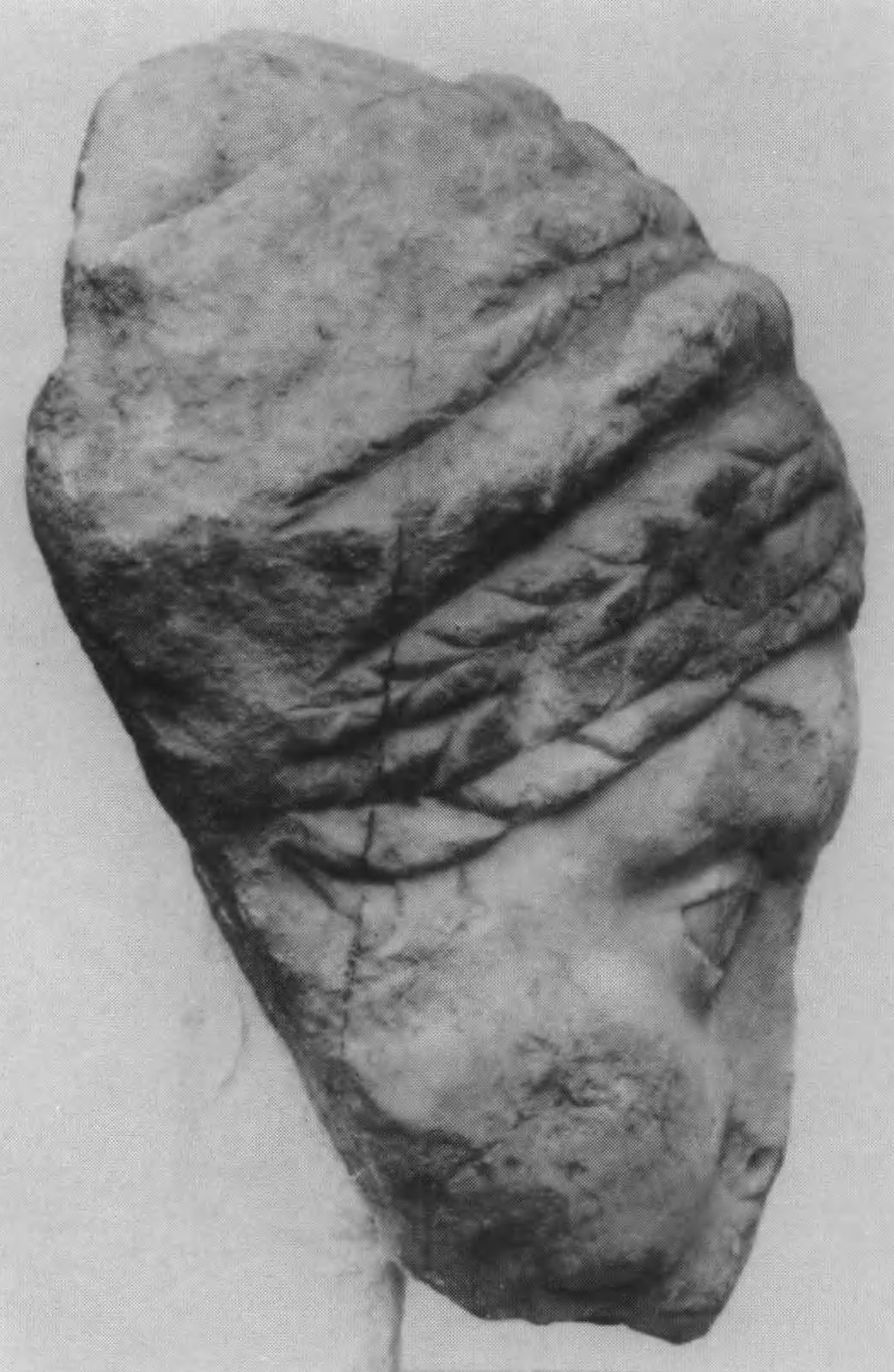
Only the front part of an over-life-sized head is preserved, from the upper lip to the top of the skull. Broken diagonally at the back. Chipping and minor breaks are evident sporadically on the surface of the marble, especially in the area of the eyebrows. The nose is broken (only two small drill-holes for the nostrils survive). The eyes are almond-shaped, with thick lids and the iris and pupil marked (the pupil with the drill). The somewhat accentuated nasolabial lines probably constitute an individual characteristic of the woman depicted. Five bipartite braids are wrapped around the skull, arranged one above the other, starting at the forehead. The circular bulge at the height of the third braid (broken in places) is probably a strophion. The texture of the hair on the surface of the braids is rendered by oblique incisions. A small lunate lock of hair is detached from the main headdress in the area in front of the ears. The hairstyle belongs to the “TurbanFrisur” type (see K. Fittschen, “Über die Haartrachten von Kaiserinnen und Bürgerinnen in der mittleren Kaiserzeit”, ÉtTrav 25 [2012], 110-114; cf. also the portrait heads {Γ30} and {Γ40}). The absence of locks of hair framing the face beneath the braids is seen again in a portrait bust in the Capitoline Museum in Rome (Palazzo dei Conservatori Fasti Moderni III 15) inv. 863: K. Fittshen, P. Zanker, Katalog der römischen Porträts in den Capitolinischen Museen und den anderen kommunalen Sammlungen der Stadt Rom III, Mainz am Rhein 1983, 62-63, cat. no. 84, pls. 105-106, late Hadrianic period. To the period of Hadrian the Heraion head must also be dated. According to C. Waldestein (1902, 141, fig. 72) the head belonged together with five other body fragments to the same (according to him seated) statue.
C. Waldstein, The Argive Heraeum I, Boston 1902, 141-142 (III), εικ. 72; P. Kastriotis, Γλυπτά του Εθνικού Μουσείου: κατάλογος περιγραφικός, Athens 1908, 366, αρ. 2138-2159; A. Datsouli–Stavridi, «Πορτραίτα του Εθνικού Αρχαιολογικού Μουσείου», ArchEph 1983, 203-204, αρ. 2141, pl. 70γ-δ (reign of Hadrian).