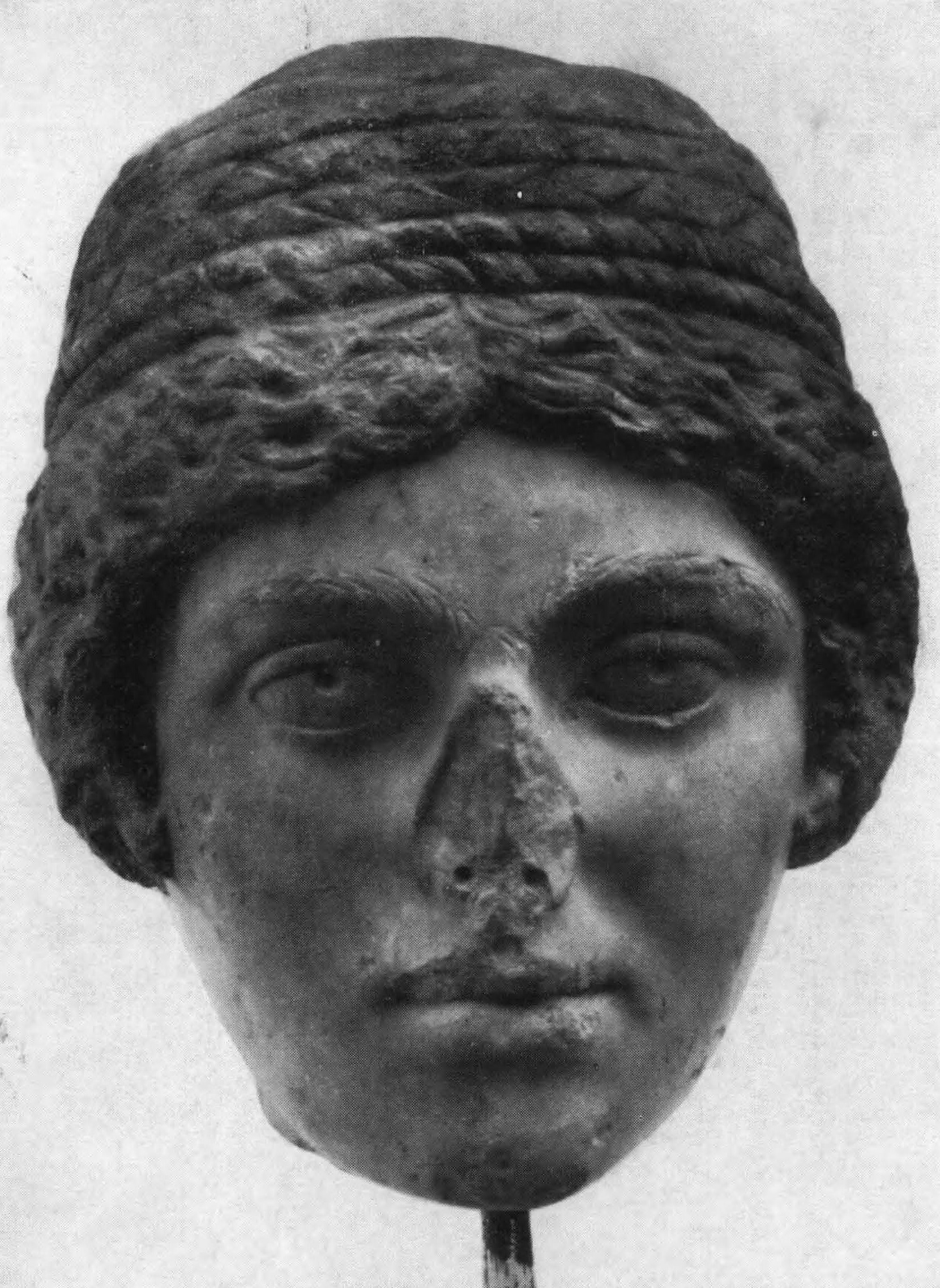
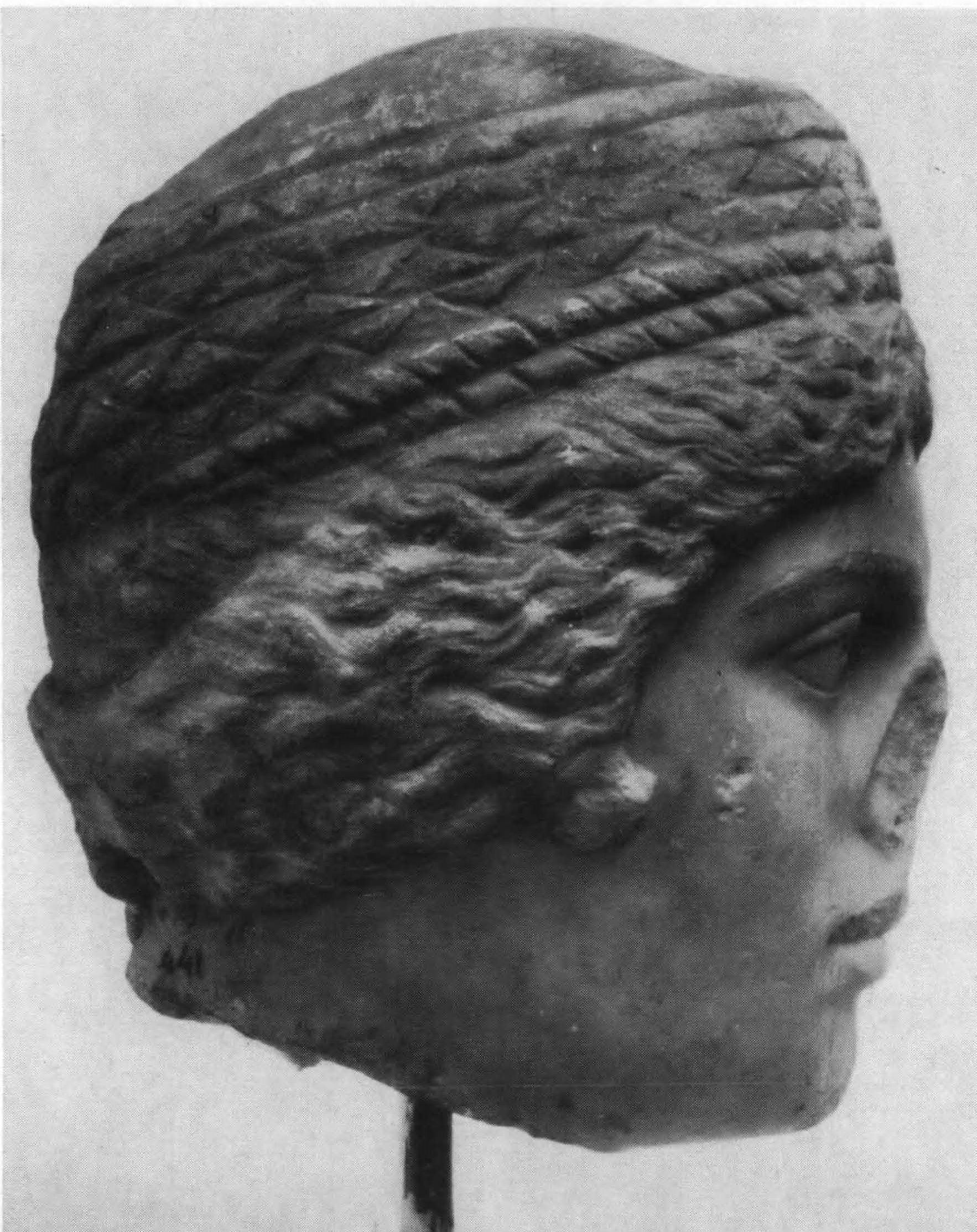
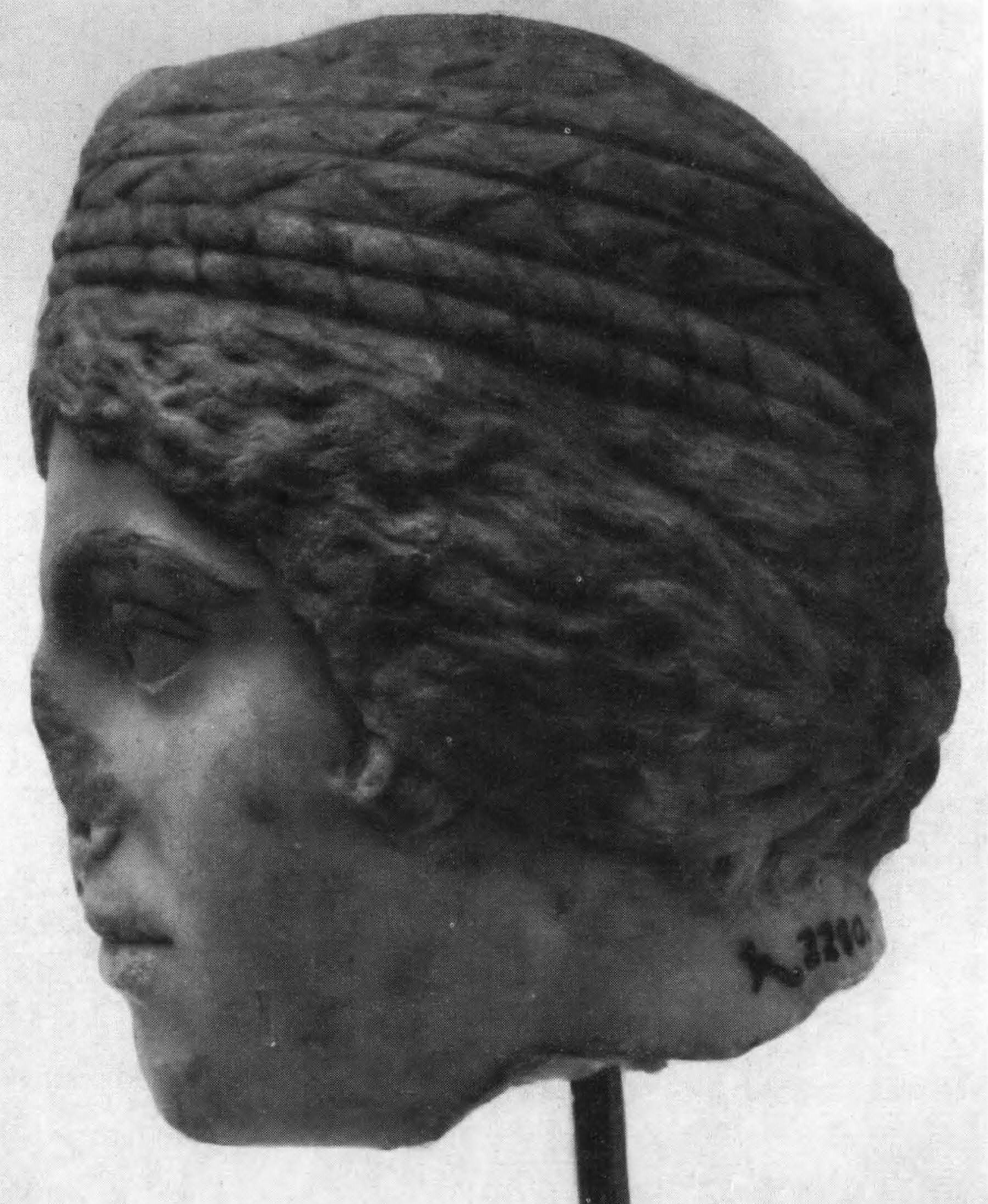
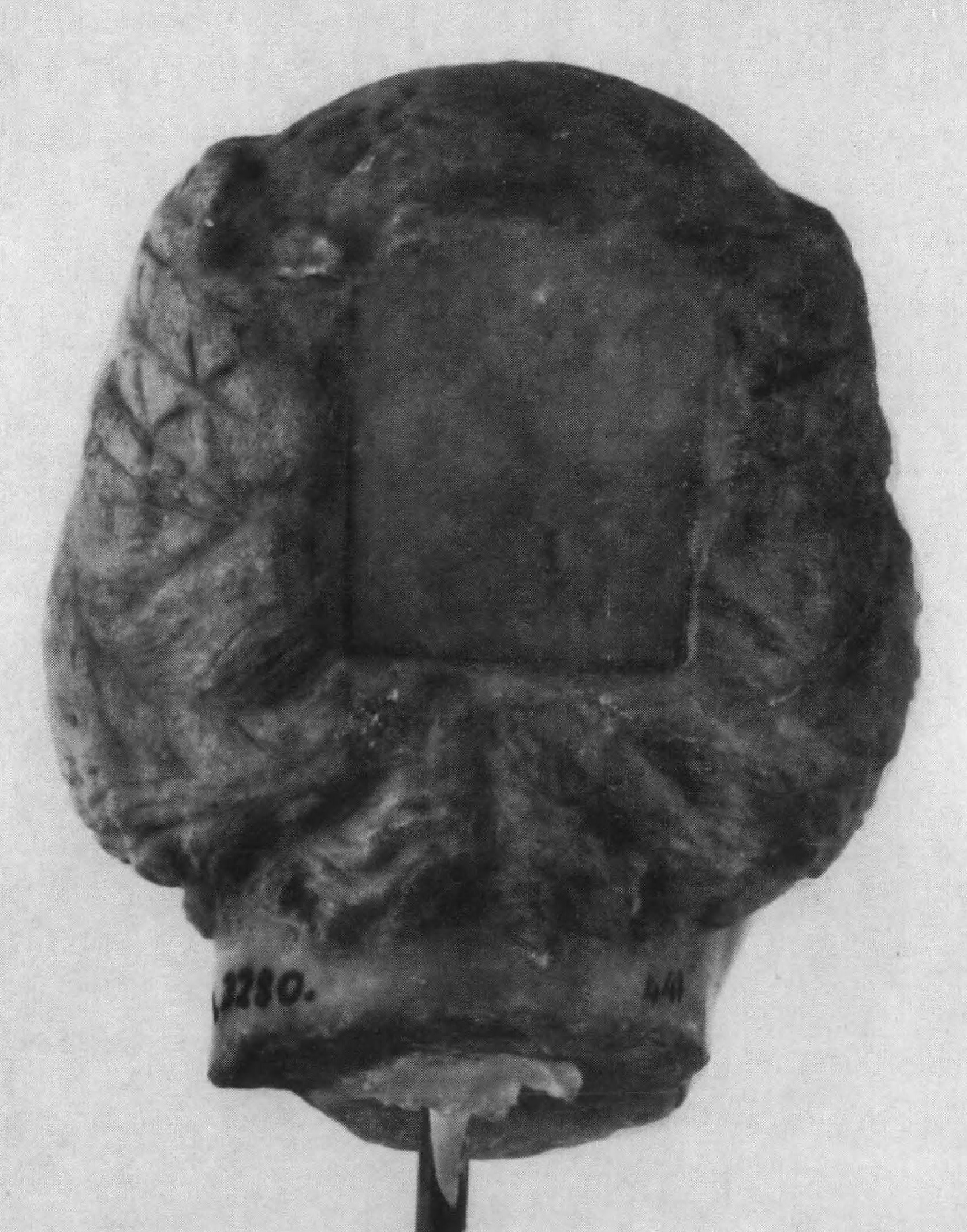
The head is well preserved. The nose is broken off, while chipping is evident sporadically on the forehead, eyebrows, cheeks, lips, chin and coiffure. At the back of the head, part of the headdress – carved separately - is missing. The almost rectangular dowel socket (dimensions according to I. Chioti: h. 0.88m, w. 0.72m [top], 0.67m [bottom], th. 0.04m) is still preserved at the back of the head. The latter depicts a young woman with an oval plump face, smooth cheeks, accentuated nasolabial folds and unibrow (the texture of the individual hairs is rendered with small diagonal incisions). The eyes are almond-shaped, with broad lids, and the iris, pupil (shield-shaped - see P. Konstantinidis, Γυναικείοι δυναστικοί εικονιστικοί ανδριάντες αυτοκρατορικής περιόδου από την Ελλάδα [τέλη 1ου αι. π.Χ. – 5ος αι. μ.Χ.], Athens 2024, 397-398, notes 524 and 531) and tear-ducts marked. The mouth is narrow, with fleshy lips. The coiffure is structured in two parts. In the lower zone, framing the face, it is divided at the top of the forehead into two equal parts, which are combed with dense overlapping waves towards the back (covering the ears along the way), where they are woven into four braids (their texture is indicated by incised triangles) and two twisted plaits (their texture is indicated by diagonal incisions). The braids and twisted plaits rise from the nape to the upper part of the head (and the headdress), where they wrap around the skull, forming a kind of “turban”, while the top is left free (and roughly worked, indicating that it wasn’t meant to be seen). At the height of the ears, a thick lunate lock of hair is plastically rendered on the surface of the temples, turning towards the cheeks, while small curly locks of hair are also left free on the surface of the nape. The headdress belongs to a wider group of portraits of the late Hadrianic and early Antonine periods which sport a tower-like “turban” configuration consisting of superimposed braids (see K. Fittchen, “Nicht Sabina”, AA 2000, 507-511; Fittschen – Zanker 1983, 65-66 in cat. no. 86; K. Fittschen, “Über die Haartrachten von Kaiserinnen und Bürgerinnen in der mittelren Kaiserzeit”, ÉtTrav 25 [2012], esp. 110-111 with references; cf. also the portrait heads from Athens and Kenchreai, {Γ58} and {Γ85} respectively). Based on the closest parallels of the headdress (see Chioti 2012, 138-139), the head is dated to the early years of the Antonine era, i.e. ca. in the decade 140-150 CE.
P. Kavvadias, Γλυπτά του Εθνικού Μουσείου: κατάλογος περιγραφικός, Athens 1890, 370, no. 441; P. Kastriotis, Γλυπτά του Εθνικού Μουσείου: κατάλογος περιγραφικός, Athens 1908, 78, nos. 439-449; A. Stavridi, “Η εικονογραφία της Φαυστίνας της πρεσβύτερης στον ελληνικό χώρο”, ArchEph 1976, 136-137, pls. 49-50; G. Touchais, “Chronique des fouilles et découvertes archéologiques en Grèce en 1977”, BCH 102 (1978), 642; M. Wegner, R. Unger, “Verzeichnis der Kaiserbildnisse von Antoninus Pius bis Commodus I”, Boreas 2 (1979), 124 (Faustina the Elder); K. Fittschen, P. Zanker, Katalog der römischen Porträts in der Capitolinischen Museen und den anderen kommunalen Sammlungen der Stadt Rom III, Mainz am Rhein 1983, 65 (m), in cat. no. 86; A. Datsouli-Stavridi, Ρωμαϊκά πορτραίτα στο Εθνικό Αρχαιολογικό Μουσείο της Αθήνας, Athens 1985, 61-62, pls. 70-71 (Faustina minor?); I. Romeo. E.C. Portale, Gortina III. Le sculture, Padova 1998, 358; I. Chioti, Αυτοκρατορικά και ιδιωτικά πορτρέτα της εποχής των Αντωνίνων στην Ελλάδα (PhD thesis Aristotle University of Thessaloniki), Thessaloniki 2012, 137, 138-139, 329, cat. no. 163, pl. 131.