
 Museum/Current place of storage:
 |
Athens, sanctuary of Asklepios, storeroom (?). |
 Inv. no:
 |
- |
 Dimensions:
 |
|
 Material:
 |
H. 0,565m., 0,17m. (base), w. 0,49m. (at the shoulders). |
 Findspot:
 |
Despite the Acropolis been mentioned as the findspot of the bust (cf. also the bust {https://achaeanwomen.eie.gr/γλυπτό/?statue_id=517}), the fact that it was stored in the Asklepieion, where it was documented by H. Jucker, probably indicates that the sanctuary is the findspot of the piece (Jucker 1961, 100; for the sanctuary see in brief E. Greco ed., Topografia di Atene I, Atene-Paestum 2010, no. 1.31, 180-183 [M. Saporiti] with bibliography). It is well-known that on the Acropolis were also stored antiquities found lower in the city of Athens (esp. during the 19th c.), while, furthermore, in the past the Ephorate of Antiquities of the Acropolis had in its jurisdiction the whole city of Athens (cf. the unfinished portrait-heads Acropolis Museum inv. 2168 and 2336, the fragment of a portrait head from probably a funerary monument Acropolis Museum inv. 7003, as well as the portrait head Acropolis Museum inv. 13147 stored in the northern tower of the so-called “Beulé Gate”, but found lower in the city, G. Dontas, Corpus Signorum Imperii Romani. Greece I.1 Les portraits attiques au Musée de l'Acropole, Athènes 2004, cat. nos. 31, 34, 75 and 78 respectively; see also ibid. 16-18; in the old Acropolis Museum was also stored the female bust {https://achaeanwomen.eie.gr/γλυπτό/?statue_id=517}). |
 Original Display Location:
 |
In the sanctuary of Asklepios (?). |
 Date:
Date: |
175-190 CE. |
 Statuary Type (body) :
 |
The bust does not follow a specific statuary type (himation-clad woman). |
 Mode of Self-Representation (head):
 |
- |
 Civic Presence (Social Role Represented):
 |
Unknown. |
 Inscribed Base:
 |
No. |
 Author:
 |
Panagiotis Konstantinidis |
 Added:
 |
2024-09-08 |
 Edited:
 |
Description - Comments:
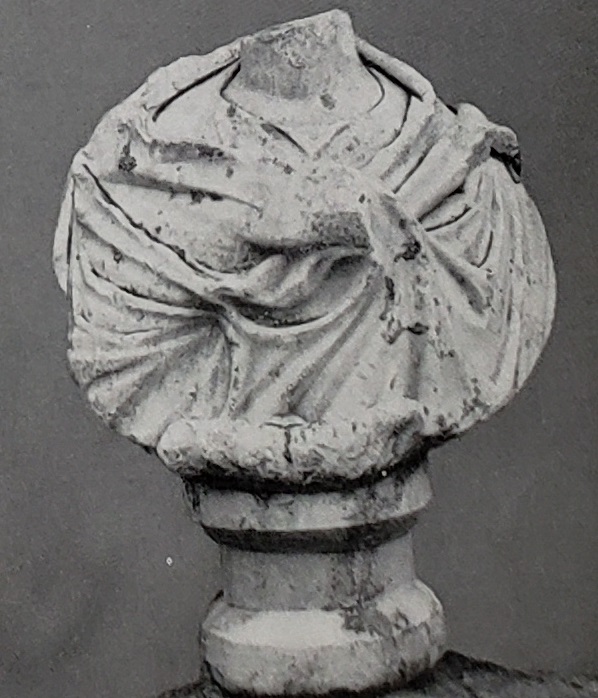
Only the body of the bust with the base are preserved. Small breaks and chipping are evident sporadically on the surface of the marble. A band of acanthus leaves (mostly broken off) is interposed between the circular base and the body of the figure. The latter wears a chiton and wide himation that covers almost the entire torso. The presence of the acanthus leaves probably indicates that the portrait was posthumous (see Jucker 1961, 33-38; other scholars consider the acanthus as a mere symbol of prosperity – see G. Daltrop, review of Jucker 1961, GGA 217 [1965], 247-268; also I. Chioti, Αυτοκρατορικά και ιδιωτικά πορτρέτα της εποχής των Αντωνίνων στην Ελλάδα [PhD thesis Aristotle University of Thessaloniki], Thessaloniki 2012, 32 with bibliography in note 132). The size of the torso and the stylistic rendering of the pleating of the garments place the bust in the late Antonine period (see Jucker 1961, 100 for parallels; for the dating of busts based on form see R.R.R. Smith ed., Aphrodisias II. Roman Portrait Statuary from Aphrodisias, Mainz am Rhein 2006, 227 with note 10 [R.R.R. Smith]).
Bibliography:
H. Jucker, Das Bildnis im Blätterkelch. Geschichte und Bedeutung einer römischen Porträtform, Olten 1961, 100, cat. no. St 48, pl. 41.