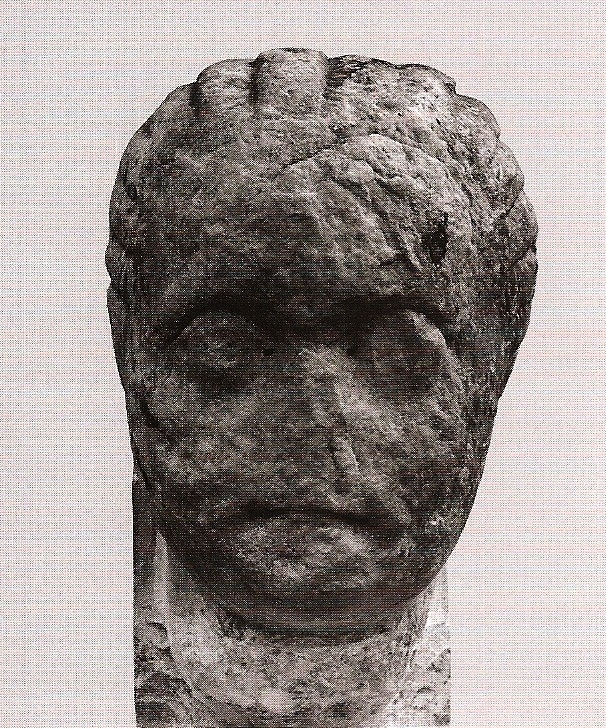
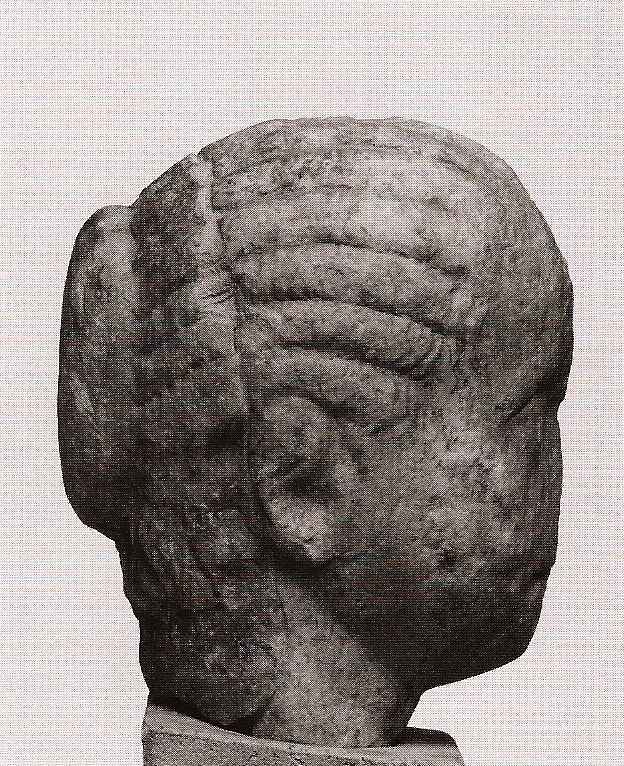
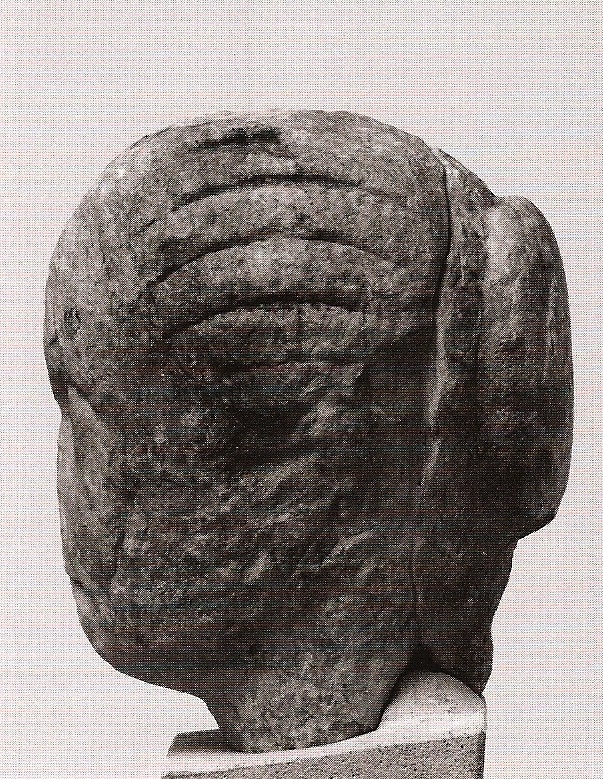
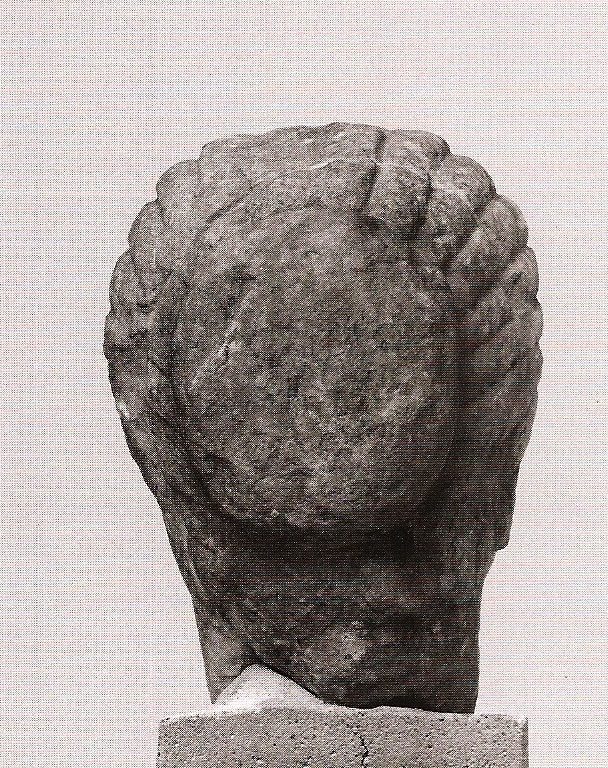
The head is preserved with the beginning of the neck. Put back together from two fragments (attached vertically behind the ears). The surface of the marble is heavily eroded, especially in the area of the face, the sides of the cheeks, the right ear and the bun. The coiffure is best preserved at the sides and top of the head. The left ear is broken off. It depicts a young girl (of about ten years old) with a plump oval face, and, as far as can be discerned, round eyes with wide lids and a thin mouth. The hair is combed in the “melon” style, forming the characteristic “slices”, at least six on each side of the head (the texture of the individual stands of hair is indicated by parallel incisions worked with the point). At the back of the skull, the hair is woven into a braid which forms a relatively flat bun that occupies most of the surface of the back of the skull. Locks of hair are left free on the nape. The combination of the “melon” arrangement with the bun at the back of the head is a type of headdress known already from the Classical period for girls and young women, and which is revived in the first iconographic type of Fulvia Plautilla, wife of Caracalla (202 CE; see the analysis in {Γ43}). Nevertheless, the flattened form of the bun brings to mind similar arrangements in other portrait types of members of the Severan dynasty, such as Julia Domna, where a wide flattened bun is located at the back of the skull (see e.g. J. Meischer, Das Frauenporträt der Severezeit, Berlin 1967, pl. 1, no. 3), leading to a dating in the first decades of the 3rd c. CE for the head. According to G. Dontas (2004, 84) the head might have come from a funerary relief. With the exception of the flat surface of the bun, which may also be due to the erosion of the marble, there is no technical element to support a relief provenance.
G. Dontas, Corpus Signorum Imperii Romani. Greece I.1 Les portraits attiques au Musée de l'Acropole, Athènes 2004, 83-84, cat. no. 74, pl. 56 (first decades of the 3rd c. CE; part of a funerary relief?).