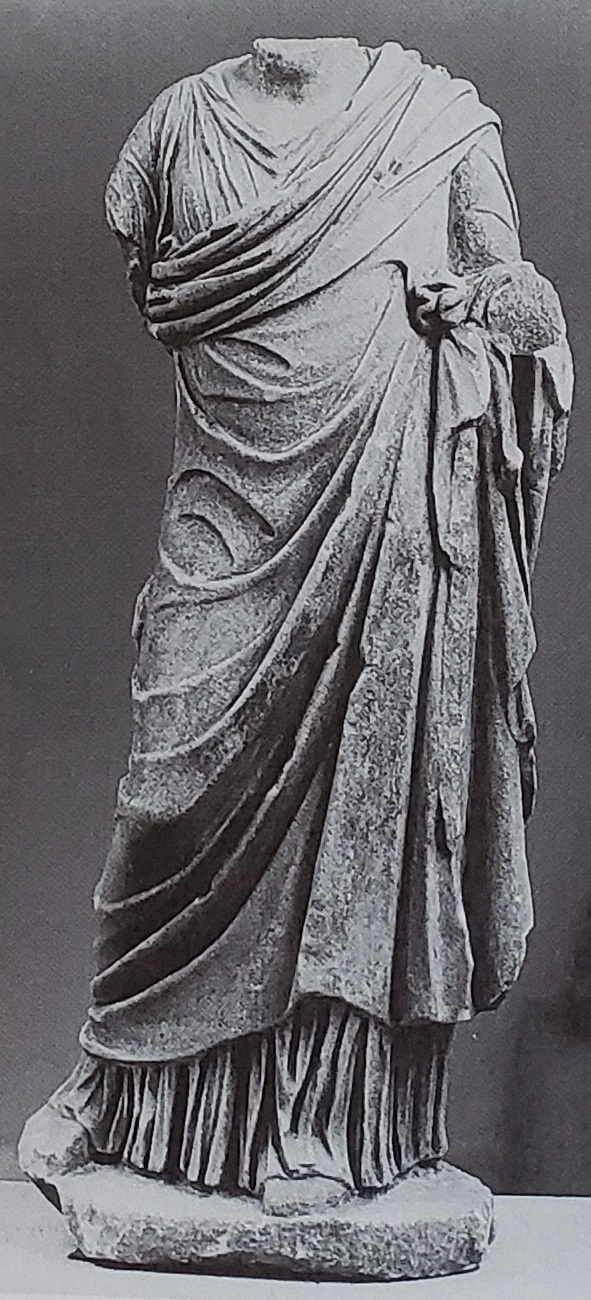
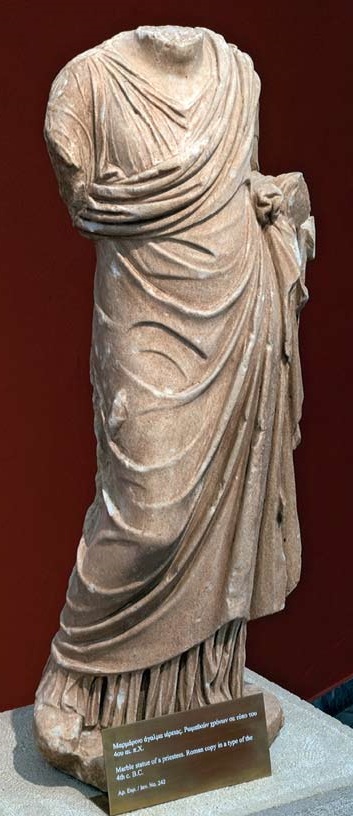
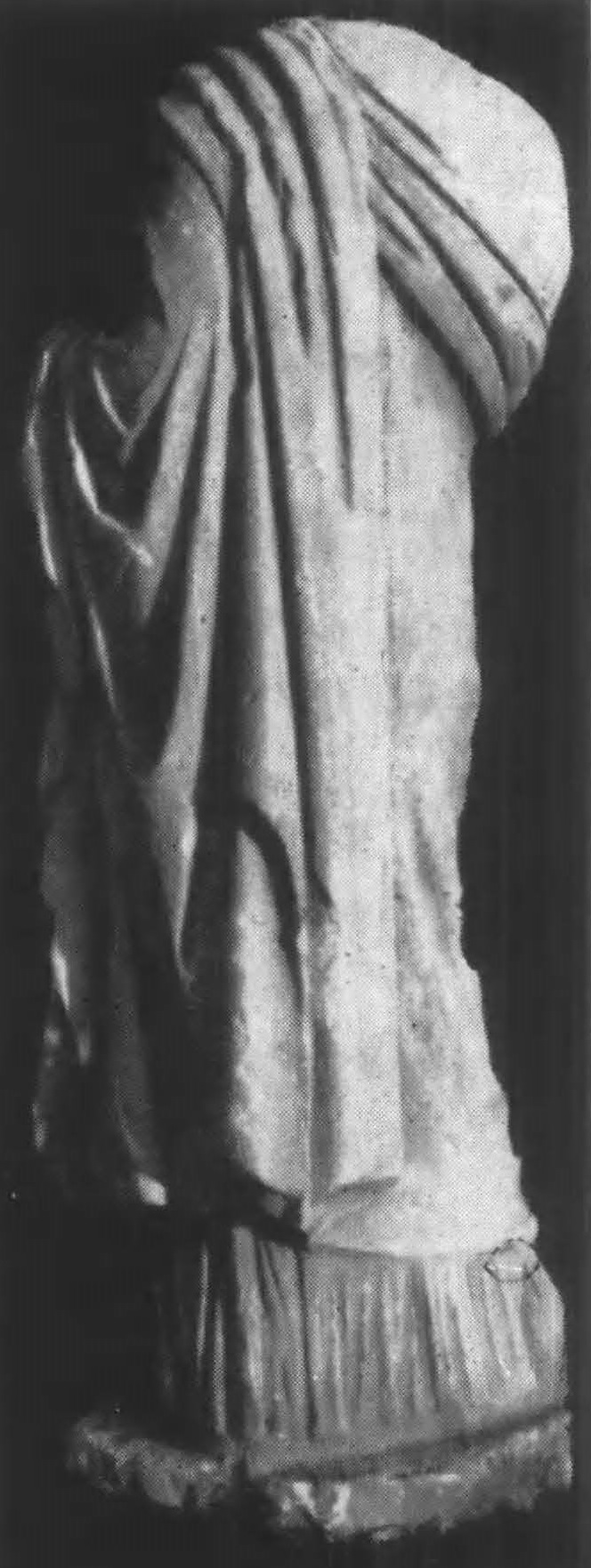
The body of the statue is preserved with the exception of the head and arms (both carved from the same block of marble). The right arm is broken from the middle of the biscep, while the extended left from the middle of the forearm. Small breaks and chipping are evident sporadically on the surface of the marble, especially along the ridges of the folds of the garments. The back side is worked with precision. It depicts a standing (on a circular plinth), smaller than life-size, frontal female figure. The weight of the body falls on the left leg, while the right, slightly bent, is carried sideways and slightly backwards. The right arm was brought downwards (a remnant of a puntello is preserved on the surface of the right thigh), while the left was stretched forward. She wears a long chiton, a wide long himation that covers most of the body, and closed leather shoes (calcei muliebres). The statue follows faithfully the so-called “Berlin/London Kore/Persephone” statuary type. The himation is carried diagonally across the chest, from the right elbow to the left shoulder, while between the body and the left elbow it forms the characteristic round gathering of folds. Stylistically, the rendition of the himation with its classicistic superimposed eye-shaped folds, as well as that of the finer pleats of the chiton, are close to works of the mid-2nd c. CE (cf. e.g. the female portrait statue from the Nymphaeum of Olympia {Γ111}, 149-153 CE). Good quality of workmanship. The cylindrical inscribed base on which the figure stood (see above) identifies the young woman with the priestess of Artemis, Eirana, daughter of Nymphodotos; the statuette was commissioned after the successful tenure of her priesthood and dedicated by a state council of elders (οἱ τᾶς Οὐπησίας ἱεροί γέροντες), charged with overseeing the functioning of the sanctuary. In the outstretched, now broken, left hand she probably held an incense box (two hands holding incense boxes in the same material and scale have been found inside the temple of Artemis - see Orlandos 1962, 112ζ, pl. 118β; G.I. Despinis, “Ανδριάς ιέρειας εκ Μεσσήνης”, in Χαριστήριον εις Αναστάσιον Κ. Ορλάνδον ΙΙ, Athens 1966, 235, pl. XXXIXα and γ; Themelis 1994, 117, pl. 22; for priestesses holding incense boxes see also P. Konstantinidis, “Archaeology of Anaphe (1100 B.C.-A.D. 600). Part 2”, Ostraka XXX [2021], 102-103 in cat. no. 14).
A. Orlandos, “Μεσσήνη”, Ergon 1962, 127, fig. 150; A. Orlandos, “Ανασκαφή Μεσσήνης”, Prakt 1962, 112α-β no. 5 fig. 10, pl. Α no. 4, 112ε, pl. 114γ-δ; SEG 23 (1968), 215; N. Kaltsas, Αρχαία Μεσσήνη, Athens 1989, 40, no. 18, fig. 27 (1st c. CE); P. Themelis, “Artemis Ortheia at Messene. The Epigraphical and Archaeological Evidence”, in R. Hägg ed., Ancient Greek Cult Practice from the Epigraphical Evidence, Stockholm 1994, 111, 115, 117, pl. 23a; E.A. Chlepa, Μεσσήνη. Το Αρτεμίσιο και οι οίκοι της δυτικής πτέρυγας του Ασκληπιείου, Athens 2001, 22 no. δ, fig. 10(Τ3); P. Themelis, Αρχαία Μεσσήνη, Ιστορία - Άνθρωποι – Μνημεία, Athens 2010, 321.