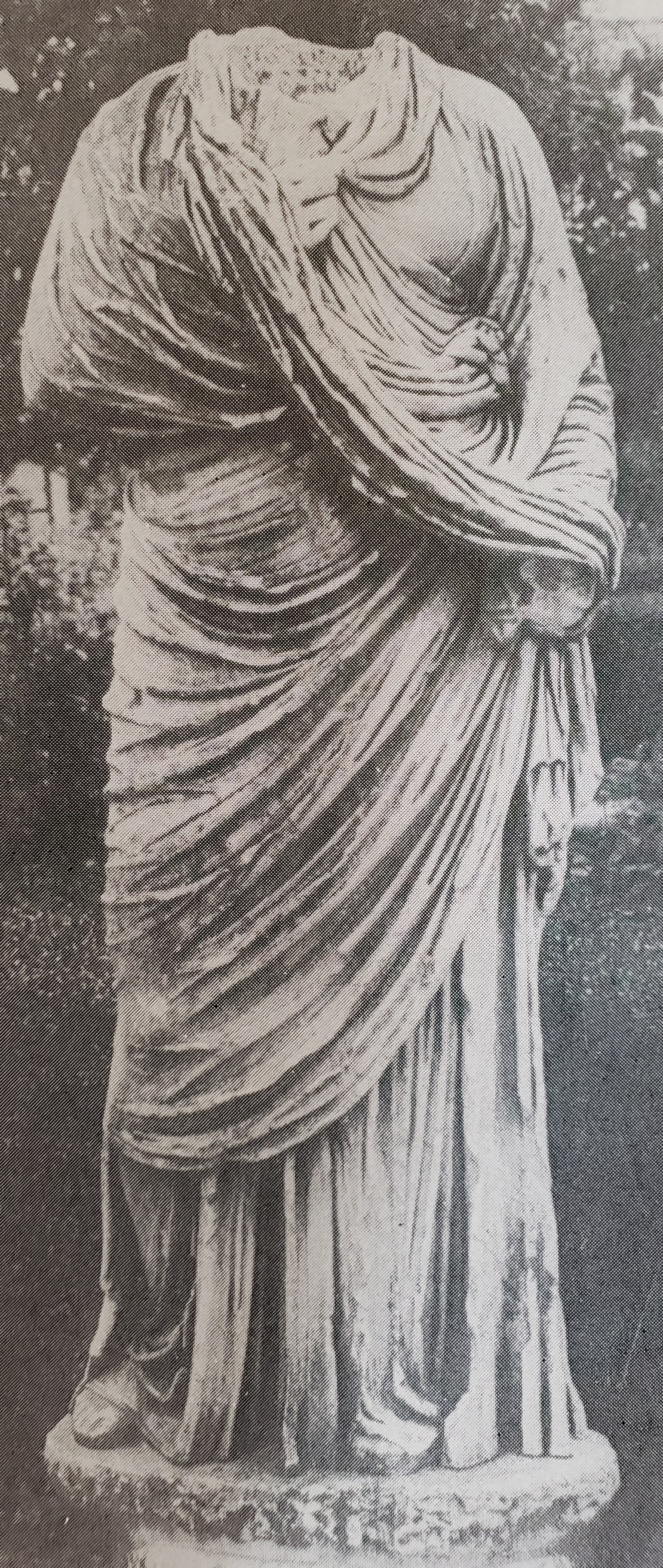
The statue is preserved essentially intact. Only the inset head and the left inset wrist are missing (a circular dowel hole is preserved on the surface of the marble). Smaller breaks and chipping are evident on the surface of the marble. It depicts a frontal female figure, standing on a circular plinth, and wearing a long chiton, a wide himation that tightly wraps around the body (including the shoulders and arms), and sandals. The weight of the body is carried on the left leg, while the right, slightly bent, is placed sideways. The himation is wrapped in a rather complex way around the body, following for the most part the arrangement of the so-called “Formia” statuary type. More specifically, it is wrapped tightly under the chest, while its front edge creates a characteristic triangular shape from the right shoulder to the slightly bending left forearm (its edge falls on the left forearm, leaving the wrist uncovered). The fingers of the bent right arm hold at the level of the neck the hem of the garment that descends from the left side of the neck; this positioning of the right arm brings the front edge of the himation more to the left, creating a triangular shape of the himation similar to that known from the “Large Herculaneum Woman” type. Contrary to the latter however, in the statue of Sparta the himation does not reach down to almost the height of the feet, but stops at the knees, forming a wide curved bottom edge between the right knee and the left hip. The arrangement of the folds of the garment in the area of the left armpit is also slightly different. It can be dated to the Antonine period (cf. the drapery of the portrait statue {Γ110}, 149-153 CE, as well as that of the portrait statue from Samos, Kruse 1975, 319-320, cat. no. C38, 160-170 CE). Good quality of workmanship.