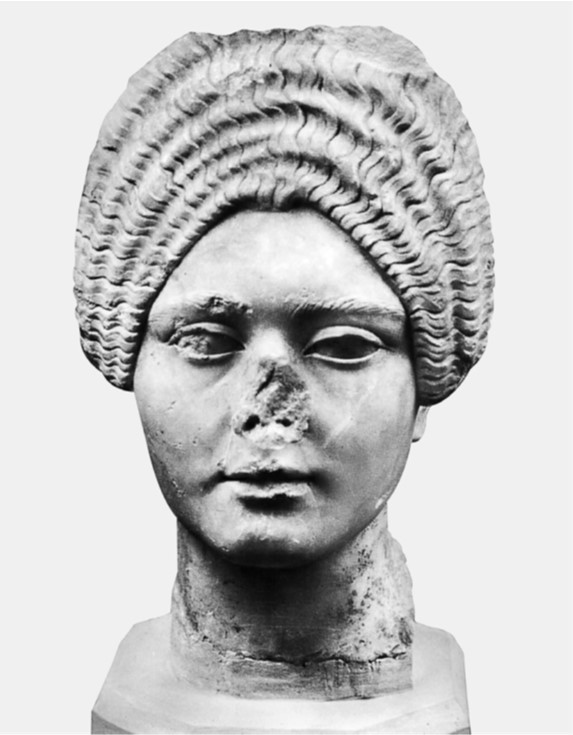
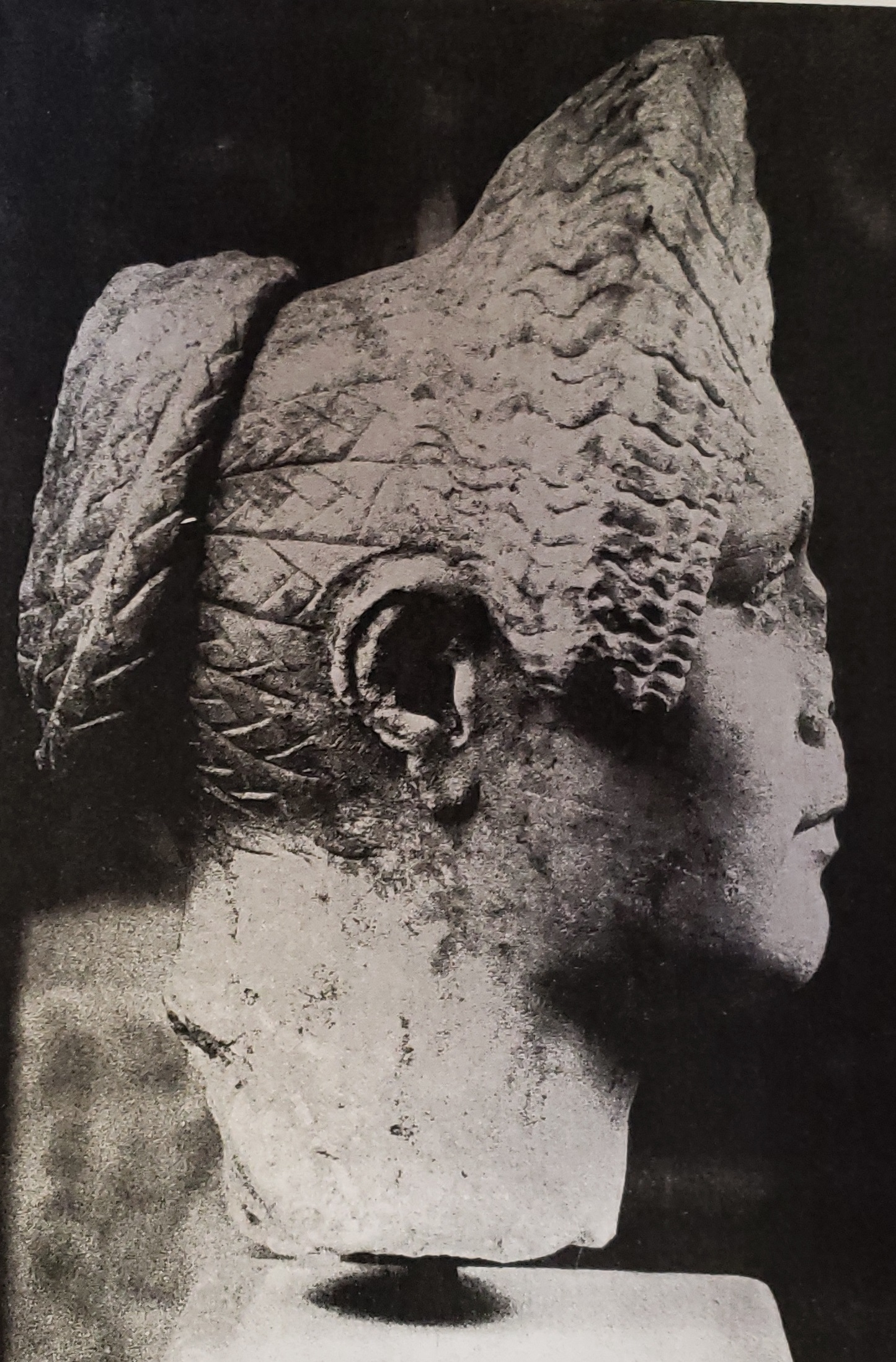
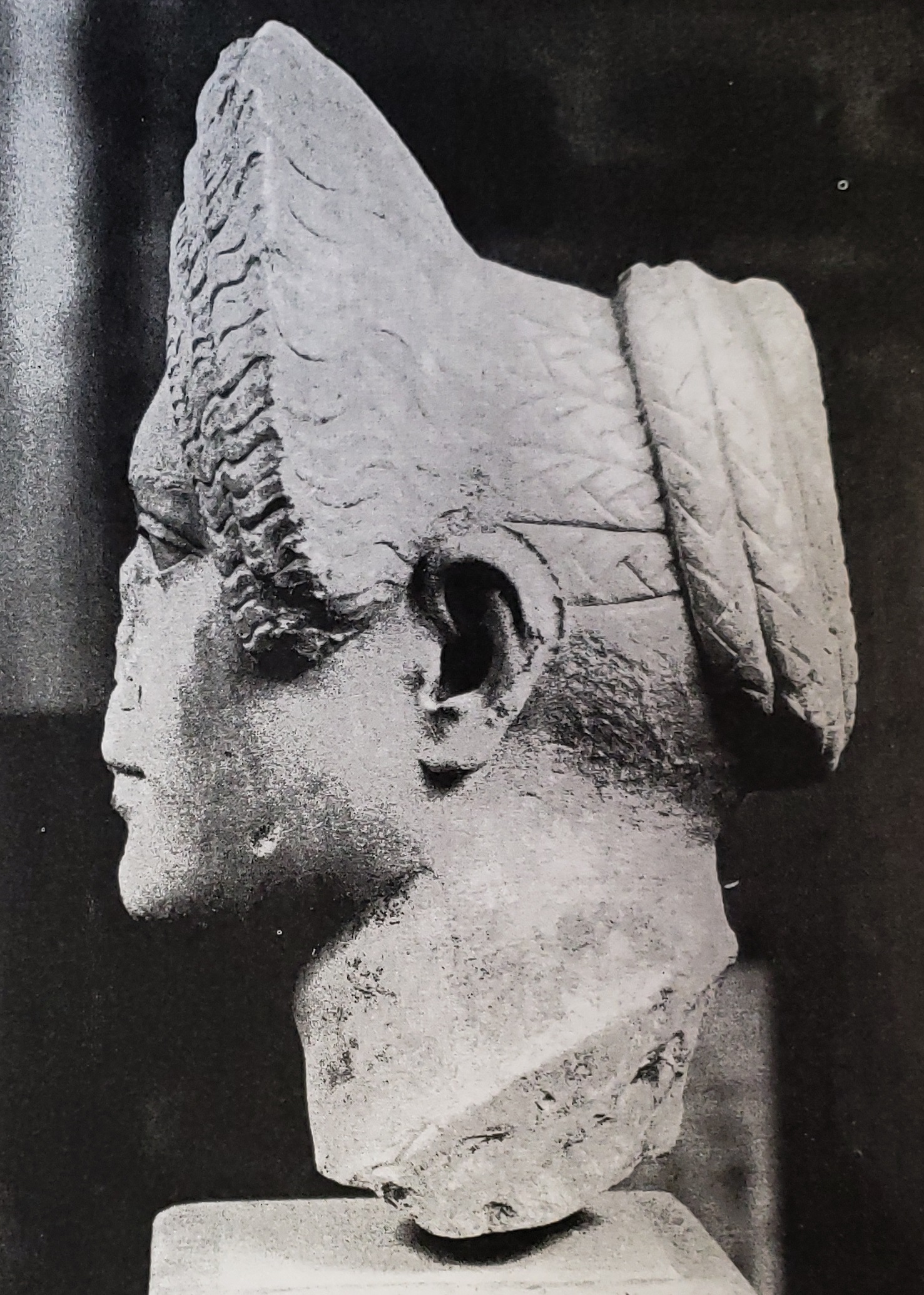
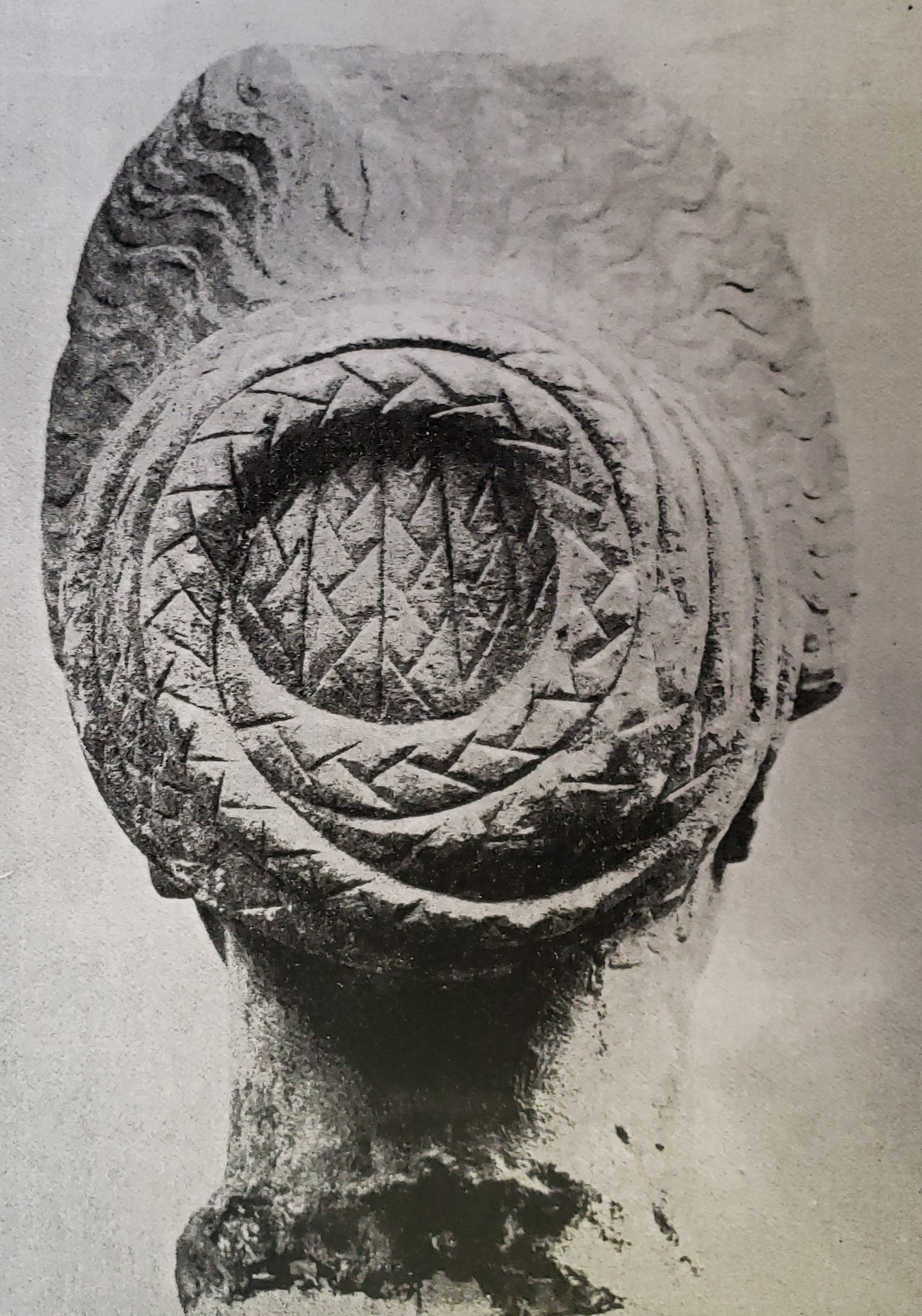
The head (almost intact) is preserved with most part of the neck (part of the tenon is also preserved on the right). The nose and a small part of the pointed end of the headdress are broken. Smaller breaks and chipping are evident sporadically on the surface of the marble (especially on the surface of the right eye and eyebrow). The drill has been used to open the nostrils and to delineate the corners of the mouth, while the eyes, headdress and eyebrows are dexterously worked with the point. The iris and the pupil were rendered in paint (on the surface of both eyes there are traces of black color - better preserved on the left eye). The surface of the face is polished. It depicts a young woman with an oval face, smooth cheeks, almost horizontal eyebrows (the texture of the individual hairs is indicated by small incisions made with the point), almond-shaped eyes with wide lids and a narrow mouth with fleshy lips. The headdress takes around the forehead a lunate shape consisting of vertical flame-shaped locks of hair (diligently worked with the point); these locks form in their turn six horizontal waves that gradually widen upwards, while narrowing in the direction of the ears (“Flammentoupet”). At the back of the head the hair is gathered in parallel superimposed braids that cover the entire surface of the skull, leaving the ears completely uncovered, and end at the back in a wide “open(Q) nest-like bun (the texture of the individual locks of hair on the surface of the braids - including the surface of the interior of the bun - is indicated by intertwined zig-zag incisions made with the point). The meticulous treatment of the entire surface of the coiffure, down to the nape of the neck, indicates that the statue would have been visible all-around. The elaborate headdress with the lunate arrangement in front and the “open nest” bun at the back is inspired by the official iconography of the female members of Trajan's family (cf. also the portrait of Antonia Cleodike from the Heraion of Olympia {Γ105}). Nevertheless, its style, as has been repeatedly observed (De Grazia Vanderpool 1993, 130-131, 133-134; Stefanidou-Tiveriou 2021, 73-75, 77 [ibid. for further analysis on the coiffure]), is closer to works dated to the principate of Hadrian, and should therefore also be dated in the same period. If this is correct, then the head from Lykosoura is one of the few examples of portraits in which the person depicted chose – in terms of coiffure - to follow neither the classicistic tradition nor contemporary imperial fashion protypes for his/her representation, but slightly older official imperial iconographic protypes instead (cf. also the portrait statue of the so-called “Popaea Sabina” from the Heraion of Olympia {Γ107}).
K. Kourouniotis, Κατάλογος του Μουσείου Λυκόσουρας, Athens 1911, 57, cat. no. 59, fig. 58; A. Stavridi, “Πορτραίτα στο Αρχαιολογικό Μουσείο Τρίπολης”, in Πρακτικά Β’ Τοπικού Συνεδρίου Αρκαδικών Σπουδών, Τεγέα 1988, Athens 1990, 144, 146, fig. 2; A. Datsouli-Stavridi, Πορτραίτα στο Αρχαιολογικό Μουσείο της Τρίπολης, Athens 1991, 10-11, figs. 3-9; C. de Grazia Vanderpool, “A Roman Portrait in the Tripolis Museum”, in O. Palagia, W. Coulson eds., Sculpture from Arcadia and Laconia. Proceedings of an International Conference Held at the American School of Classical Studies at Athens, April 10-14, 1992, Oxford 1993 (Oxbow Monograph 30), 129-135 (120-130 CE, period of Hadrian); A. Datsouli-Stavridi, Γλυπτά του Αρχαιολογικού Μουσείου Τρίπολης. Περιγραφικός Κατάλογος, Athens 1997, 46-48, figs. 26-28 (period of Trajan; Attic import; high quality); E. Kalavria, Αττικά πορτρέτα κατά την εποχή της ρωμαιοκρατίας (1ος αι. π.Χ. - αρχ. 2ου αι. μ.Χ.): ζητήματα τυπολογίας, λειτουργίας και παραγωγής (PhD. thesis National and Kapodistrian University of Athens), Athens 2015, 424, no. 18 (period of Trajan); Th. Stephanidou-Tiveriou, “Γλυπτά με χαμένες (;) ταυτότητες”, ArchEph 2021, 74-75, 77, figs. 3-4 (120-130 CE; Hadrianic with an older, Trajanic hairstyle); M. Tasopoulou, Το πορτρέτο της εποχής του Τραϊανού στην Ελλάδα (MA thesis, Aristotle University of Thessaloniki), Thessaloniki 2018, 55-56, 74, 112, cat. no. 44, pl. 39 (late period of Trajan – early period of Hadrian); P. Konstantinidis, Γυναικείοι δυναστικοί εικονιστικοί ανδριάντες αυτοκρατορικής περιόδου από την Ελλάδα (τέλη 1ου αι. π.Χ. – 5ος αι. μ.Χ.), Athens 2024, 216, note 130, 246 note 16.