
 Museum/Current place of storage:
 |
Tegea, Archaeological Museum. |
 Inv. no:
 |
1324 |
 Dimensions:
 |
|
 Material:
 |
- |
 Findspot:
 |
Tegea, at the “Ibrahim effendi” location, today’s “Palaia Episcopi”, north of the Agora of the ancient city (see Jost 1985, 149; A.V. Karapanagiotou, Αρκαδία. Τόπος, χρόνος, άνθρωποι, Athens 2010, 86). |
 Original Display Location:
 |
In the sanctuary of Artemis Soteira in Tegea. |
 Date:
Date: |
182 CE. |
 Statuary Type (body) :
 |
No specific statuary type is replicated. |
 Mode of Self-Representation (head):
 |
- |
 Civic Presence (Social Role Represented):
 |
Priestess of Artemis Soteira. |
 Inscribed Base:
 |
Yes (IG V 2, 84). |
 Author:
 |
Panagiotis Konstantinidis |
 Added:
 |
2024-09-26 |
 Edited:
 |
Description - Comments:
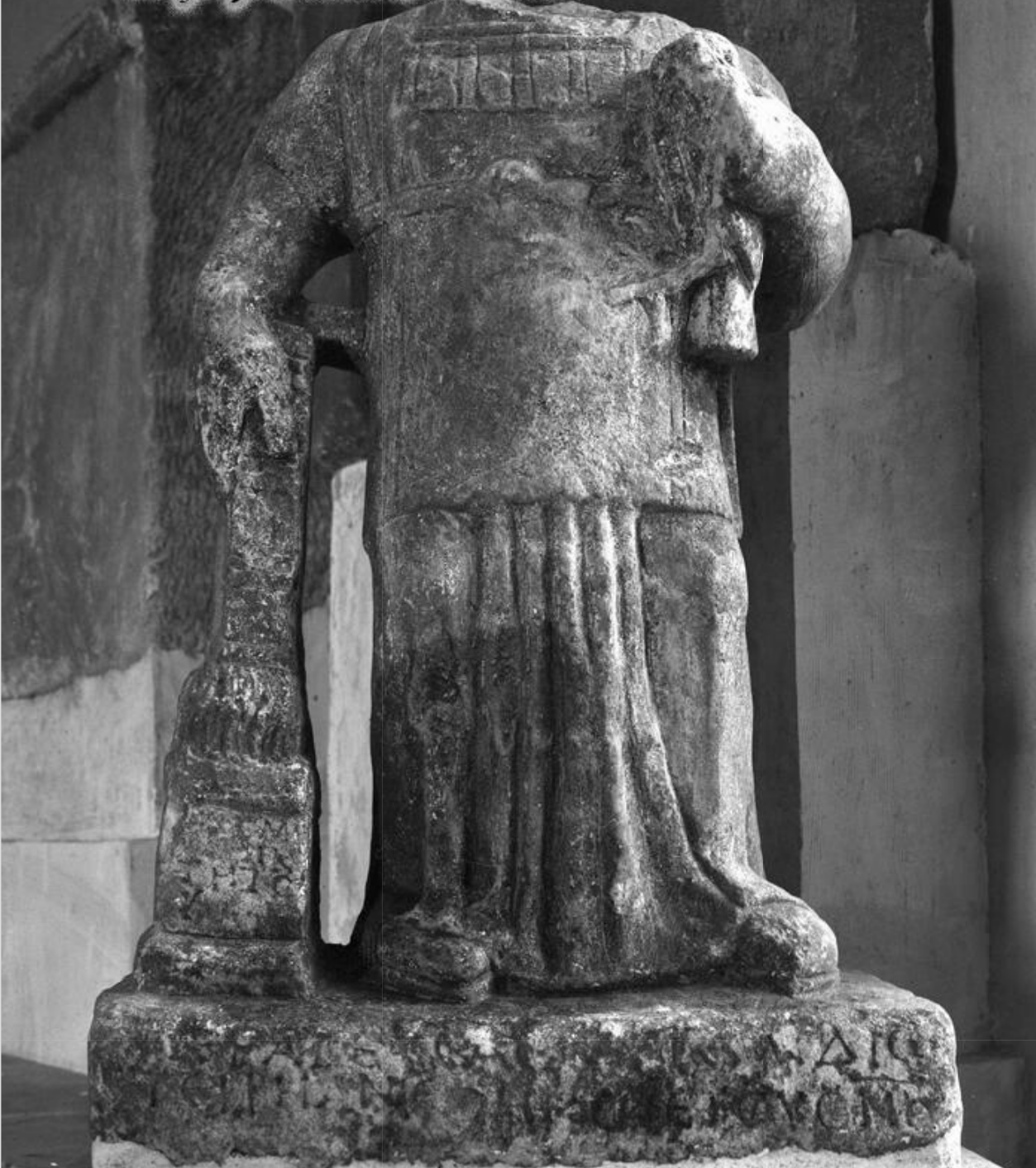
The low-quality statuette is in a relatively good state of preservation. Only the head is missing. Weathering is evident on the surface of the marble, especially the hands and attributes, the base and the altar. There is a large four-sided puntello between the arm and the torso of the figure. It depicts a frontal female figure standing on a rectangular inscribed base. On the right there is a rectangular inscribed altar (sporting simple cymatia above and below). She wears a long chiton with short sleeves, and closed leather shoes (calcei muliebres). Above the chiton there is a separate garment, a kind of ependytes belted under the breasts, extending to the middle of the thighs. The garment sports a square neckline, and immediately below it a rectangular, probably sewn-in, band (cf. the sewn-in embroidered illuminated band on the chiton of the auletes and periodonikes L. Cornelius Korinthos on his honorary relief stele in the sanctuary of Poseidon Isthmios, Isthmia, Archaeological Museum, inv. IS 69-1, 2nd c. CE, S. Lattimore, Sculpture II: Marble Sculpture 1967-1980, Princeton N.J. 1996, 34-37, cat. no. 87, pls. 29-30). Alternating narrow and wide smaller rectangular vertical shapes can be seen on the surface of the band. The figure is depicted holding with the left at breast height a wild bird (raptor), while in the right hand a four-sided inverted burning torch with which she lights the altar. The inscription begins on the front part of the altar, where the name of the woman depicted, Edyme, daughter of Epictetus is mentioned (Ἡδύ̣μ | [η Ἐ]π̣ικ | τήτο | υ; the name is rare, and appears once more, in the imperial period, in the case of a freedwoman in Gomphoi, Thessaly (see LGPN ΙΙΙΒ [2000], 180, λ. Ἡδύμη), and continues at the base, where her priestly office, the worshiped deity, Artemis Soteira, as well the year of the dedication are mentioned ([ἱ]ερατεύσασα Ἀ̣ρ̣τ̣έ̣μ̣ιδι Σω̣ | τείρῃ ἀνέθηκεν ἔτους νθ). The year 59 (νθ´) mentioned in the inscription was converted by G. Kolbe (IG V 2, 84) on the one hand into the year 182 CE, taking the first visit of the emperor Hadrian to Greece in 124 CE, which established a new era for many cities of the region (see St. Katakis, Επίδαυρος. Τα γλυπτά των Ρωμαϊκών χρόνων από το ιερό του Απόλλωνος Μαλεάτα και του Ασκληπιού, Athens 2002, 200, 325, 389 notes 561-562 with references) as a starting point, and into the year 29 CE on the other, starting from the battle of Actium in 31 BC. A dating to the late 2nd c. CE fits better with the whole style of the statuette, but also with the lunate shape of several letters of the inscription (Ε, Σ, Ω). The iconography of the statuette is, to my knowledge, rare (see F.T. Van Straten, Hierà kalà. Images of Animal Sacrifice in Archaic and Classical Greece, Leiden/Boston 1995, esp. 167-168, 186-192; J.B. Connelly, Portrait of a Priestess. Women and Ritual in Ancient Greece, Princeton NJ 2007; ThesCra V passim). Little is known about the cult of Artemis Soteira in Tegea. The site of the sanctuary is located north of the area of the city agora (the site of “Ibrahim effendi” or “Palaia Episkope”), where the other two surviving dedications to the goddess – all made by women - were also found (in addition to the present one, the other two dedications to Artemis Soteira are IG V 2, 68 [Megisto, 2nd c. CE] and 85 [Onasikrate, priestess of the goddess, as Edyme, 1st – 2nd c. CE = Schörner 2003, 436, cat. no. 810] – see also Jost 1985, note 9, 415 notes 1-2), indicating that the epithet of the goddess referred to the individual protection of women (see also Jost 1985, 415 note 3). The rare iconography of the statuette probably reflects an important ritual performed by the priestess, that of lighting the altar; a similar case is known from Kos, where the priestess of Artemis Pergaia is specifically mentioned to be in charge of lighting the altar of the goddess (Connely 2007, 166, 189). In addition, in the sanctuary of Artemis Orthia in Messene, as we are informed by the inscriptions on the pedestals of their honorific statues, young girls were dedicated to the goddess by their parents and participated in a torch ritual. We know that they carried the sacred image of the goddess (bretas) and kept lit torches in front of her altar (phosphoroi). The torches were later dedicated to Artemis (cf. the indicative case of Mego, 1st c. BCE: Connely 2007, 148-153 with references). Difficulty arises in identifying the bird held by Edyme, probably a sacrificial animal. Artemis as the goddess of wild nature (potnia theron) is broadly associated with wild birds and birds of prey (E. Bevan, Representations of Animals in Sanctuaries of Artemis and of Other Olympian Deities, PhD University of Edinburgh 1975, 31-33; L. Bodson, Ἱερά Ζῶια. Contribution à l’étude de la place de l’animal dans la religion grecque ancienne, Bruxelles 1975, 95). The bird is identified by G. Kolbe (IG V 2, 84) specifically as an eagle.
Bibliography:
IG V 2, 84; M. Jost, Sanctuaires et cultes d'Arcadie, Paris 1985, 149 note 9, 394, 414-415, note 1; G. Schörner, Votive im römischen Griechenland: Untersuchungen zur späthellenistischen und kaiserzeitlichen Kunst- und Religionsgeschichte, Wiesbaden 2003, 435, cat. no. 807, pl. 72.1 (with inv. no. 42; 182 CE); https://arachne.dainst.org/entity/1133938?fl=20